Correlation Is Not Causation
Here is one of the most tested ideas in all of science reasoning, and one of the easiest traps to fall into: just because two things happen together does not mean one causes the other. When two things rise and fall together, we say they are correlated. When one thing actually makes the other happen, that is causation. They are not the same, and the test checks whether you know the difference.
You do not need statistics for this. You need a healthy dose of caution and a habit of asking, “Could something else explain this?” That question alone will catch most of the traps.
Let’s make the difference concrete, because once you see it clearly, you will spot it everywhere.
Two Things Moving Together
Consider this observation:
A town notices that months with more umbrella sales also have more traffic accidents.
Umbrella sales and traffic accidents rise and fall together, so they are correlated. Does buying umbrellas cause car crashes? Of course not. Something else — rainy weather — causes both. Rain makes people buy umbrellas and makes roads slick and dangerous. That hidden third factor is called a confounding variable, and it is behind most misleading correlations.
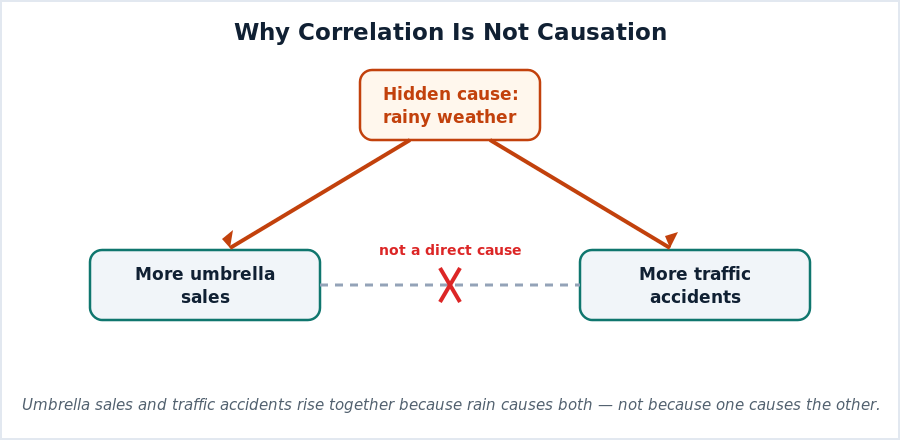
Whenever you see two things linked, train yourself to ask: is one really causing the other, or is a third factor causing both?
Why a Correlation Can Fool You
Correlations are everywhere, and many are coincidences or the work of a confounder. Ice cream sales and drowning both go up in summer — because hot weather drives both, not because ice cream is dangerous. Countries that eat more chocolate have more award-winning scientists — because wealthier countries tend to have both more chocolate and more research funding. In each case, a lurking third factor explains the link.
The test uses exactly these setups. It shows you two things that move together and offers a tempting answer that says one causes the other. The better answer usually notes that the link exists but does not prove cause, or points to a possible third factor.
What It Takes to Show Causation
To claim that one thing truly causes another, scientists run a controlled experiment: they change one factor on purpose, hold everything else steady, and compare a treatment group with a control group. That design is what rules out confounders. An observation that two things happen together, on its own, cannot do that. So when a passage only reports that two things are correlated, the safe conclusion is that they are linked — not that one causes the other.
Watch: A Short Video Lesson
Dr Nic’s Maths and Stats walks through this skill clearly in a few minutes. It is a helpful companion to the reading above:
A Routine for Correlation Questions
- Name the two things that move together.
- Ask: could a third factor cause both? Look for weather, age, wealth, season, or size.
- Prefer the answer that says “linked” over the answer that says “causes,” unless a controlled experiment is described.
- Remember: only a controlled experiment can strongly support a cause-and-effect claim.
Practice
- What does it mean when two things are correlated?
- What is a confounding variable?
- Ice cream sales and drowning both rise in summer. What third factor explains the link?
- Does a correlation prove that one thing causes the other?
- What kind of study is needed to support a cause-and-effect claim?
- A passage says two things move together and asks for the best conclusion. Should you pick “one causes the other” or “the two are linked”?
Answers
- They rise and fall together, but that alone does not tell you why.
- A hidden third factor that affects both of the things being compared.
- Hot weather — it drives both more ice cream and more swimming.
- No. Correlation shows a link, not a cause.
- A controlled experiment with a treatment group and a control group.
- “The two are linked” — unless a controlled experiment is described.
Where This Fits in Your Science Prep
Correlation versus causation is the most common overreach in science reasoning, so it builds on drawing valid conclusions, identifying claims, and weighing evidence. It also connects to experimental design, where controlled experiments rule out confounders. See all topics on the Science Topics Hub.

Related to This Article
More math articles
- The Legal Campaign, the Clark Studies, and Brown v. Board
- Free Grade 7 English Worksheets for Alaska Students
- Free Grade 7 English Worksheets for Utah Students
- Free Grade 6 English Worksheets for Utah Students
- Hypotheses, Theories, and Scientific Explanations
- The Hidden Arithmetic That Breaks the Martingale System Every Time
- Math anxiety is a common reality, yet the signs can be misinterpreted
- Doubling Down: When the EV Curve Bends Toward You
- FTCE Math FREE Sample Practice Questions
- Best SAT Math Prep Books




















What people say about "Correlation Is Not Causation"?
No one replied yet.