Compare Sums and Differences of Fractions for 4th Grade
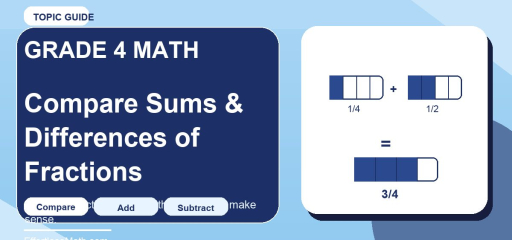
Compare Sums and Differences of Fractions for 4th Grade: this Effortless Math guide explains the topic in plain language, shows how it works through solved examples, and gives you free practice to try immediately, so the idea sticks instead of staying abstract.
Comparing sums and differences of fractions helps students decide which result is greater, smaller, or equal after doing fraction operations.
This skill builds number sense because students must pay attention to denominators, equivalent fractions, and the size of each part.
Key Ideas to Remember
- Compare fractions only after thinking about equal-size parts or a common denominator.
- Use a visual model or a benchmark such as one-half or one whole when needed.
- After adding or subtracting, compare the results again to confirm the answer.
Detailed Explanation
When fractions have unlike denominators, students often rewrite them with a common denominator before adding, subtracting, or comparing. Benchmarks such as one-half and one whole can also help.
After finding each sum or difference, compare the results just like you would compare any two fractions: use equivalent fractions, drawings, or benchmark values.
Worked Example
Problem: Compare 1/4 + 1/2 and 3/4.
- Rewrite 1/2 as 2/4.
- Add: 1/4 + 2/4 = 3/4.
- Now compare 3/4 and 3/4.
Answer: The two amounts are equal.
Practice Tip
Have students draw fraction bars when the denominators are different so they can see why two results compare the way they do.
Common Mistakes
Students usually improve faster in compare sums and differences of fractions when they slow down and watch for a few repeated mistakes. These are the ones worth checking first:
- Comparing numerators without considering whether the denominators match.
- Adding or subtracting before finding a fair way to compare the results.
- Skipping a model or benchmark when the fractions are hard to visualize.
Pre-Algebra for Beginners 2026 The Ultimate Step by Step Guide to Preparing for the Pre-Algebra Test
Practice Strategy
A short but consistent review routine helps students build confidence with compare sums and differences of fractions without getting overwhelmed.
- Draw fraction bars or circles to compare the results visually.
- Practice rewriting fractions with common denominators before comparing them.
- Explain in words why one result is greater, smaller, or equal.
Watch Another Example
Use a second example video to hear the steps explained in a different way and reinforce the same skill from another angle.
Frequently Asked Questions
Why do students compare the sizes of the fraction parts in compare sums and differences of fractions?
Fractions only make sense when the parts are equal-sized. Thinking about the denominator first keeps the comparison fair and accurate.
When should students use a common denominator?
Use a common denominator when the fractions are hard to compare mentally or when you need to add or subtract them before comparing the results.
What is a simple way to check the answer?
Draw a quick fraction model or compare each value to benchmarks such as one-half and one whole.
Keep Practicing
After finishing this lesson on compare sums and differences of fractions, spend a few minutes on mixed review so the skill stays connected to the rest of Grade 4 math.
Need more Grade 4 review? Explore the Grade 4 Mathematics Worksheets hub for extra guided practice, review sets, and printable support.

Related to This Article
More math articles
- How to Solve Pythagorean Theorem Problems? (+FREE Worksheet!)
- Top 10 Free Websites for CHSPE Math Preparation
- Top 10 AFOQT Math Practice Questions
- Party platforms
- Roles and Powers of the President
- Free Oregon OSAS Grade 5 Math Worksheets: 49 Printable PDFs with Friendly Answer Keys
- Top Calculators for the ACT Math Test 2026: Quick Review
- The Best Grade 5 Math Book for North Carolina Students
- Family Change, Cohabitation, Divorce, and the Second Shift
- Whistleblowers

What people say about "Compare Sums and Differences of Fractions"?
No one replied yet.