YOUR ACCUPLACER STUDY COMPANION
The Best ACCUPLACER Math Book to Skip Remedial College Math
The ACCUPLACER math test rarely gets the respect it deserves — and that costs students real money. It is not a test you pass or fail. It is a placement test, and your result decides which math class you start college in. Place low, and you land in remedial,…

The ACCUPLACER math test rarely gets the respect it deserves — and that costs students real money. It is not a test you pass or fail. It is a placement test, and your result decides which math class you start college in. Place low, and you land in remedial, non-credit math: extra semesters, extra tuition, and no progress toward your degree. Place well, and you start in a credit-bearing course and keep your time and money.
The students who do well on ACCUPLACER are almost never the ones with natural math talent. They are the ones who prepared. And preparing is very doable — with the right book.
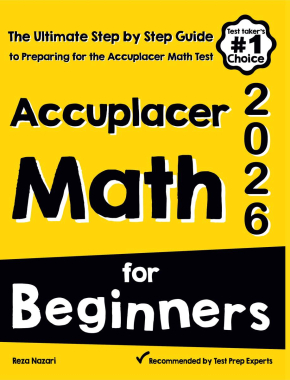
Our pick: ACCUPLACER Math for Beginners
ACCUPLACER Math for Beginners is built for the reality of who takes this test. Many ACCUPLACER test-takers are returning to school after a gap, or never felt confident in math to begin with. This book meets them where they are: it starts from the basics, explains every concept in plain language, and builds up carefully with worked examples and steady practice.
It does not try to dazzle you with shortcuts. It rebuilds the math itself — which is the only thing that genuinely moves a placement score — and it does it at a pace a rusty or nervous learner can actually follow.
What the ACCUPLACER math test covers
ACCUPLACER math is split into three separate tests, and which ones you take depends on your school and target program:
- Aritmetic — whole numbers, fractions, decimals, percents, and number comparisons
- Quantitative Reasoning, Algebra, and Statistics (QAS) — basic algebra, linear equations, ratios, probability, and data interpretation
- Advanced Algebra and Functions (AAF) — quadratics, polynomials, functions, exponentials, logarithms, and trigonometry
The test is computer-adaptive and untimed — it adjusts to find the precise edge of what you know. There is no guessing your way through and no time pressure to blame. The score reflects what you genuinely understand, which means real preparation is the only lever — and it is a powerful one.
Why this book works for ACCUPLACER
- It covers all three test areas. Arithmetic, QAS, and AAF are all built up from the ground, so you are ready whichever ones your school requires.
- It starts from the basics. If arithmetic or early algebra is rusty, the book rebuilds it — no gaps, no embarrassment.
- It teaches before it tests. Every topic is explained and demonstrated first, then practiced — the right order for an adaptive placement test.
- It includes realistic practice. Practice that mirrors the test removes the surprise and shows you exactly where you stand.
How to study with it: a 4 to 6 week plan
- Week 1: Find out which ACCUPLACER tests your college requires, then take a practice run to map your weak spots.
- Weeks 2–3: Rebuild arithmetic and the QAS topics — fractions, percents, ratios, and basic algebra.
- Weeks 4–5: Work through advanced algebra and functions if your program needs the AAF test.
- Week 6: Full practice and review of anything still shaky.
One smart move before you study: contact your college’s advising or testing office and ask which specific ACCUPLACER tests you need and what score places you out of remedial math. Knowing your exact target turns vague studying into focused studying — and focused studying is what raises scores.
Who this book is for
- Incoming college students facing ACCUPLACER placement
- Adult and returning students who have been away from math
- Students retaking ACCUPLACER to place out of remedial, non-credit math
- Anyone who has felt unsure about math and wants a patient, ground-up guide
Common ACCUPLACER mistakes
- Not preparing at all. Students treat ACCUPLACER as a formality, then get placed into a remedial semester they could have skipped.
- Not knowing the target. Studying without knowing which tests you need, or what score you are aiming for, wastes effort.
- Skipping arithmetic. It feels too basic to study — but fraction and percent errors quietly drag the whole score down.
- Cramming. An adaptive test measures real understanding. That is built over weeks, not in one night.
Frequently asked questions
Can you fail the ACCUPLACER test?
No — ACCUPLACER is a placement test, not a pass/fail test. But a low score places you into remedial, non-credit math, so a higher score genuinely saves you time and tuition.
How long should I study for ACCUPLACER?
Four to six weeks of steady study suits most students. If you have been away from math for a long time, give yourself closer to eight.
Is the ACCUPLACER math test timed?
No. ACCUPLACER is untimed and computer-adaptive, so you can work carefully. That also means there is no time pressure to blame — the score reflects what you truly know.
Which ACCUPLACER math tests do I need to take?
It depends on your college and your intended program. Ask your school’s testing or advising office, and study specifically for the tests they require.
Can I retake the ACCUPLACER test?
Most colleges allow retakes, though policies on waiting periods and attempt limits vary. Confirm with your school — but preparing well before your first attempt is always the smartest path.
The bottom line
ACCUPLACER is one of the highest-value tests to prepare for, precisely because so few students bother. A few focused weeks with a book that rebuilds the math can move you out of remedial classes and into credit-bearing coursework — saving real time and real money.
ACCUPLACER Math for Beginners gives you what that preparation requires: every tested topic, taught from the ground up, at a pace that works for a returning or nervous learner. Find your target, study with intent, and start college exactly where you belong.
Official source: free practice tests, sample questions and learning resources for ACCUPLACER are published by the College Board at accuplacer.collegeboard.org.

Related to This Article
More math articles
- 4th Grade PARCC Math FREE Sample Practice Questions
- The Best Grade 8 Math Book for Georgia Students
- Top 10 ASVAB Math Prep Books (Our 2023 Favorite Picks)
- Sources of inequality have different policy implications
- The Best Grade 4 Math Book for Connecticut Students
- Impartial jury
- The Best AFOQT Math Worksheets: FREE & Printable
- 6th Grade Math: The Complete Parent’s Guide for 2026
- PPE, Bloodborne Pathogens, Sharps, and Area Safety
- Randomness in Action: What Slot-Style Games Teach Us About Math























What people say about "The Best ACCUPLACER Math Book to Skip Remedial College Math - Effortless Math"?
No one replied yet.