Decimal Multiplication with Grids: Models and Missing Factors
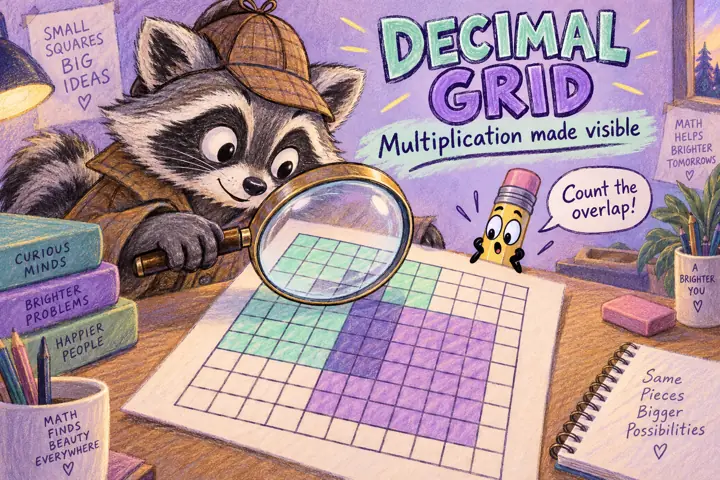
A hundredths grid makes decimal multiplication visible: one whole grid has 100 equal squares, so each small square is 0.01. To complete a sentence such as 0.2 × □ = 0.4, count how many groups of 0.2 fit into 0.4. Two groups fit, so the missing factor is 2.
Set the value of the whole
For these models, the entire 10 × 10 grid represents 1. One full row or column contains ten small squares and represents 0.1. Twenty squares represent 0.20, which is the same number as 0.2.
Keep that unit fixed throughout the calculation. A count of 12 small squares means twelve hundredths, or 0.12—not 12 wholes.
Find a missing factor: 0.2 × □ = 0.4
The blue columns show one group of 0.2. The orange columns show another group of 0.2. Together, they cover 40 of the 100 squares.
- Identify the size of one group: 0.2, or 20 squares.
- Identify the total: 0.4, or 40 squares.
- Count the groups: 40 ÷ 20 = 2.
- Check the completed sentence: 0.2 × 2 = 0.4.
For 0.5 × □ = 1, each group covers half a grid. Two halves cover one whole, so the missing factor is also 2.
Multiply two decimals: 0.3 × 0.4
Repeated groups work well when one factor is a whole number. When both factors are less than 1, use an overlapping area model. Here, multiplication means taking three tenths of four tenths.
- Shade 3 of the 10 columns to represent 0.3 of the width.
- Shade 4 of the 10 rows in a second color to represent 0.4 of the height.
- Count only the overlapping squares: 3 × 4 = 12.
- Each square is one hundredth, so 0.3 × 0.4 = 0.12.
The written method agrees: 3 tenths × 4 tenths = 12 hundredths. The product is smaller than either positive factor because each factor is less than 1. Multiplication does not always make a number larger.
If a product exceeds 1, use more than one whole grid. For example, 0.6 × 2 = 1.2 covers 120 small squares: one full grid and 20 squares of another.
Practice and check
Complete each original multiplication sentence. Draw equal groups if it helps, then check by multiplying.
- 0.3 × □ = 0.6
- 0.4 × □ = 0.8
- 0.1 × □ = 0.5
- 0.6 × □ = 1.2
- 0.7 × □ = 1.4
Show answers and a check
- 2: two groups of 0.3 total 0.6.
- 2: two groups of 0.4 total 0.8.
- 5: five groups of 0.1 total 0.5.
- 2: two groups of 0.6 total 1.2; use two grids.
- 2: two groups of 0.7 total 1.4; use two grids.
Watch the existing video
Choose your next lesson
For more place-value and decimal review, explore the Grade 5 Math Online Center. The Grade 5 number and base-ten standards connect decimal operations with concrete models, drawings and written reasoning.
Older learners building toward algebra can explore Pre-Algebra for Beginners. Open the product page to compare its preview and current purchase details with your review needs. The lesson and practice above remain free.
Pre-Algebra for Beginners 2026 The Ultimate Step by Step Guide to Preparing for the Pre-Algebra Test

Related to This Article
More math articles
- Free South Carolina SC READY Grade 5 Math Practice: 49 Printable PDFs for Classrooms, Tutors, and Parents
- Sentence Solvers: How to Completing Addition and Subtraction Equations
- Free Grade 7 English Worksheets for Indiana Students
- How to Find Volume by Spinning: Washer Method
- How to Unravel One-to-One Functions
- Selecting and Integrating Evidence
- How to Solve Systems of Equations: 4 Methods That Always Work
- Best Laptop Tables and Carts for online teaching
- A 4-Week Grade 8 ELA Study Plan: Reading, Writing, Vocabulary, and Review That Actually Fits Real Life
- Free Grade 4 English Worksheets for Wyoming Students
What people say about "Decimal Multiplication with Grids: Models and Missing Factors"?
No one replied yet.