The Tie Bet: A Probability Autopsy of Baccarat’s Worst Wager
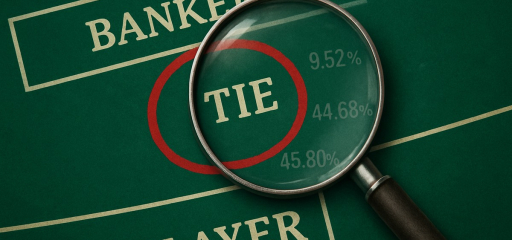
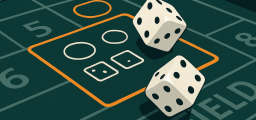
The baccarat tie bet sits on the felt like a slice of pie nobody should eat, bright, tempting, and full of stuff that’ll wreck you. It pays 8 to 1, which sounds generous until you actually run the numbers. I’ve watched smart people drop hundreds chasing it because the payout looks juicy and the dealer keeps announcing “Tie!” just often enough to feel reachable. Here’s what’s really happening underneath that 8:1 sticker, and why this wager has one of the meanest house edges on the floor.
Why Ties Happen At All
Baccarat ends each round with two hands, Banker and Player, and each lands on a total somewhere between 0 and 9. A tie is exactly what it sounds like: both sides finish on the same number. They could both end on 7, both on 3, both on 0 (yes, that happens), and the round resolves as a push for the main bets while the side wager pays out. The drawing rules are fixed, so there’s no skill involved in producing ties. They just fall out of the shoe naturally because the math allows it.
The interesting wrinkle is that not all tied totals are equally likely. Ties on 6 and 7 show up more often than ties on 0 or 1, because the third-card rules push more hands into the mid-range. But for the basic Tie bet, none of that matters. You’re paid the same whether both hands land on 0 or both land on 9. It’s a single lumped probability, and that’s where the trouble starts.
The Actual Probability: 9.52%
Combinatoric analyses of an 8-deck shoe, the standard format you’ll see in almost any casino, peg the probability of a tie at roughly 9.52%, or about 0.0952 per hand. That’s where the famous “ties happen about once every 10.5 hands” figure comes from. Run a long session and you’ll see it confirm itself: ties cluster, they vanish, they cluster again, but over thousands of rounds the rate settles right around 9.5%.
People hear “10%” and their brain rounds it up to “pretty common.” It’s not bad as side-bet odds go, the event itself isn’t astronomically rare. The problem isn’t the frequency. It’s the price the casino charges to bet on it.
The 8:1 Payout vs. The Fair Payout
Here’s the math nobody at the table is doing in their head. If the true probability of a tie is 0.0952, then the fair payout, the payout that would make the bet break even over the long run, works out to:
\[\text{Fair payout} = \frac{1}{0.0952} – 1 \approx 9.504 \text{ to } 1\]
So a fair, no-edge tie bet would pay roughly 9.5 to 1. The casino offers 8 to 1. They’re shaving more than a full unit off every winning payout, and over time, that gap is what eats your bankroll. It’s not subtle. It’s not buried in fine print. It’s just sitting there in plain sight, hoping you don’t do the division.
House Edge at 8:1 to 14.36% in Detail
The expected value per dollar wagered on the Tie bet at 8:1 looks like this:
\[E = 0.0952 \times 8 – (1 – 0.0952) = 0.7616 – 0.9048 = -0.1432\]
That’s a house edge of 14.36%. For comparison, the Banker bet sits around 1.06% and the Player bet around 1.24%. The Tie bet is roughly 12 times worse than the worst of the two main wagers. I’ll say it plainly. I think this is one of the most punishing standard bets you’ll find in a major casino. Slots can be worse, sure, but they don’t dress up in a tuxedo and pretend to be sophisticated.
The way to feel that 14% is to translate it into dollars. A 14.36% edge means that for every $100 you push onto the tie spot, you’re handing the house an expected $14.36, not eventually, not after a streak, but in expectation, hand after hand.
The Rare 9:1 Tables, Edge Drops to 4.85%
A handful of casinos, mostly online and a few generous live rooms, pay 9 to 1 on the Tie bet instead of 8 to 1. One extra unit of payout completely changes the math:
\[E = 0.0952 \times 9 – 0.9048 = 0.8568 – 0.9048 = -0.0480\]
House edge drops to about 4.85%. Still not a good bet, you’re paying nearly five times the edge of the Banker wager, but it’s no longer the felt’s villain. If you’re going to play the Tie bet anyway (and look, I’m not going to pretend nobody ever has fun on a long-shot side wager), at least hunt down the 9:1 version. Don’t let casinos collect 14% from you when 4.85% is available across town.
What 14% Looks Like Over 100 and 1,000 Hands
Numbers are easier to digest when they hit your wallet. Let’s say you bet $100 per hand on the Tie at 8:1. Over 100 hands, your expected loss is:
\[100 \times 100 \times 0.1432 = \$1{,}432\]
Over 1,000 hands, you’re looking at an expected loss of $14,320. That’s not a worst case. That’s the average. Half the time you’ll do worse. A few sessions you’ll get lucky and end up ahead, because variance on a 9% event with an 8x payout is enormous, but the long-run gravity is brutal and unrelenting.
Variance, by the way, is exactly why this bet survives. Players win three or four ties in an hour, feel like geniuses, and forget the dozens of losing hands in between. The casino doesn’t care. They’ve already booked the edge.
The “Tie Streak” Myth, Independence Is the Whole Point
Walk past a baccarat table and you’ll see scoreboards tracking ties, “naturals,” runs, the works. Players study them like ancient scrolls. The myth goes something like this: “Three ties just hit, another one’s coming.” Or the opposite: “No tie for 40 hands. We’re due.” Both are wrong, and they’re wrong for the same reason.
Each hand is dealt from a shoe that’s been reset or deeply shuffled. The shoe doesn’t remember what happened five hands ago. The probability of a tie on the next hand is approximately 0.0952 whether ties have been hitting like crazy or haven’t shown up all day. That’s what “independent” means, and it’s the whole foundation of the math we just did.
- Three ties in a row? Coincidence. Probability of the next being a tie is still ~9.52%.
- Zero ties in 50 hands? Coincidence. Probability of the next being a tie is still ~9.52%.
- The scoreboard is a record of what happened, not a forecast of what’s next.
- Gambler’s fallacy and hot-hand fallacy are mirror images, both assume memory in a memoryless system.
- Card-counting strategies on the Tie bet exist but require tracking specific composition effects deep into the shoe, and the edge gained is tiny compared to the edge being charged.
The Tie Bet vs. Other Side Bets, Where Does It Rank?
Casino side bets are notorious for high edges, and the Tie bet fits right in. Dragon Bonus, Lucky 6, Perfect Pairs in blackjack, Insurance, all of them charge a steep premium for the chance at a big payout. The Tie bet isn’t the absolute worst (some progressive side bets can run 20%+), but it’s worse than most of what you’ll find at a typical baccarat table. The Wizard of Odds maintains a detailed analysis of baccarat bets and edges if you want to dig deeper into the math behind every wager on the felt.
Comparison Table: 8:1 vs. 9:1 vs. Fair Pay
| Payout | Win Probability | Expected Value per $1 | House Edge | Expected Loss / 100 hands ($100 bet) |
|---|---|---|---|---|
| 8 to 1 (standard) | 9.52% | −$0.1432 | 14.36% | −$1,432 |
| 9 to 1 (rare) | 9.52% | −$0.0480 | 4.85% | −$480 |
| ~9.5 to 1 (fair) | 9.52% | ≈ $0.000 | ≈ 0% | ≈ $0 |
Look at the middle column. Going from 8:1 to 9:1 doesn’t just shave a little. It slashes the edge by roughly two-thirds. That’s the single biggest “free” win a baccarat player can grab, and most folks don’t even know to ask the pit boss what the local payout schedule is.
Why Players Keep Falling For It
You’d think a 14% edge would be enough to scare anyone off, but the Tie bet has staying power for a few very human reasons. First, the payout looks impressive, 8 to 1 in chips feels enormous compared to the 1:1 returns on Banker and Player. Second, ties happen often enough that you’ll see them every session, which keeps the “it’s coming any minute” feeling alive. Third, the casino’s marketing, the scoreboards, the dealer announcements, the special highlight on the layout, all subtly suggests this bet matters. It does matter, just not in your favor.
I’ll throw in a second opinionated aside here: the visual design of a baccarat table is a masterclass in nudging players toward the worst wager. The Tie spot is dead center, often colored differently, and the payout is printed in large friendly numerals. Banker and Player sit on the sides like supporting cast. If you redesigned the felt with house edges printed next to each bet, the Tie spot would empty out in a week.
The behavioral fix is boring but effective, set a hard limit on how much of your session bankroll can touch the Tie spot. Five percent, maybe ten if you’re feeling reckless. Anything more and you’re not playing baccarat anymore; you’re donating to the floor’s quarterly numbers.
A Few Practical Takeaways
If you’re genuinely committed to the math, you’ll skip the Tie bet entirely and stick with Banker (the lowest-edge bet on the table). If you can’t resist the occasional flutter, and honestly, I’d never tell someone they can’t enjoy a long-shot bet for fun, the rule is simple: never play 8:1, and bet small. Treat it like buying a lottery ticket, not like a strategy. For more on probability and expected value in everyday math contexts, Effortless Math has solid primers worth bookmarking.
FAQ
Q: Why is the Tie bet’s house edge so much higher than Banker or Player?
A: Because the payout (8:1) is significantly lower than the fair payout (~9.5:1). The probability isn’t unfair, the price is. Banker and Player have edges under 1.25% because their payouts are much closer to fair.
Q: Does counting cards help on the Tie bet?
A: Slightly, deep into a shoe, but the gain is tiny. Even optimal composition-dependent play doesn’t overcome a 14.36% starting edge in any practical way.
Q: I just saw four ties in 20 hands, is something off?
A: Nope, that’s well within normal variance for a ~9.5% event. You’d see runs like that fairly often over a long session. It doesn’t mean ties are “hot” or “due to stop.”
Q: Is the 9:1 payout really worth seeking out?
A: If you’re going to play the Tie at all, absolutely. The edge drops from 14.36% to 4.85%, roughly a third of the cost, for the same exact bet on the same exact outcome.
Q: What’s the worst-case scenario over a long session?
A: Variance cuts both ways, but at 8:1 you’re fighting a 14% headwind. Over 1,000 $100 hands, expected loss is $14,320, with a real chance of losing substantially more if ties cluster against you.
Gambling outcomes are uncertain; no strategy guarantees profit.

Related to This Article
More math articles
- Necessary and Proper Clause
- How to Solve Multi-Step Word Problems
- Federalist No. 70 and executive power
- Top 10 Tips to ACE the ASVAB Math
- Top 10 Tips to Create the FTCE General Knowledge Math Study Plan
- Full-Length CLEP College Algebra Practice Test
- Vermont SBAC Grade 4 Math Free Worksheets: Free Printable PDF Worksheets with Worked Solutions
- Perimeter for 4th Grade
- Connecting People, Events, and Ideas
- Reading and Interpreting Line Plots for 4th Grade




What people say about "The Tie Bet: A Probability Autopsy of Baccarat’s Worst Wager - Effortless Math"?
No one replied yet.