Why Card Counting Almost Never Works in Baccarat
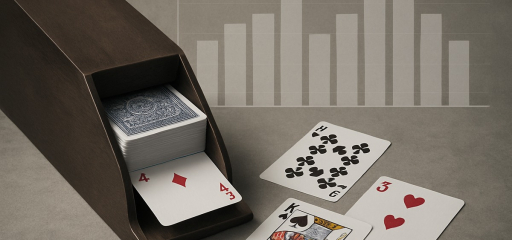
Card counting in blackjack is one of those rare advantage-play stories that’s actually true. A patient player, a halfway-decent count, and a few weekends of practice can flip the house edge into a small player edge. So a reasonable question shows up at every baccarat table eventually: if it works there, why not here? The shoes look the same. The cards look the same. The pit boss is even grumpier. Shouldn’t the same trick port over?
It doesn’t, and the reason is almost entirely mathematical, not mystical, not casino propaganda, just arithmetic about how the two games handle their cards. I’ve sat through more baccarat sessions than I’d like to admit watching guys with notebooks track every card, and I keep wanting to tap them on the shoulder. The math just isn’t there. Let’s walk through why.
Why Counting Works in Blackjack in the First Place
Blackjack counting exists because of one structural rule: the dealer is forced to hit on 16 and stand on 17 (or soft 17 in some houses). The dealer can’t think, can’t fold, can’t deviate. When the remaining shoe is rich in tens and aces, the dealer busts more often on stiff hands, players hit blackjack more often, and double-downs land harder. The player, meanwhile, gets to deviate, stand, hit, double, split, surrender, insurance, based on the count.
That asymmetry is the whole game. The counter isn’t predicting cards. They’re choosing when to bet bigger and when to play differently because the deck composition genuinely changes the expected value of the next hand. Skilled counters playing six-deck shoes can squeeze out roughly 0.5%, 1.5% advantage, which sounds tiny until you multiply it by a few hundred hands an hour at black-chip stakes.
Baccarat Doesn’t Give You That Lever
Baccarat’s draw rules are completely fixed. The player and banker hands follow a rigid table, if the player’s first two cards total 0 to 5, they draw; if 6 to 7, they stand; 8 to 9 is a natural and ends the hand. The banker’s third-card decision depends on what the player drew, but it’s still mechanical. Neither side makes choices. You don’t even physically play the hand. You’re just betting on which fixed procedure ends up with a higher total.
So even if you knew the next card was a 9, you couldn’t do anything strategic with that information besides shift your bet between Banker, Player, or Tie. That’s it. No doubling, no splitting, no insurance. The information has nowhere to live.
How Much Does the Edge Actually Move?
This is the part that ends the debate for most people who like numbers. The base house edges in baccarat are roughly 1.06% on Banker, 1.24% on Player, and a brutal 14.4% on Tie. Removing specific cards from the shoe does shift those edges, Thorp and Griffin worked this out decades ago, but the shifts are microscopic compared to blackjack.
Here’s roughly how the edge moves when you remove a single card from a fresh eight-deck shoe. The numbers come from the standard analyses (you can dig into the original work over at Wizard of Odds if you want the full derivations):
| Card Removed | Effect on Banker Edge | Effect on Player Edge | Effect on Tie Edge |
|---|---|---|---|
| Ace | +0.019% | −0.018% | +0.18% |
| 2 | +0.024% | −0.014% | −0.39% |
| 3 | +0.023% | −0.013% | −0.21% |
| 4 | +0.036% | −0.025% | −0.55% |
| 5 | −0.024% | +0.029% | −0.39% |
| 6 | −0.029% | +0.023% | −0.46% |
| 7 | −0.020% | +0.017% | −0.41% |
| 8 | −0.015% | +0.011% | +0.10% |
| 9 | −0.013% | +0.008% | +0.18% |
| 10/J/Q/K | +0.005% | +0.001% | +0.18% |
Look at the magnitudes. We’re talking thousandths of a percent per card removed. Across realistic shoe compositions, the Banker edge wobbles between roughly 1.01% and 1.08%. Even when you’ve burned through most of the shoe and the composition has gone as lopsided as it realistically gets, you almost never see the Player main bet flip into a player advantage. And on the rare occasions you do, you’re talking about an edge so small that natural variance swamps it.
The 0.01% Problem
The headline result from the Thorp/Wong-era studies is the one that should kill counting baccarat as a serious project: an ideal counter playing perfectly, betting only when the count tells them to, gains about 0.01% per hand in expected value. Not 1%. Not 0.1%. One basis point.
Run the numbers on what that means for a real player:
- A $100 flat bettor playing 60 hands per hour expects $6,000 in action per hour.
- 0.01% of $6,000 is sixty cents.
- That’s before tipping the dealer, paying for drinks the cocktail waitress brought, or accounting for the comped meal you didn’t really earn.
- It’s also before you factor in that you’ll only actually bet on a fraction of hands, since most counts won’t be favorable enough to act on.
- And it assumes perfect play, one miscount or one missed card and your edge evaporates.
Sixty cents an hour. I tip more than that walking past a busker. Calling this “advantage play” is generous; it’s closer to a slow leak in your own direction, and the rake from variance alone can eat it in a single shoe.
What About the Side Bets?
This is where counting baccarat gets a bit more interesting on paper and a bit more depressing in practice. Side bets like Dragon Bonus, Lucky 6, Panda 8, and the basic Tie wager have wild payout structures, which means their edges do swing more dramatically as the shoe depletes. In theory, a counter watching the right side bet can find spots where the edge tilts genuinely positive, sometimes by a percent or more.
The catch is two-fold. First, those side bets carry house edges in the 5%, 15% range to start with, so the count has to move a long way before any positive territory shows up. Second, casinos aren’t stupid. Side-bet-vulnerable shoes get shuffled aggressively, sometimes after every hand on the riskier wagers, sometimes with continuous shufflers, and almost always with deeper cut cards than blackjack uses. By the time the count would actually justify a bet, the shoe’s gone.
I’ve seen exactly one player at a Vegas baccarat pit try to count Lucky 6 with any apparent system. He lasted about 40 minutes before the table was “rotated” and the shoe got reshuffled mid-stream. Whether that was a coincidence or surveillance doing its job, I couldn’t say. But it tracked.
The Things That Did Work, and Aren’t Counting
It’s worth separating card counting from two adjacent techniques that actually have produced real money for real players, because they sometimes get lumped together in casino-floor mythology.
Shuffle tracking is the practice of following clumps of high or low cards through a riffle shuffle, predicting roughly where they’ll end up in the next shoe, and timing bets accordingly. It’s not card counting. It’s a different beast that depends on weak, predictable shuffles. Casinos have largely defeated it with machine shufflers and stricter procedures, but in the ’80s and ’90s it was real, and it worked in both blackjack and baccarat for a handful of disciplined teams.
Edge sorting is what Phil Ivey famously did at Crockfords and the Borgata: identifying minute asymmetries on the backs of the cards and exploiting them to know the value of a card before it was dealt. The casinos sued, the courts sided with the casinos, and Ivey gave back a lot of money, but the technique unambiguously beat baccarat. That’s not counting either. It’s exploiting a defective product.
Both of these had real expected value attached. Card counting, in the standard sense, doesn’t. Lumping them together makes it sound like baccarat is beatable through patient observation, and it mostly isn’t, at least not by anyone who isn’t willing to do the substantially weirder work those other techniques require.
Why the Myth Persists Anyway
If the math is so clear, why do you still see scorecards at every baccarat table and players tracking trends with religious focus? A few reasons, and most of them are psychological rather than mathematical.
Baccarat has a long history with high rollers, especially in Asian gambling culture, and tracking outcomes, even when those outcomes don’t predict anything, is part of the ritual. The casino encourages it. Free scorecards, free pens, big boards displaying the history of every hand. They want you tracking. It feels like skill. It produces the same neurochemical hit a counter gets in blackjack, except the math isn’t paying it back.
There’s also the slow-edge illusion. Because the house edge on Banker is just 1.06%, players sometimes round it down to “basically zero” and convince themselves that even a tiny counting edge can flip it. The arithmetic above shows why that doesn’t pencil out, but the intuition is stubborn, and it’s reinforced every time someone has a hot shoe and credits their tracking system instead of variance.
If you want to keep getting sharper on the math behind games like this without the marketing fluff, I’d point you to the practice materials over at Effortless Math, building real fluency with probability and expected value is what makes these casino-floor questions stop being mysterious.
So When Could Counting Baccarat Make Sense?
Honestly, almost never, but let’s be fair and lay out the conditions. You’d need a hand-shuffled shoe with deep penetration, say, 90%+ of the cards dealt before reshuffling. You’d need a casino that doesn’t reshuffle when the count gets juicy. You’d need to be playing for stakes high enough that one basis point matters. You’d need to not get backed off after a few sessions of obvious counting behavior. And you’d need a side bet whose payout structure is actually vulnerable to count, plus the discipline to bet only when the count says yes.
That’s a long list. Most of those conditions don’t coexist in any modern casino. Some live online baccarat with hand-dealt shoes comes closer, but the latency and bet limits usually make the project not worth the time. If your goal is to make money grinding casino games, blackjack, video poker with full-pay schedules, and even certain promotional plays will all return more per hour than counting baccarat, by orders of magnitude.
FAQ
Has anyone ever made real money counting baccarat? A small handful of advantage players have claimed positive results targeting specific side bets in specific casinos with specific shuffle conditions, but no one has built a sustained career out of it the way blackjack counters have. The expected value just isn’t there over the long haul.
Why is the Tie bet so volatile in the table above? Because Tie pays 8-to-1 (or 9-to-1 in rare houses), so the math is leveraged. Small composition changes that barely move the main bets can move the Tie edge by half a percent or more. It still doesn’t make Tie a good bet, the house edge stays brutal, but it’s why the column swings hardest.
Do continuous shufflers make counting impossible? Effectively, yes. Continuous shufflers and frequent reshuffles reset the count constantly, which is exactly the point. You can’t build information about a shoe that keeps regenerating.
Is the Banker commission what kills the math? No, the 5% commission on winning Banker bets is already baked into the 1.06% house edge figure. The commission is what gives Banker its slight edge over Player; without it, Banker would actually be a small player-favorable bet, which is why casinos charge it.
What about no-commission baccarat? Different game, different math, usually with a special Banker-6 payout rule that brings the house edge back up to something the casino can live with. Not relevant to counting strategy.
Closing Thought
Card counting works in blackjack because the dealer’s hands are tied and yours aren’t. Baccarat ties everyone’s hands equally, then tells you to pick a side. You can count every card that comes out of the shoe with perfect accuracy and you’ll still be looking at a game where the best-case advantage is roughly the value of the loose change in your couch cushions per hour. The math isn’t hiding anything. It’s just telling you to go play a different game.

Related to This Article
More math articles
- Wyoming WY-TOPP Grade 8 Math Free Worksheets: Printable Standards-Aligned Practice, Answers Included
- Packaging Compatibility and Selection
- Best Laptops for Teachers
- What is Rationalizing Trigonometric Functions: Useful Techniques to Simplify Limits
- ASVAB Math FREE Sample Practice Questions
- CPA BAR vs ISC vs TCP: Choose a Discipline by Fit (2027 Prep)
- CPA REG Agency vs Contract Liability: Read the Legal Relationship (2027 Prep)
- Counting Outcomes and Compound Probability
- How to Find Rational and Irrational Numbers?
- Free Grade 6 English Worksheets for Tennessee Students










What people say about "Why Card Counting Almost Never Works in Baccarat - Effortless Math"?
No one replied yet.