Louisiana LEAP Algebra 1 Free Worksheets: Free Algebra 1 PDF Worksheets with Clear Answer Keys
The first time a student is asked to solve for x, something quiet shifts in how they have to think. Up through middle school, math has been mostly about doing, adding, multiplying, dividing, calculating. Algebra 1 asks for something different: looking at a sentence built out of symbols and figuring out what would have to be true for that sentence to balance. It is the work of a translator as much as a calculator, and it is the reason this course is the single biggest predictor of how the rest of a student’s high school math will go.
Once a ninth grader gets comfortable with the translation, the year tells a clean story. Linear equations come first, then the lines they draw. Lines lead to functions, and functions lead to a way of thinking about how one quantity depends on another. Systems show what happens when two lines share a coordinate. Exponents stretch the number line in a new direction, and quadratics introduce the first curves of high school math. By the end, a student can take a real situation, a phone plan, a savings goal, a falling object, and write the algebra that describes it.
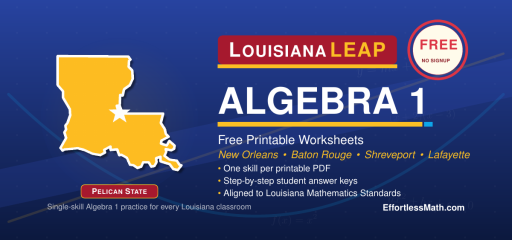
For families and teachers across Louisiana, in New Orleans, Baton Rouge, Shreveport, Lafayette, and the smaller parishes in between, the goal is the same: enough focused practice that a student can walk into the LEAP Algebra I test feeling like the questions look familiar. These 68 worksheets are built for exactly that kind of practice.
What’s on this page
Sixty-eight single-skill PDFs aligned to the Louisiana Algebra 1 standards. Each page handles one specific skill, solving inequalities, graphing in slope-intercept form, factoring a difference of squares, and only that skill. Nothing on a Solving Two-Step Equations page is going to sneak in a quadratic; nothing on a Slope page is going to ask about exponential decay. Single focus is what makes single sittings actually work.
Each PDF opens with a one-page Quick Review: a plain-English definition of the skill, plus one example carried through every step. Then twelve practice problems building easy to hard, the early ones to rebuild a student’s confidence, the later ones to push them toward the difficulty LEAP and classroom tests use. The final page is a student-facing answer key with short, tutoring-tone explanations, written so a fifteen-year-old can read it alone and figure out where they went wrong.
Foundations of Algebra
Students meet the language of algebra here: naming unknowns, simplifying expressions, and using the rules that govern how numbers combine. Steady practice now makes the LEAP feel far more manageable later.
- Variables, Expressions, and Properties
- Order of Operations and Evaluating Expressions
- Simplifying Algebraic Expressions
- Introduction to Equations and Solutions
- Personal Financial Literacy
Solving Linear Equations
The chapter drills the discipline of solving, clear, collect, isolate, across increasingly layered linear equations. Master it early and the rest of the Louisiana course leans on it with ease.
- Solving One-Step Equations
- Solving Two-Step Equations
- Solving Multi-Step Equations
- Equations with Variables on Both Sides
- Literal Equations and Formulas
Inequalities and Absolute Value
Ranges of solutions take over, graphing inequalities, reasoning through compound cases, and working with absolute value. It’s a frequent early hurdle for learners in New Orleans and across the state.
- Solving One-Step Inequalities
- Solving Multi-Step Inequalities
- Compound Inequalities
- Absolute Value Equations
Relations, Functions, and Sequences
The function arrives, one input, one output, alongside domain, range, function notation, and sequences that behave like functions. These worksheets give Louisiana students focused, low-pressure practice.
- Relations and Functions
- Function Notation and Evaluating Functions
- Domain and Range
- Graphing Functions and Transformations
- Arithmetic Sequences as Linear Functions
- Geometric Sequences
- Comparing Functions
- Piecewise Functions
- Combining Functions
Linear Functions and Their Graphs
The chapter is all about lines, finding slope, writing equations in several forms, and relating parallel and perpendicular slopes. For Louisiana students, fluency here shows up directly on the LEAP.
- Slope and Rate of Change
- Slope-Intercept Form
- Point-Slope Form
- Standard Form of a Linear Equation
- Writing Linear Equations from Graphs and Tables
- Parallel and Perpendicular Lines
- Inverse Variation
- Understanding Graphs as Solution Sets
Systems of Equations and Inequalities
The chapter builds methods for solving systems and reasoning about where multiple constraints overlap. Getting comfortable here pays off all the way through the LEAP.
- Solving Systems by Graphing
- Solving Systems by Substitution
- Solving Systems by Elimination
- Applications of Systems of Equations
- Systems of Linear Inequalities
Exponents, Polynomials, and Real Numbers
Powers, polynomials, and number sense combine, exponent rules, polynomial operations, and rational versus irrational numbers. Time spent here is time saved when the LEAP rolls around.
- Adding and Subtracting Polynomials
- Multiplying Polynomials
- Special Products of Polynomials
- Rational and Irrational Numbers
Factoring
Here expressions get taken apart, common factors first, then trinomials and the special products that factor cleanly. Across Louisiana, this is one of the skills that rewards regular reps.
- Greatest Common Factor and GCF Factoring
- Factoring Trinomials: \(x^2 + bx + c\)
- Factoring Trinomials: \(ax^2 + bx + c\)
- Factoring Special Products
Quadratic Functions and Equations
Curves replace lines: graphing parabolas and solving quadratics by factoring, square roots, completing the square, and the formula. It is worth the extra reps for Louisiana learners aiming for a strong score on the LEAP.
- Graphing Quadratic Functions
- Characteristics of Quadratic Functions
- Solving Quadratics by Factoring
- Solving Quadratics by Completing the Square
- Solving Quadratics by Square Roots
- The Discriminant
- The Quadratic Formula
Statistics and Probability
Students summarize and display data, read two-way tables and scatter plots, and reason about likelihood. New Orleans families can use these pages to lock the skill in before it’s tested.
- Measures of Center and Spread
- Scatter Plots and Correlation
- Lines of Best Fit and Predictions
- Counting Principles
- Probability
- Two-Way Frequency Tables
Exponential Functions and Modeling
The final unit covers exponential growth and decay and how to tell exponential models from the others. In New Orleans classrooms it tends to separate confident students from hesitant ones.
- Graphing Exponential Functions
- Comparing Linear, Quadratic, and Exponential Models
- Exponential Growth
- Interpreting Functions and Parameters
More Topics
- Absolute Value Inequalities
- Direct Variation
- Displaying Data with Box Plots
- Displaying Data with Histograms
- Exponential Decay
- Graphing Cube Root Functions
- Graphing Square Root Functions
How to use these worksheets at home
Two short sittings a week, kept on the calendar like any other appointment, will outperform one long marathon every time. Algebra is built layer on layer, and the brain consolidates new ideas during the days between practice, not during a single three-hour Sunday. Aim for fifteen minutes, one PDF at a time, and stop when the page is done.
Pair related skills so each new worksheet builds on the last. Solving Two-Step Equations belongs before Solving Multi-Step Equations, the second page is the first one with one or two extra steps. Slope and Rate of Change belongs before Slope-Intercept Form, because slope-intercept form is just slope plus the starting value. Factoring Trinomials belongs before Solving Quadratics by Factoring, because once a student can factor cleanly, the solving step takes a single short line. The order of the worksheets is doing real teaching work, and following it pays off.
The answer key earns its keep at the end of each session. Hand it over and let your student check their own work, circle anything they missed, read the explanation, and then redo the missed problems on a clean sheet. Louisiana teenagers are old enough to own that step, and that act of self-correction is the single habit that distinguishes students who pass an end-of-course exam comfortably from students who scrape by.
A note about LEAP Algebra I
LEAP, the Louisiana Educational Assessment Program, gives an Algebra I end-of-course test that students typically take in the spring of the year they complete the course. Most ninth graders in Louisiana take it then, though students who finish Algebra I in eighth or tenth grade sit the same exam in whichever spring fits their schedule. LEAP Algebra I is built on the Louisiana Student Standards for Algebra 1, a framework that is closely aligned with the Common Core for high school mathematics.
The exam asks for more than recall. Items mix straightforward computation with multi-step reasoning, modeling a real situation with an equation, interpreting a graph, and explaining whether a given solution actually makes sense. Because these worksheets each isolate a single Louisiana standard, you can treat the LEAP blueprint as a checklist, after each unit, run through the matching PDFs and you will know in twenty minutes which one or two skills are still shaky. That kind of pinpoint review, repeated through the year, is what most reliably turns a passing score into a strong one.
A short closing
LEAP Algebra I rewards consistent, focused practice more than any single cram session ever could. Bookmark this page, print one PDF tonight, and let your Louisiana student take the next small step. By the time the spring window opens, the habit of working one careful page at a time will have done its quiet, accumulating work, and the test will feel like one more familiar afternoon at the kitchen table.
New to Algebra? Start with the basics


Related to This Article
More math articles
- Agents and Conflicting Messages
- Free Grade 5 English Worksheets for Missouri Students
- How to Find Mean, Median, Mode, and Range of the Given Data? (+FREE Worksheet!)
- Reproduction and Development
- Free Grade 3 English Worksheets for South Dakota Students
- The Best Grade 3 ELA Practice Tests for Florida Students
- How to Organize Data?
- CPA TCP Basis and Distributions: Build a Transaction Timeline (2027 Prep)
- Exponential and logarithmic integrals Simplified
- 7 Best Digital Pen Tablets for Online Math Teaching in 2026











What people say about "Louisiana LEAP Algebra 1: Free Worksheets"?
No one replied yet.