Free Grade 3 English Worksheets for Hawai’i Students

There’s a stretch of third grade, usually around January, where a kid will pick up a book at home and just keep reading without being asked. No deal-making, no timer, no “ten more minutes.” It’s quiet, and it’s the whole point of everything that came before.
If you’re a parent or teacher in Hawai’i, you already know the Grade 3 ELA portion of HSAP runs on Smarter Balanced. That means short passages, longer passages, multiple-choice items, and a few short written answers where kids have to point back to the text. The worksheets on this page are built around the same skills the test measures, but they don’t try to *be* the test. They’re just clean, focused practice, one skill per page, with an answer key that does some teaching of its own.
Everything here is free. Tap a title, the PDF opens, print it for home or the classroom. No signup. No “create an account” wall. Take what you need.
What’s in here
These worksheets follow the Hawai’i Common Core State Standards for Grade 3 ELA. Reading literature, reading informational texts, writing, speaking and listening, language. Each PDF is short on purpose. Twelve minutes of focused practice on one skill is worth more than a packet you push your kid through on a Sunday afternoon.
Reading: Literature
- Text Evidence in Stories, [RL.3.1] find proof in the story for what you say about it
- Central Message, Lesson, or Moral, [RL.3.2] figure out the lesson a story teaches
- Describing Characters in a Story, [RL.3.3] traits, feelings, motivations
- Literal and Nonliteral Language, [RL.3.4] the difference between what words say and what they mean
- Parts of Stories, Dramas, and Poems, [RL.3.5] chapters, scenes, stanzas
- Point of View in Stories, [RL.3.6] who’s telling the story
- Illustrations in Stories, [RL.3.7] reading the pictures alongside the words
- Comparing Stories, [RL.3.9] two stories side by side
Reading: Nonfiction
- Text Evidence in Nonfiction, [RI.3.1] back up answers with the article itself
- Main Idea and Key Details, [RI.3.2] what the passage is mostly about, and the facts that support it
- Sequence, Steps, and Cause & Effect, [RI.3.3] first, next, because, so
- Vocabulary in Nonfiction, [RI.3.4] the topic-specific words in science and social-studies texts
- Text Features in Nonfiction, [RI.3.5] headings, sidebars, captions
- Author’s Point of View in Nonfiction, [RI.3.6] what the writer thinks vs. Plain facts
- Using Maps, Photos, and Diagrams, [RI.3.7] the picture is doing some of the work
- Logical Connections in Nonfiction, [RI.3.8] how paragraphs connect
- Comparing Two Texts on the Same Topic, [RI.3.9] two articles, same topic, different angles
Foundational Reading Skills
- Prefixes and Suffixes, [RF.3.3a] word parts that change meaning
- Words with Latin Suffixes, [RF.3.3b] -tion, -sion, -able
- Decoding Multisyllable Words, [RF.3.3c] break the long ones into pieces
- Irregularly Spelled Words (Sight Words), [RF.3.3d] the tricky words that just have to be memorized
- Reading Fluency: Rate and Expression, [RF.3.4b] read aloud so it sounds like talking
- Self-Correcting While You Read, [RF.3.4c] fix it when the sentence stops making sense
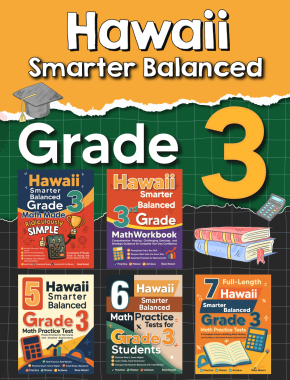
Working on Math Too? Try the Hawaii Smarter Balanced Grade 3 Math Bundle
Many third graders are getting ready for the Smarter Balanced in both subjects. If your child also needs math practice that matches the same standards, this companion bundle is the shortest path, workbook, study guide, and full practice tests in one download.
Writing
- Opinion Writing, [W.3.1] say what you think and back it up
- Informative / Explanatory Writing, [W.3.2] teach someone something they didn’t know
- Narrative Writing, [W.3.3] tell a story in order, with details
- Organizing Writing for Task and Purpose, [W.3.4] different writing for different jobs
- Editing and Revising, [W.3.5] make a draft better, one pass at a time
- Short Research Project, [W.3.7] ask a question, find some answers
- Gathering Information and Taking Notes, [W.3.8] write down what you find, not everything you see
Listening and Speaking
- Listening for Main Idea (Read-Aloud), what was that mostly about?
- Asking Questions of a Speaker, what to ask after a presentation
- Reporting on a Topic, telling a class about something, clearly
Grammar
- Parts of Speech, nouns, pronouns, verbs, adjectives, adverbs
- Regular and Irregular Plural Nouns, [L.3.1b] tables; geese; children
- Abstract Nouns, [L.3.1c] words for ideas and feelings
- Regular and Irregular Verbs, [L.3.1d] walked vs. Went
- Simple Verb Tenses, past, present, future
- Subject, Verb and Pronoun, Antecedent Agreement, [L.3.1f] the dog barks; the dogs bark
- Comparative and Superlative Adjectives and Adverbs, [L.3.1g] fast, faster, fastest
- Coordinating and Subordinating Conjunctions, [L.3.1h] and, but, because, when
- Simple, Compound, and Complex Sentences, [L.3.1i] all three sentence types
Capitalization, Punctuation, and Spelling
- Capitalizing Words in Titles, [L.3.2a] title-case rules
- Commas in Addresses and Dates, [L.3.2b] where the commas go
- Commas and Quotation Marks in Dialogue, [L.3.2c] punctuating what characters say
- Possessives, [L.3.2d] showing that something belongs
- Conventional Spelling, common words you’ll spell often
- Spelling Patterns and Generalizations, [L.3.2f] the rules behind the spellings
- Using Reference Materials to Check Spelling, [L.3.2g] look it up to confirm
Vocabulary and Word Study
- Word Choice for Effect, [L.3.3a] pick vivid words for a stronger sentence
- Spoken vs. Written English, [L.3.3b] casual vs. Formal
- Context Clues, [L.3.4a] use surrounding words to find meaning
- Affixes for Vocabulary, [L.3.4b] use word parts to figure out meaning
- Root Words, [L.3.4c] the base word inside a longer one
- Using Glossaries and Beginning Dictionaries, [L.3.4d] look up words to confirm meaning
- Figurative Language: Similes, Metaphors, and Idioms, [L.3.5a] read figurative phrases with confidence
- Real-Life Word Connections, [L.3.5b] connect words to real situations
- Shades of Meaning, [L.3.5c] tell apart words with similar meanings
- Academic and Domain-Specific Vocabulary, [L.3.6] Grade 3 academic words
A few honest tips on using these
If you took every worksheet on this page and printed them all this weekend, you’d have a stack a quarter-inch thick and a kid who never wants to see another PDF in their life. So don’t. Try this instead:
Pick one. Just one. A single sheet, done with attention, beats five rushed ones. Always.
Start with the Quick Review box. That little summary at the top is the lesson the worksheet is built around. Read it together. Talk through the example. Then hand over the pencil and step back.
Save the answer key for after. Then go through every miss together. The explanations in the back are the part that teaches. Don’t let your kid skip it because they “already finished.”
Come back to the same skill later. If your kid struggles on something, don’t grind on it the same night. Pick a fresh worksheet on that same skill next weekend. Memory works better when there’s space between practice sessions.
What about Smarter Balanced?
The Grade 3 ELA portion of HSAP, what most folks just call the Smarter Balanced assessment, focuses on close reading. Kids see a passage, answer questions about it, sometimes write a short response, and the trick of the test is that nearly every answer wants them to point back to specific words in the text. That’s a learnable habit, and most of the worksheets on this page practice it directly.
If you want to pick one to start with, try Text Evidence in Nonfiction. Smarter Balanced loves asking which sentence in a passage best supports an answer, and that’s exactly what this worksheet teaches.
A note on hybrid schools and small islands: even if your kid is at a smaller school where state-test prep doesn’t dominate the spring, these skills travel. Reading carefully and writing clearly help in every classroom in every grade after this one.
Questions families ask
Are these aligned with Hawai’i standards? Yes. Hawai’i adopted the Common Core State Standards for ELA, and each worksheet here targets one of those Grade 3 skills.
Can I use them for homeschool? Definitely. Many ohana doing ‘ohana-based homeschool use these as a steady weekly rhythm. They also work well for ESL learners working in English alongside Hawaiian or Pidgin at home.
My kid is reading above grade level. What now? Try Comparing Two Texts on the Same Topic and Figurative Language. Both stretch strong readers without forcing fourth-grade content.
My kid is behind on reading. Start with Decoding Multisyllable Words and Context Clues. They unlock a lot of the rest.
Can a tutor use these in a session? They were practically built for that. Bring one, work through it for ten minutes, save the rest for next week.
One more thing
Third grade reading doesn’t grow in a straight line. There will be weeks where your kid seems to lose ground, then suddenly a story clicks and they’re off again. Print one of these when you need it. Try a different one tomorrow if today’s was a flop. The goal isn’t to finish anything. It’s to keep going. Mahalo for reading, and come back whenever you need another one.
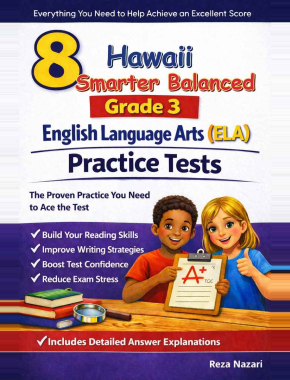
Best Bundle to Ace the Hawaii Smarter Balanced Grade 3 ELA
Looking for the best resource to help your kid ace the Hawaii Smarter Balanced? Try this bundle, four full practice-test books (5 + 6 + 7 + 8 tests) covering the same Grade 3 reading, writing, and language skills your child is already learning. Instant PDF download, answer keys included.

Related to This Article
More math articles
- Controls redistribute and destroy surplus
- Free Grade 4 English Worksheets for New Hampshire Students
- FTCE Mathematics 6-12 Flashcards
- Single-Skill Grade 3 Math for New York (NYSTP): 49 Free Practice PDFs, No Signup
- 5th Grade NYSE Math FREE Sample Practice Questions
- What Kind of Math Is on the ATI TEAS 7 Test?
- 10 Most Common 7th Grade Georgia Milestones Assessment System Math Questions
- 5 Best ASVAB Math Study Guides
- Stretching the Line: How to Multiply Fractions by Whole Numbers with Number Lines
- 8th Grade PSSA Math Worksheets: FREE & Printable







What people say about "Free Grade 3 English Worksheets for Hawai'i"?
No one replied yet.