ACCUPLACER Math Flashcards (Free Online: Formulas, Terms & Concepts)
ACCUPLACER Math Flashcards: a free, printable set covering the topics you will see on the test, with answer keys included, so you can practice each topic one skill at a time and check your own work before test day.
ACCUPLACER Math Flashcards: a free, printable set covering the topics you will see on the test, with answer keys included, so you can practice each topic one skill at a time and check your own work before test day.
Free ACCUPLACER Math review
Lock in every key ACCUPLACER Math formula, term, and concept with a free, interactive flashcard deck covering numbers and operations, fractions and decimals, percent, ratios and proportions, exponents and roots, algebra, linear equations, quadratics, functions, geometry, coordinate geometry, trigonometry, statistics and probability.
Each card shows the rule or definition, a short explanation, and many include a quick diagram. Flip a card, filter by topic or card type, shuffle, and mark what you know so the cards you miss come back for review.
Free to use on class pages, blogs and course pages. Copy the code below and paste it into your page:
What These ACCUPLACER Math Flashcards Cover
This free deck collects the formulas, key terms, and concepts students use across the whole ACCUPLACER Math course, organized into 14 topics. Use the dropdown to study one topic at a time, or shuffle the full deck for mixed review before a test.
7 cards. Integers, real numbers, order of operations, factors and primes, GCF and LCM, and the distributive property.
Fractions & Decimals
5 cards. This topic covers Add or subtract fractions, Multiply fractions, Divide fractions, Convert a fraction to a decimal, and Convert a fraction to a percent.
Percent
6 cards. This topic covers Percent of a number, What percent is one number of another, Percent change, Find the original after a percent change, Simple interest, and Compound interest.
Ratios & Proportions
5 cards. Ratios, proportions, unit conversions, simple interest, and average speed.
Exponents & Roots
7 cards. The exponent rules, including product, quotient, power, zero, negative, and fractional exponents, plus square roots, simplifying radicals, and scientific notation.
Algebra
6 cards. Variables and expressions, solving one and two step equations, combining like terms, FOIL and special products, factoring, the quadratic formula, systems, and inequalities.
Linear Equations
6 cards. This topic covers Slope between two points, Slope-intercept form, Point-slope form, Standard form of a line, Parallel vs perpendicular slopes, and Solve a system of equations.
Quadratics
5 cards. This topic covers Quadratic formula, Discriminant & what it tells you, Vertex of a parabola y = ax squared + bx + c, Vertex form, and Zero-product property.
Functions
4 cards. Function notation and evaluation, domain and range, composition, inverses, and transformations of graphs.
Geometry
13 cards. Area, perimeter, and volume formulas for common shapes, the Pythagorean theorem and triples, angle rules, and polygon interior angles.
Coordinate Geometry
3 cards. Slope, slope-intercept and point-slope form, the distance and midpoint formulas, and parallel and perpendicular lines.
Trigonometry
8 cards. The sine, cosine, and tangent ratios, the unit circle, special right triangles, and basic trig identities.
Statistics & Probability
5 cards. This topic covers Mean (average), Median, mode, range, Probability of an event, Probability of independent events (both), and Mean vs median, which to use.
Test Facts
4 cards. Quick facts about the ACCUPLACER Math test, the math question types, and the calculator policy.
How to Use These ACCUPLACER Math Flashcards
1
Pick one topic
Use the topic dropdown instead of facing all 84 cards at once. Start with the topics you find hardest.
2
Flip, then mark
Read the front, say the rule or definition out loud, then flip. Mark Know it only when you can explain it, not just recognize it.
3
Practice right away
After a set, solve a few problems that use those rules. Flashcards build recall; worked practice turns them into test-day tools.
Best Order for Studying
If the deck feels like a lot, study the foundational topics first, such as numbers, fractions and percents, and exponents, then move on to algebra, geometry, and data, and review the test facts last. This moves from the skills every other topic builds on to the ones that appear in specific problem types.
Most Important Formulas and Facts to Know First
Order of operations: the sequence that keeps every calculation consistent.
Exponent rules: product, quotient, power, zero, and negative exponents.
Fraction operations: and converting between fractions, decimals, and percents.
Percent of a number and percent of change: the backbone of word problems.
Slope and slope-intercept form: for reading and writing linear graphs.
Area, perimeter, and volume: the core geometry formulas.
The Pythagorean theorem: for right triangles and distance.
Factoring and the quadratic formula: for solving quadratics.
Mean, median, mode, and range: the four measures that summarize data.
Probability of an event: favorable outcomes over total outcomes.
Common Mistakes These Cards Help Fix
Ignoring order of operations and simply working left to right.
Adding or subtracting fractions without a common denominator.
Confusing area with perimeter, or surface area with volume.
Flipping an inequality sign at the wrong time, instead of only when multiplying or dividing by a negative.
Mixing up mean, median, and mode.
Treating a negative exponent as a negative number instead of a reciprocal.
Applying the Pythagorean theorem to triangles that are not right triangles.
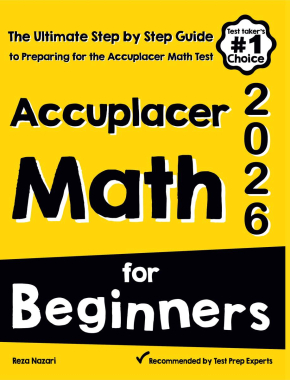
Accuplacer Math for Beginners 2026: The Ultimate Step by Step Guide to Preparing for the Accuplacer Math Test
Recommended when a student needs more than flashcards: a step-by-step ACCUPLACER Math study path with lessons, worked examples, and practice to use alongside the deck.
Every topic taught from the ground up, not just listed.
Pairs naturally with these flashcards and the free practice tests.
The ACCUPLACER math test is not pass or fail; it places you in the right college course, and it is adaptive, so questions get harder or easier based on your answers. It feels hard mostly when basic rules are rusty. Reviewing fractions, percents, linear equations and exponent rules with flashcards beforehand makes a real difference.
How many questions are on the ACCUPLACER math test?
Each Next-Generation ACCUPLACER math test has 20 questions. There are three math tests, Arithmetic, Quantitative Reasoning, Algebra and Statistics (QAS), and Advanced Algebra and Functions (AAF), and your college decides which ones you take. The tests are untimed, so focus on accuracy rather than speed.
What kind of math questions are on the ACCUPLACER?
ACCUPLACER math questions are multiple choice and computer adaptive, and some allow an on-screen calculator while others do not. Expect short computation items, such as finding 15% of 80 (which is 12), alongside word problems and algebra questions where you solve or simplify an expression.
What is on the ACCUPLACER math test?
The Arithmetic test covers whole numbers, fractions, decimals and percents. QAS covers ratios, linear equations, basic geometry and statistics. AAF goes further into quadratics, polynomials, exponential and logarithmic functions, and trigonometry. This deck has 14 topics that map onto all three, so study the ones that match the test your college assigns.
Are there free ACCUPLACER flashcards?
Yes. This ACCUPLACER math deck is free online, with 84 cards across 14 topics and 51 formula cards. Filter by topic or card type, shuffle for mixed review, and mark cards as Know it or Review again. Your progress is saved in your browser, so the cards you miss come back next time.
All 105 Flashcards, Text Version
Every card from the deck above, listed as text so you can read, search, or print it without the flip player.
Official source: free practice tests, sample questions and learning resources for ACCUPLACER are published by the College Board at accuplacer.collegeboard.org.
by: Effortless Math Team about
(category: Articles)





What people say about "ACCUPLACER Math Flashcards: Free Online Practice"?
No one replied yet.