Primary and Secondary Sources

Social studies is built on evidence, and evidence comes from sources. Before you can judge what a source tells you, you need to know what kind of source it is. The test asks this constantly, and the distinction is simple once it clicks.
A primary source is original evidence from a period, event, institution, or participant, for example, a letter, speech, photograph, or law. A secondary source is a later interpretation or synthesis, such as a textbook, biography, or documentary. Primary sources provide direct evidence from the period; secondary sources connect and interpret evidence from multiple sources.
This lesson shows you how to tell them apart and why it matters for judging evidence.
What Makes a Source Primary or Secondary?
The key question is: was this created at the time by someone directly involved, or afterward by someone looking back? A soldier’s wartime diary is primary. A history book about that war is secondary, because it was written later using primary sources.
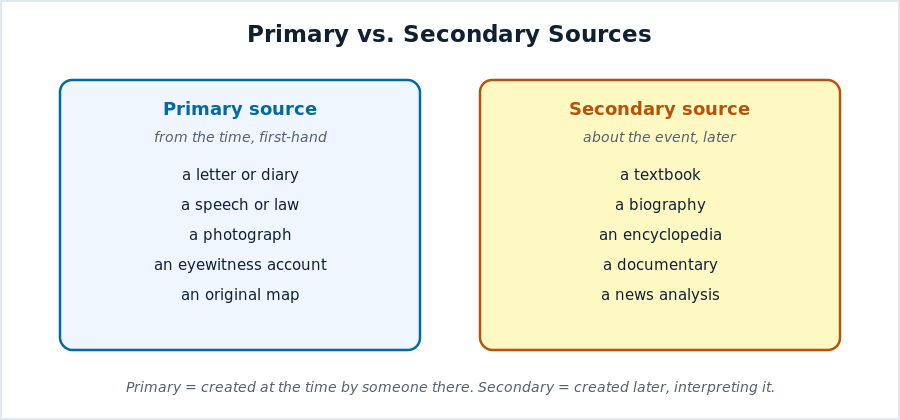
The same topic can appear in both. A speech President Lincoln actually gave is a primary source. An article analyzing that speech is a secondary source. Both are useful — they just do different jobs.
Why the Difference Matters
Primary sources give you direct evidence and they carry the views and limits of one person who was there. Secondary sources pull many primary sources together and add analysis, but they can also reflect the author’s interpretation. Strong social-studies thinking uses both: primary sources for raw evidence, secondary sources for context and explanation.
Spotting the Type on the Test
When the test shows a source, ask three quick questions: Who made it? When — at the time, or later? Were they directly involved? If it was made at the time by someone involved, it is primary. If it was made later by someone studying the event, it is secondary. Dates, diaries, quotations, and original documents point to primary; textbooks, summaries, and “according to historians” point to secondary.
Watch: A Short Video Lesson
History Skills gives a clear overview to go with this lesson:
A Routine for Source Questions
- Identify who created the source and when.
- At the time by someone involved → primary. Later, looking back → secondary.
- Use primary sources for direct evidence, secondary sources for context.
- Remember that both can carry a point of view.
Practice
- Is a photograph taken during a protest a primary or secondary source?
- Is a textbook chapter about that protest primary or secondary?
- What is the key question for telling the two apart?
- Is a letter written by a soldier during a war primary or secondary?
- Is a documentary made 50 years after an event primary or secondary?
- Why are both types of source useful?
Answers
- Primary — it was made at the time.
- Secondary — it was written later to explain the event.
- Was it made at the time by someone involved, or later by someone studying it?
- Primary.
- Secondary.
- Primary sources give direct evidence; secondary sources add context and analysis.
Where This Fits in Your Social Studies Prep
Judging sources is the foundation for everything else. Build on it with finding main ideas and drawing conclusions and spotting point of view, bias, and propaganda. See every topic on the Social Studies Prep Hub.

Related to This Article
More math articles
- Redistricting
- Human Ecology and Urban Spatial Models
- Enhanced ACT Math 2026: The New 45-Question Section, Explained
- How to Graph Linear Inequalities? (+FREE Worksheet!)
- How to Use a Venn Diagram to Classify Rational Numbers?
- Free Grade 8 English Worksheets for West Virginia Students
- Line Plots for 5th Grade: Display and Interpret Data
- Overview of the ISEE Lower Level Mathematics Test
- Word Problems: Measurement for 4th Grade
- How to Add and subtract Fractions with Like Denominators in Recipes





















What people say about "Primary and Secondary Sources"?
No one replied yet.