Estimate Division with Two-Digit Divisors: Examples
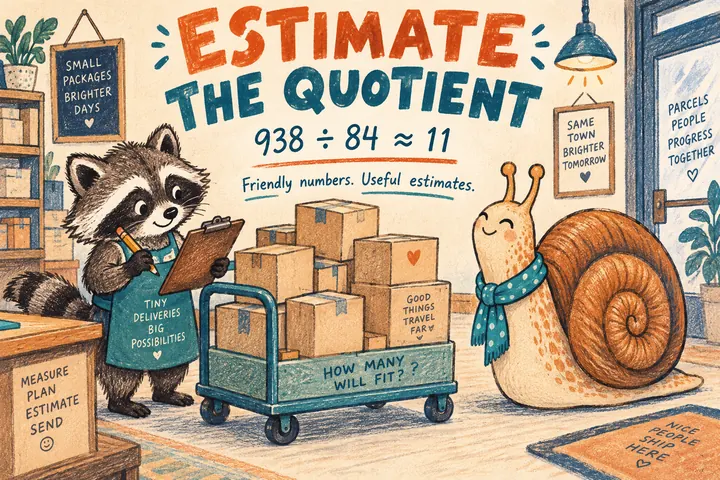
To estimate division with a two-digit divisor, choose nearby numbers that divide easily. For example, \(938 \div 84\) is close to \(880 \div 80 = 11\). Then multiply the original divisor by your estimate to check whether it is reasonable. Different nearby numbers can give different valid estimates.
Quick answer: To estimate the quotient, replace the numbers with nearby compatible numbers that divide easily, then divide. For 418 ÷ 62, think 420 ÷ 60 = 7. The exact answer is about 6.7, so 7 is a good estimate. Compatible numbers usually work better than plain rounding, because rounding can leave a division that is still hard to do mentally.
How to Choose Compatible Numbers
Compatible numbers are a nearby pair you can divide mentally. Round the divisor to a convenient ten, then choose a nearby dividend that is a multiple of that divisor. Keep the original problem in view: changing the numbers gives an estimate, not an exact answer.
For a positive dividend, rounding it down while rounding a positive divisor up makes the quotient smaller. If both numbers move in the same direction, a multiplication check helps you judge the result. Avoid choosing a pair simply because it divides easily if it is far from the original numbers.
Worked Examples with Two-Digit Divisors
Example 1:
Divide \(525\) by \(46\).
Estimation Process:
1. Round \(525\) to \(500\).
2. Round \(46\) to \(50\).
3. Estimate the quotient: \(500 \div 50 = 10\).
Answer:
The estimated quotient is \(10\).
Check the estimate: \(46 \times 10 = 460\), which is below \(525\). The estimate of \(10\) is low; \(46 \times 11 = 506\) and \(46 \times 12 = 552\) show that the exact quotient lies between \(11\) and \(12\). A rough estimate need not be the nearest whole number.
Example 2:
Divide \(938\) by \(84\).
Estimation Process:
1. Round \(938\) to \(900\).
2. Round \(84\) to \(80\).
3. Using rounding gives \(900 \div 80 = 11.25\), or about \(11\). For a mental compatible-number estimate, choose \(880 \div 80 = 11\) instead.
Answer:
The estimated quotient is \(11\). Check: \(84 \times 11 = 924\) and \(84 \times 12 = 1008\), so the exact quotient is between \(11\) and \(12\).
The first example gives a rough lower estimate; the second gives an estimate close to the exact quotient. Decide how precise the task needs you to be, then check your choice by multiplication.
Practice: Estimate Each Quotient
Choose nearby compatible numbers, write your estimate, and multiply to check. The sample answers below show one reasonable method; a different method can give a different estimate.
1. Estimate the quotient of \(672\) divided by \(56\).
2. What is the estimated quotient when \(1145\) is divided by \(92\)?
3. Divide \(789\) by \(72\) and estimate the quotient.
4. What is the estimated result of \(430\) divided by \(38\)?
5. Estimate the quotient of \(1256\) divided by \(45\).
Sample Estimates and Multiplication Checks
\(672 \div 56\): use \(720 \div 60 = 12\). Checking \(56 \times 12 = 672\) shows that this estimate happens to equal the exact quotient.
\(1145 \div 92\): use \(1080 \div 90 = 12\). Since \(92 \times 12 = 1104\) and \(92 \times 13 = 1196\), the exact quotient is between \(12\) and \(13\).
\(789 \div 72\): use \(770 \div 70 = 11\). Checking \(72 \times 11 = 792\) shows that \(11\) is a little high.
\(430 \div 38\): use \(440 \div 40 = 11\). Checking \(38 \times 11 = 418\) and \(38 \times 12 = 456\) places the exact quotient between \(11\) and \(12\).
\(1256 \div 45\): keep the friendly divisor \(45\) and use the nearby multiple \(1260\). Because \(45 \times 28 = 1260\), the estimate is \(28\), a little above the exact quotient.
Use an estimate to check the size of an answer. If a task requires an exact quotient or remainder, return to the original numbers and complete the division.
Continue with the Grade 5 Math hub for related number and operation review. If you need a book, compare the listed format, contents and preview before choosing.
Rounding vs compatible numbers
Both methods give an estimate. The difference is whether the new numbers divide evenly.
| Problem | Rounding to the nearest ten | Compatible numbers | Exact answer |
|---|---|---|---|
| 287 ÷ 43 | 290 ÷ 40 = 7.25 (awkward) | 280 ÷ 40 = 7 | about 6.7 |
| 615 ÷ 32 | 620 ÷ 30 ≈ 20.7 (awkward) | 600 ÷ 30 = 20 | about 19.2 |
| 347 ÷ 68 | 350 ÷ 70 = 5 | 350 ÷ 70 = 5 | about 5.1 |
Start by rounding the divisor to the nearest ten. Then change the dividend to a nearby multiple of that number. For 287 ÷ 43, the divisor becomes 40, and 280 is the closest multiple of 40, so the estimate is 7.
Common mistakes when estimating quotients
- Rounding the dividend first and getting stuck. Pick the divisor first, then find a dividend it divides evenly.
- Ignoring which way you rounded. Rounding the divisor up makes the estimate smaller. Rounding the dividend up makes it bigger.
- Forgetting place value. 1,200 ÷ 40 is 30, not 3. Use a fact you know: 12 ÷ 4 = 3, so 120 ÷ 4 = 30, and 1,200 ÷ 40 = 30.
- Skipping the check. Multiply your estimate by the original divisor. For 418 ÷ 62, 7 × 62 = 434, which is close to 418.
Frequently Asked Questions
What does estimate the quotient mean?
To estimate the quotient means to find an approximate answer to a division problem instead of the exact one. You swap the numbers for nearby ones that divide easily in your head. For 289 ÷ 31, think 300 ÷ 30 = 10. The exact answer is about 9.3, so 10 is a sensible estimate that shows the answer is close to ten.
How do you estimate quotients with 2-digit divisors?
Round the two-digit divisor to the nearest ten, then change the dividend to a nearby multiple of that ten that you can divide using a basic fact. For 283 ÷ 41, use 280 ÷ 40 = 7, since 28 ÷ 4 = 7. Check: 41 × 7 = 287, which is very close to 283, so 7 is a strong estimate.
How do you estimate the quotient using compatible numbers?
Compatible numbers are nearby numbers that divide evenly because they come from a known fact. For 1474 ÷ 22, round 22 to 20, then pick 1400 because 14 ÷ 2 = 7. That gives 1400 ÷ 20 = 70. The exact answer is 67, so the estimate is close and much faster to find than long division.
What is the estimated quotient of 614 and 65?
A good estimate for 614 ÷ 65 is 10, using the compatible numbers 600 ÷ 60 = 10. The exact answer is about 9.4, so 10 is slightly high but reasonable. Checking with multiplication helps: 65 × 10 = 650, which is a bit more than 614, so the true quotient must be a little under 10.
What is the best estimate for the quotient of 7712 ÷ 19?
About 400. Round 19 up to 20 and 7712 up to 8000, then 8000 ÷ 20 = 400. The exact answer is about 405.9, so 400 is a very good estimate. Rounding both numbers in the same direction tends to keep the estimate close, and a quick check, 19 × 400 = 7600, confirms it.
How can estimating the quotient help you check your answer?
An estimate tells you roughly how big the answer should be, so it catches place-value mistakes. If you work out 936 ÷ 24 and get 3.9 or 390, an estimate of 900 ÷ 30 = 30, or 1000 ÷ 25 = 40, shows the answer should be in the 30s. The exact answer is 39, which fits.

Related to This Article
More math articles
- Free Colorado CMAS Grade 3 Math Practice: 49 Printable PDFs for Classrooms, Tutors, and Parents
- 10 Most Common 8th Grade OST Math Questions
- How to Compare Rational Numbers
- The Best SAT Math Book for Students Starting From the Basics
- Eighth Grade Writing: Argument, Informative, and Narrative Expectations Explained
- Free Grade 8 English Worksheets for Illinois Students
- Do Speaking Clubs Boost Math Confidence? – The Power of Communication and Logic
- FREE 3rd Grade Common Core Math Practice Test
- Party identification
- The Best Grade 7 Math Book for Oregon Students








What people say about "Estimate the Quotient: Compatible Numbers and Rounding"?
No one replied yet.