Prediction Markets vs. Sportsbooks: Two Pricing Engines for One Bet
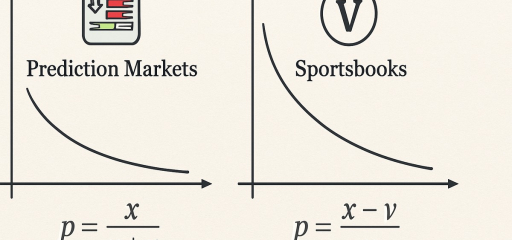
Two people can bet on the same NFL game tonight and pay wildly different prices for the same outcome, depending on whether they tap a sportsbook app or a prediction market. The bet looks identical from ten feet away. The pricing engine underneath isn’t even in the same family. One sets the price for you, takes a cut on both sides, and prays the action balances out. The other lets buyers and sellers find each other in an order book, charges a tiny explicit fee, and walks away. If you’ve never compared the two side by side, the gap will surprise you.
The Sportsbook Pricing Engine
A sportsbook is, mathematically speaking, a market maker that never wants to be a market taker. The book posts a line, say, the Chiefs −3 over the Bills, and then attaches a price to each side, typically −110/−110 in American odds. You give them $110 to win $100. They post the same deal on the other side. If the action is balanced, they collect the vig and don’t care who wins.
That −110/−110 line implies a probability of 110/210 ≈ 52.38% on each side. Add them up and you get 104.76%. Real probabilities sum to 100%. The extra 4.76% is the overround, the hold, the juice, pick your favorite jargon. It’s the house’s margin baked directly into the price quote, and you pay it whether you win or lose.
Books don’t always run a balanced book in practice. Sharp money on one side gets respected and the line moves. Square money on the other side gets soaked up. Modern books also profile customers and limit winners, which is its own conversation. But the pricing mechanic, quote a price, embed a margin, adjust on flow, has been the same since chalkboards in Vegas backrooms.
The Prediction Market Pricing Engine
Prediction markets ditch the bookmaker entirely. On Kalshi, Polymarket, or any CFTC-regulated event contract venue, you trade a binary contract that pays $1 if an event happens and $0 if it doesn’t. Want to bet the Chiefs win? You buy YES contracts. Someone has to sell them to you, which means someone is implicitly taking the NO side. The platform doesn’t set the price, the order book does.
The contract price is the probability, expressed in cents. YES at 56¢ means the market thinks there’s a 56% chance the event resolves YES. If you’re right and it does, you collect $1 per contract, a profit of 44¢ on a 56¢ stake. If you’re wrong, you lose the 56¢. The math is so clean it almost feels like cheating after years of decoding American odds.
Fees are explicit and small. Kalshi charges roughly 1 to 2% per trade depending on the contract. Polymarket runs on a blockchain and charges only network gas fees, which are usually negligible. There’s no hidden margin baked into the quote. What you see is what the other side of the trade is willing to pay.
Same Event, Two Prices
Let’s run an actual game through both engines. Suppose the Chiefs are favored over the Bills, and the moneyline is real but the implied probabilities don’t line up. Here’s what you might see in any given week:
| Venue | Chiefs (YES) Price | Bills (NO) Price | Implied P(Chiefs) | Implied P(Bills) | Total | Hold / Fee |
|---|---|---|---|---|---|---|
| DraftKings | −135 | +115 | 57.4% | 46.5% | 103.9% | 3.9% vig |
| FanDuel | −140 | +118 | 58.3% | 45.9% | 104.2% | 4.2% vig |
| Kalshi | YES 56¢ | NO 44¢ | 56.0% | 44.0% | 100.0% | ~1% trade fee |
| Polymarket | YES 0.555 | NO 0.445 | 55.5% | 44.5% | 100.0% | gas only |
Look at what that table is actually saying. The two sportsbooks both think the Chiefs are about a 58% favorite, and they’re charging you about 4% on top to bet either side. The two prediction markets think the Chiefs are about a 55 to 56% favorite, and the only cost is a sliver of trading fee. If you’ve got a model that says the true probability is 57%, you have a small edge on Kalshi (buying YES at 56¢ when fair value is 57¢) and zero edge, actually negative edge, at DraftKings (paying 57.4% implied for a 57% outcome and eating vig on top).
That gap doesn’t show up every game. Sometimes the sportsbook is sharper than the prediction market. Sometimes the order book on Kalshi is thin and the spread is wider than the sportsbook’s hold. But the structural advantage, no embedded margin, only explicit fees, is real and it compounds across hundreds of bets.
Where the Vig Actually Lives
Here’s the part that took me embarrassingly long to internalize: sportsbook vig isn’t a fee you pay at checkout. It’s a haircut on every probability you see quoted. When DraftKings shows you −110/−110, they’re telling you the game is 52.38%/52.38%, which can’t be true. Both numbers are inflated by about 2.38 percentage points each. Strip that out and you get back to a 50/50 fair line, but you’ll never see the fair line on the screen.
Prediction markets cannot lie this way. The YES and NO contracts must sum to $1, because that’s the total payout. If YES is 56¢, NO has to be 44¢, arbitrage closes any gap within seconds. The implied probabilities sum to exactly 100%, every time, on every contract. You’re seeing the market’s real estimate, not a marked-up version of it.
That structural honesty is also why you’ll occasionally find prediction market prices that look wrong. Sometimes they are. Thin markets, slow news propagation, or just a few stubborn traders can keep a contract mispriced for hours. If your model is better than the order book’s median trader, you can profit from those gaps in a way that sportsbooks essentially never let you do.
Liquidity Is the Catch
If prediction markets are so much cleaner, why does DraftKings have a hundred-billion-dollar valuation while Kalshi is still scrappy and growing? Liquidity, mostly. A sportsbook will take your $5,000 NFL bet at the posted price without blinking. The Chiefs game on Kalshi might have $40,000 of depth at 56¢, and if you try to slam $100,000 of YES through, you’ll walk the price up to 58¢, 59¢, 60¢ before you fill. Congratulations, you just paid your own vig.
This matters more than I think most retail bettors realize. Here are the practical liquidity tradeoffs to keep in mind:
- Major NFL/NBA games on Kalshi or Polymarket: usually deep enough for $500, $5,000 bets at the quoted price. Beyond that, you’ll start moving the market.
- Niche events (small-conference college games, mid-tier soccer, obscure political contracts): order books can be painfully thin. The bid-ask spread alone might be 4 to 6 cents, which is functionally a 4 to 6% spread fee.
- Sportsbooks at scale: deep books on NFL/NBA/MLB, willing to take five-figure bets at the screen price. The catch is they’ll quietly limit your account if you keep winning.
- Live in-game betting: sportsbooks dominate here. Prediction markets exist for in-play but the latency and liquidity are nowhere close.
- Long-tail markets (election outcomes, weather, “will X happen by Y date”): prediction markets are the only real venue. Sportsbooks either don’t offer these or quote insane vig when they do.
I’ve watched a friend try to move serious size on a thin Polymarket contract and effectively pay 8% in slippage. Same friend, same week, dropped a four-figure bet at a sportsbook and got filled instantly. Different tools for different jobs.
Who’s Watching the Pricing Engine
Sportsbooks in the U.S. Are regulated state by state, New Jersey, New York, Pennsylvania, Michigan, and so on each have their own gaming commission, licensing process, and tax regime. The rules vary, the consumer protections vary, and the legal status of any given operator depends entirely on which state you’re standing in when you place the bet.
Prediction markets are a different animal. Kalshi operates as a CFTC-regulated Designated Contract Market, meaning it falls under federal commodities oversight rather than state gaming law. That’s a meaningful distinction. These contracts are legally event derivatives, not bets, and the regulatory framework comes from the Commodity Futures Trading Commission. Cornell’s Legal Information Institute has a useful overview at law.cornell.edu/wex/prediction_markets, and Kalshi’s own primer at kalshi.com/learn walks through the mechanics in plainer language. Polymarket runs on Polygon and currently restricts U.S. Users, which is its own regulatory saga.
The practical implication: prediction markets give you a clearer paper trail, federal-level oversight, and contracts that look more like financial instruments than gambling tickets. Whether that matters to you depends on whether you care about 1099 reporting, account stability, and not having your wagers reclassified mid-season.
Who Should Use What
Recreational bettors, the people putting $20 on their team because they want to care about the fourth quarter, are almost always better served by sportsbooks. The UX is polished, the bonuses are real (if encrusted with wagering requirements), live betting works, and the extra 3 to 4% of vig on a $20 bet is 60 to 80 cents. Nobody’s retirement hinges on that.
Analytical bettors with an actual edge, people who run models, track closing line value, and grind decisions over thousands of bets, should be looking hard at prediction markets. A 3% vig differential doesn’t sound like much until you compound it over 500 bets a year at $500 a pop. That’s $7,500 in friction you’re handing the sportsbook annually for the privilege of using their app. Move that volume to Kalshi and the same edge nets meaningfully more profit, plus your account doesn’t get limited the first time you go on a heater.
There’s also a middle case: people who like sports betting but want to learn how pricing actually works. Spending a weekend reading both order books and sportsbook lines side by side teaches more about implied probability than any textbook will. If you want to brush up on the probability math itself before diving in, Effortless Math has the foundational material on odds, expected value, and probability conversions that makes all of this click faster.
FAQ
Are prediction markets legal in the U.S.? Kalshi is, with CFTC oversight as a Designated Contract Market. Polymarket isn’t currently available to U.S. Residents through its main interface. State laws don’t apply the same way they do to sportsbooks because event contracts are federally regulated as derivatives.
Can I arbitrage between sportsbooks and prediction markets? In theory, yes, and people do, on games where the prices diverge enough to overcome both fees and slippage. In practice, sportsbooks limit accounts that consistently take +EV lines, and prediction market liquidity caps your size. The math works; the operational reality is harder than it looks.
Why don’t sportsbooks just match prediction market prices? Because they don’t have to. Their customers don’t shop for the best line, most bet on whatever app they already have installed. Sportsbooks compete on bonuses, UX, and parlay aggression, not on tight pricing. Prediction markets compete on price because that’s the only thing they have to offer.
Is the implied probability on a sportsbook line the “true” probability? No. It’s the market’s estimate plus the vig. To get a vig-free probability from −135/+115, you’d compute each side’s raw implied probability (57.4% and 46.5%), then divide by their sum (103.9%) to get 55.2% and 44.8%. That normalized number is the sportsbook’s actual probability estimate, stripped of margin.
Do Kalshi and Polymarket charge anything I should know about? Kalshi takes a small per-trade fee, typically around 1 to 2% depending on the contract and price level. Polymarket only charges blockchain gas fees, which run a few cents per trade in normal conditions. Neither embeds a markup in the quoted price.
Which has tighter pricing on big games? For top-tier NFL and NBA games, both venues usually land within a percentage point or two on probability, and prediction markets generally win on net cost. For niche markets, sportsbooks are deeper but charge more vig, and prediction markets are tighter but might not have a market at all.
Two Engines, One Bet
The same NFL game, the same outcome, two completely different pricing mechanisms. Sportsbooks bake margin into every quote and rely on volume and account management to stay profitable. Prediction markets show you the order book directly and charge a small fee to facilitate the trade. Neither approach is universally better, recreational bettors get more from sportsbooks, analytical bettors get more from prediction markets, and most people benefit from understanding both well enough to know which tool fits which bet. If you’ve only ever priced a game one way, run a few side-by-side comparisons next weekend. The numbers will do more convincing than any article could.

Related to This Article
More math articles
- Algebra Puzzle – Challenge 37
- Free Grade 3 English Worksheets for New York Students
- Top 10 Tips to Overcome PERT Math Anxiety
- Accuplacer Math: How to Place Out of Remedial Courses
- Estimation Practice — Rounding to Estimate Sums & Differences
- Labouchere Cancellation System: The Math of Why ‘Eraser Tape’ Fails
- Cultural Lag, Modernization, and Globalization
- Matter and Its Changes: Particles, Properties, and Mixtures
- How to Read and Interpret Graphs: Bar, Line, Pie & Scatter
- The Best Grade 3 Math Book for New Hampshire Students









What people say about "Prediction Markets vs. Sportsbooks: Two Pricing Engines for One Bet - Effortless Math"?
No one replied yet.