Sources of inequality have different policy implications
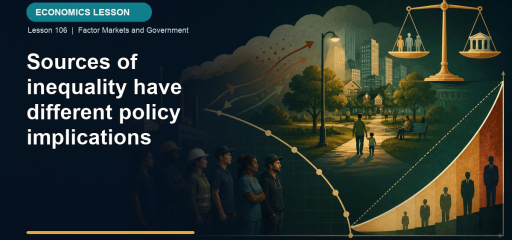
Sources of inequality have different policy implications: this Effortless Math guide explains the topic in plain language, shows how it works through solved examples, and gives you free practice to try immediately, so the idea sticks instead of staying abstract.
Observed gaps do not identify one cause.
A policy commission is separating measurable claims from judgments about fairness. Which statement belongs in the second category?
- The lowest quintile receives 6 percent of total income.
- The government should reduce inequality even if doing so lowers total output slightly.
- A transfer increased disposable income for eligible households.
- The post-tax Gini is lower than the pre-tax Gini.
- Education and experience are associated with earnings differences.
The government should reduce inequality even if doing so lowers total output slightly. The word “should” expresses a value judgment about the preferred tradeoff. The other claims can be checked with evidence.
Watch the idea in action
A focused video lesson from EconplusDal.
Education and experience can raise productivity and earnings. Compensating differentials pay for risk or undesirable hours. Market power, discrimination, inheritance, household composition, health, and luck also matter. A measured wage gap alone cannot reveal how much each mechanism contributes.
Mobility concerns movement over time, while inequality is a snapshot of distribution. High mobility can coexist with high inequality. Poverty measures whether resources fall below a threshold, not how spread out the entire distribution is.
Comparisons must also use consistent definitions. Pretax income, after-tax income, household income, individual earnings, and wealth describe different distributions. Transfers can reduce disposable-income inequality without changing market wages, while a recession can lower measured inequality because top incomes fall even as many households become worse off. A lower Gini therefore does not by itself prove that living standards improved.
Read the curve cautiously
The bottom 60 percent receives 30 percent of income in distribution A and 22 percent in B. A is more equal at that point. To rank the full distributions, confirm that the curves do not cross elsewhere.
Keep fact and value separate
“The Gini fell after transfers” is positive. “The resulting distribution is fair” is normative. Evidence can clarify tradeoffs, but fairness requires a criterion beyond the measure itself.
An observed income gap is an outcome, not a diagnosis. Earnings can differ because workers supply different hours, possess different education and experience, perform jobs with different risks, face different product demand, or encounter discrimination and unequal opportunity. Property income reflects saving, inheritance, entrepreneurship, asset prices, and luck. Household income also depends on the number of earners and family structure.
Human capital is education, training, health, and experience that raise productivity. If training increases a worker’s marginal revenue product, competitive employers are willing to pay more. A compensating wage differential works differently: an unpleasant or risky job may pay more to attract workers even when measured skill is similar. A wage premium for night work is not automatically evidence of higher productivity.
Discrimination means equally productive people receive different opportunities or rewards because of group identity or prejudice. A raw wage gap can be consistent with discrimination but cannot measure it by itself. Occupation, experience, hours, selection, and access to education also affect averages. Conversely, “controlled” differences do not necessarily remove all discrimination if earlier barriers shaped the controls. Economic reasoning should match the evidence given rather than asserting one universal cause.
| Mechanism | Evidence to look for | Policy connection |
|---|---|---|
| Human-capital gap | Education, training, productivity | Schooling, health, training access |
| Compensating differential | Risk, schedule, undesirable conditions | Safety rules and informed choice |
| Market power | Few employers or entry barriers | Competition and mobility policy |
| Discrimination | Unequal treatment at comparable productivity | Enforcement and institutional reform |
Redistribution can use progressive taxes, cash transfers, in-kind benefits, wage subsidies, or public services. A transfer changes disposable resources but is not payment for current production. Benefit phaseouts and marginal tax rates can affect work incentives, while insurance programs can protect against risks that private markets handle poorly. Policy design therefore considers adequacy, targeting, administrative cost, and behavioral responses.
Distinguish inequality, poverty, and mobility. Inequality describes dispersion across the full distribution. Poverty compares resources with a threshold. Mobility tracks movement across positions or generations. A country can have high inequality and high mobility, or low measured inequality with persistent poverty. None of these alone gives average living standards.
Positive analysis estimates who gains, who pays, and how behavior changes. Normative analysis evaluates fairness using a criterion such as equality of opportunity, minimum living standards, desert, or total welfare. Economists can clarify tradeoffs and consequences, but a Gini coefficient cannot settle a moral judgment. On the economics exam, answers that turn a descriptive statistic into an unsupported claim about justice are usually too strong.

Reza is an experienced Math instructor and a test-prep expert who has been tutoring students since 2008. He has helped many students raise their standardized test scores--and attend the colleges of their dreams. He works with students individually and in group settings, he tutors both live and online Math courses and the Math portion of standardized tests. He provides an individualized custom learning plan and the personalized attention that makes a difference in how students view math.
Related to This Article
More math articles
- Top 5 Tutors in Toronto for Math Success
- Eighth Amendment
- Subtraction of Amounts of Money
- Top 10 Free Websites for CLEP College Algebra Preparation
- Top Calculators for the TASC 2026: Quick Review
- Skip Counting & Number Line Game — Click the Right Number
- The Best Grade 7 ELA Practice Tests for Washington Students
- How to Create a Praxis Core Math Study Plan?
- CLEP U.S. History I 021: Colonial Government and Salutary Neglect
- The Ultimate 6th Grade North Carolina EOG Math Course (+FREE Worksheets)




















What people say about "Sources of Inequality and Policy"?
No one replied yet.