YOUR SAT STUDY COMPANION
SAT Math Flashcards (Free Online: Formulas, Terms & Concepts)
SAT Math Flashcards: a free, printable set covering the topics you will see on the test, with answer keys included, so you can practice each topic one skill at a time and check your own work before test day.
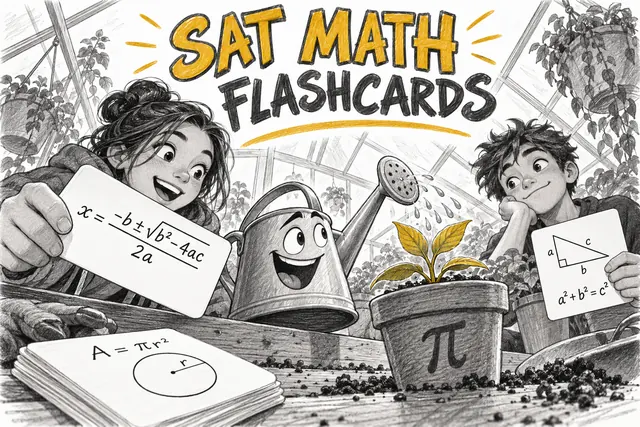
SAT Math Flashcards: a free, printable set covering the topics you will see on the test, with answer keys included, so you can practice each topic one skill at a time and check your own work before test day.
Practice with interactive SAT Math flashcardsOur free SAT Math practice hub has a Study Lab with flip cards for formulas and Desmos moves, grammar rules, a daily question and a study plan for your test date.
Free SAT Math review
Lock in every key SAT Math formula, term, and concept with a free, interactive flashcard deck covering numbers, fractions and percents, ratios and proportions, exponents and roots, algebra, functions, coordinate geometry, geometry, trigonometry, data and statistics.
Includes the advanced-algebra, function, and right-triangle-trig formulas the digital SAT expects you to know. Each card shows the rule or definition, a short explanation, and many include a quick diagram. Flip a card, filter by topic or card type, shuffle, and mark what you know so the cards you miss come back for review.
106flashcards
11topics covered
32cards with a diagram
Freeonline, progress saved
What These SAT Math Flashcards Cover
This free deck collects the formulas, key terms, and concepts students use across the whole SAT Math course, organized into 11 topics. Use the dropdown to study one topic at a time, or shuffle the full deck for mixed review before a test.
| Topic | Cards | What students review |
|---|---|---|
| Numbers | 11 cards | Integers, factors, primes, GCF and LCM, order of operations. |
| Fractions & Percents | 8 cards | Fraction operations, percent of a number, percent of change, conversions. |
| Ratios & Proportions | 6 cards | Ratios, proportions, unit conversion, simple interest, average speed. |
| Exponents & Roots | 12 cards | Exponent rules, square roots, radicals, scientific notation. |
| Algebra | 17 cards | Equations, like terms, FOIL, factoring, the quadratic formula, inequalities. |
| Functions | 6 cards | Function notation, domain and range, composition, inverses, transformations. |
| Coordinate Geometry | 8 cards | Slope, line equations, distance and midpoint, parallel and perpendicular. |
| Geometry | 19 cards | Area, perimeter, volume, the Pythagorean theorem, angle rules. |
| Trigonometry | 5 cards | Sine, cosine, tangent, the unit circle, special triangles. |
| Data & Statistics | 10 cards | Mean, median, mode, range, graphs, and probability. |
| Test Facts | 4 cards | Test format, question types, and calculator policy. |
Jump to a Topic
NumbersFractions & PercentsRatios & ProportionsExponents & RootsAlgebraFunctionsCoordinate GeometryGeometryTrigonometryData & StatisticsTest Facts
Numbers
11 cards. Integers, real numbers, absolute value, factors and primes, GCF and LCM, order of operations, the distributive property, and factorials.
Fractions & Percents
8 cards. Converting mixed numbers and improper fractions, adding, subtracting, multiplying and dividing fractions, percent of a number, percent of change, and fraction, decimal, and percent conversions.
Ratios & Proportions
6 cards. Ratios, proportions, unit conversions, simple interest, and average speed.
Exponents & Roots
12 cards. The exponent rules, including product, quotient, power, zero, negative, and fractional exponents, plus square roots, simplifying radicals, and scientific notation.
Algebra
17 cards. Variables and expressions, solving one and two step equations, combining like terms, FOIL and special products, factoring, the quadratic formula, systems, and inequalities.
Functions
6 cards. Function notation and evaluation, domain and range, composition, inverses, and transformations of graphs.
Coordinate Geometry
8 cards. Slope, slope-intercept and point-slope form, the distance and midpoint formulas, and parallel and perpendicular lines.
Geometry
19 cards. Area, perimeter, and volume formulas for common shapes, the Pythagorean theorem and triples, angle rules, and polygon interior angles.
Trigonometry
5 cards. The sine, cosine, and tangent ratios, the unit circle, special right triangles, and basic trig identities.
Data & Statistics
10 cards. Mean, median, mode, and range, reading graphs and tables, probability, and basic statistics.
Test Facts
4 cards. Quick facts about the SAT Math test, the math question types, and the calculator policy.
How to Use These SAT Math Flashcards
1
Pick one topic
Use the topic dropdown instead of facing all 106 cards at once. Start with the topics you find hardest.
2
Flip, then mark
Read the front, say the rule or definition out loud, then flip. Mark Know it only when you can explain it, not just recognize it.
3
Practice right away
After a set, solve a few problems that use those rules. Flashcards build recall; worked practice turns them into test-day tools.
Best Order for Studying
If the deck feels like a lot, study the foundational topics first, such as numbers, fractions and percents, and exponents, then move on to algebra, geometry, and data, and review the test facts last. This moves from the skills every other topic builds on to the ones that appear in specific problem types.
Most Important Formulas and Facts to Know First
- Order of operations: the sequence that keeps every calculation consistent.
- Exponent rules: product, quotient, power, zero, and negative exponents.
- Fraction operations: and converting between fractions, decimals, and percents.
- Percent of a number and percent of change: the backbone of word problems.
- Slope and slope-intercept form: for reading and writing linear graphs.
- Area, perimeter, and volume: the core geometry formulas.
- The Pythagorean theorem: for right triangles and distance.
- Factoring and the quadratic formula: for solving quadratics.
- Mean, median, mode, and range: the four measures that summarize data.
- Probability of an event: favorable outcomes over total outcomes.
Common Mistakes These Cards Help Fix
- Ignoring order of operations and simply working left to right.
- Adding or subtracting fractions without a common denominator.
- Confusing area with perimeter, or surface area with volume.
- Flipping an inequality sign at the wrong time, instead of only when multiplying or dividing by a negative.
- Mixing up mean, median, and mode.
- Treating a negative exponent as a negative number instead of a reciprocal.
- Applying the Pythagorean theorem to triangles that are not right triangles.
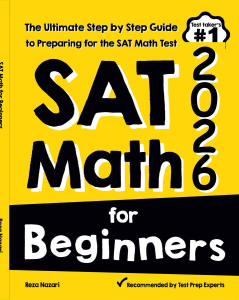
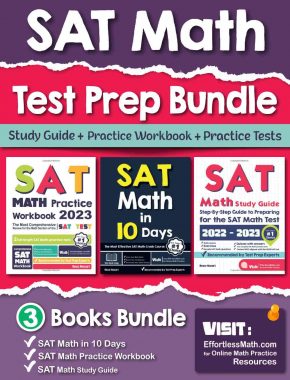
SAT Math for Beginners 2026: The Ultimate Step by Step Guide to Preparing for the SAT Math Test
Recommended when a student needs more than flashcards: a step-by-step SAT Math study path with lessons, worked examples, and practice to use alongside the deck.
- Every topic taught from the ground up, not just listed.
- Pairs naturally with these flashcards and the free practice tests.
- Great for rebuilding weak skills before a test.
Frequently Asked Questions
What math is mostly on the SAT?
Algebra and Advanced Math make up most of the SAT math section, about 35% each. Algebra covers linear equations, inequalities and systems, while Advanced Math covers quadratics, exponential functions and nonlinear equations. The rest is Problem-Solving and Data Analysis and Geometry and Trigonometry, about 15% each, so prioritize the algebra and function cards in this deck.
What is the SAT math time limit?
The digital SAT math section takes 70 minutes in total, split into two 35-minute modules with 22 questions each, for 44 questions. That is about 1 minute 35 seconds per question. The test is adaptive, so how you do on the first module decides the difficulty of the second, which makes accuracy early on especially valuable.
Are there free SAT math flashcards?
Yes. This SAT math deck is free online, with 106 cards across 11 topics, including functions, coordinate geometry and right-triangle trigonometry, and 32 cards include a diagram. You can filter by topic or card type, shuffle the deck, and mark cards to review, and your progress is saved in your browser.
What SAT math formulas should I know?
The SAT gives you a reference sheet with area, volume and special right triangle facts, but many key formulas are not on it. Memorize slope m = (y₂ − y₁)/(x₂ − x₁), slope-intercept form y = mx + b, the quadratic formula, vertex form y = a(x − h)² + k, exponential growth y = a(1 + r)ˣ, and the circle equation (x − h)² + (y − k)² = r².
Is there an SAT math flashcards PDF?
This SAT math deck is built to be used online, so you can flip, shuffle and track the cards you miss instead of printing a fixed list. If you like paper, write your missed cards on index cards, and use the printable worksheets and practice tests in the SAT Math hub for written practice.
All 106 Flashcards, Text Version
Every card from the deck above, listed as text so you can read, search, or print it without the flip player.
Numbers
| Front | Back |
|---|---|
| Integers | The set { …, −3, −2, −1, 0, 1, 2, 3, … } — the counting numbers, their negatives, and zero. |
| Real numbers | Every number on the number line: integers, fractions, decimals, and irrationals like √2 and π. |
| Absolute value | A number’s distance from 0 on the number line, so it is never negative. |−22| = 22. Also: |x| < n means −n < x < n. |
| Order of operations | PEMDAS: Parentheses, Exponents, Multiply/Divide (left→right), Add/Subtract (left→right). |
| Factoring a number | Breaking a number into a product of smaller numbers. 12 = 2 × 2 × 3, so 2 and 3 are factors of 12. |
| Prime number | A whole number greater than 1 whose only factors are 1 and itself: 2, 3, 5, 7, 11, 13, … |
| Distributive property | a(b + c) = ab + ac. Multiply the outside term by each term inside the parentheses. |
| Factorial (n!) | The product of n and every counting number below it: 5! = 5×4×3×2×1 = 120. By definition 0! = 1. |
| Coefficient | The number multiplied by a variable. In 3x, the coefficient is 3. |
| Complex numbers and i | i is the imaginary unit with i² = −1, so √(−1) = i. A complex number has the form a + bi. |
| Powers of i | i¹ = i, i² = −1, i³ = −i, i⁴ = 1, then the pattern repeats every 4 powers. |
Fractions & Percents
| Front | Back |
|---|---|
| Decimal | A fraction written in a special place-value form. Instead of 1/2 you can write 0.5. |
| Mixed number → improper fraction | a c/b = (a·b + c)/b. Example: 2 3/4 = (2×4 + 3)/4 = 11/4. |
| Add or subtract fractions | Rewrite over a common denominator, add or subtract the numerators, then simplify. |
| Multiply fractions | Multiply the numerators together and the denominators together, then simplify. (a/b)(c/d) = ac/bd. |
| Divide fractions | Keep the first fraction, flip the second, and multiply (multiply by the reciprocal). |
| Percent: find the part | part = (percent ÷ 100) × whole. Example: 20% of 80 = 0.20 × 80 = 16. |
| Percent of change | (New Value − Old Value) ÷ Old Value × 100%. Positive = increase, negative = decrease. |
| Fraction → percent | Divide to get a decimal, then multiply by 100. 3/4 = 0.75 = 75%. |
Ratios & Proportions
| Front | Back |
|---|---|
| Ratio | A comparison of two numbers by division, written 3 : 5 or 3/5. |
| Proportion | Two equal ratios: a/b = c/d. Solve by cross-multiplying: a·d = b·c. |
| Simple interest | I = prt (Interest = principal × rate × time). Use the rate as a decimal. |
| Average speed | Average speed = total distance ÷ total time. |
| Convert units | Multiply by the conversion factor. 1 lb = 16 oz, so 2.75 lb = 2.75 × 16 = 44 oz. |
| Unit rate | A rate with denominator 1. Divide to compare: 9.45 dollars for 3.5 lb is 9.45 ÷ 3.5 = 2.70 dollars per pound. |
Exponents & Roots
| Front | Back |
|---|---|
| Exponent | Tells how many identical factors to multiply. 2³ = 2 × 2 × 2 = 8. The base is 2. |
| Product of powers | xᵃ · xᵇ = xᵃ⁺ᵇ. Same base → add the exponents. |
| Quotient of powers | xᵃ ÷ xᵇ = xᵃ⁻ᵇ. Same base → subtract the exponents. |
| Power of a power | (xᵃ)ᵇ = xᵃᵇ. Multiply the exponents. |
| Power of a product | (xy)ᵃ = xᵃ · yᵃ. Distribute the exponent to each factor. |
| Zero exponent | x⁰ = 1 for any nonzero x. |
| Negative exponent | x⁻ᵃ = 1/xᵃ. A negative exponent means divide instead of multiply. |
| Fractional exponent | x^(1/n) = ⁿ√x. Example: 8^(1/3) = ³√8 = 2. |
| Square root | √x is the number r with r² = x. √36 = 6. |
| Simplify a radical | √(xy) = √x · √y. Pull out the largest perfect square: √72 = √36 · √2 = 6√2. |
| Scientific notation | Write as m × 10ⁿ with 1 ≤ |m| < 10. 25,000 = 2.5 × 10⁴; 0.5 = 5 × 10⁻¹. |
| Exponential growth / decay | y = a·bˣ. If b > 1 the quantity grows; if 0 < b < 1 it decays. a is the starting amount. |
Algebra
| Front | Back |
|---|---|
| Variable | A letter that stands for an unknown or unspecified number, such as x. |
| Expression vs. equation | An expression has no equals sign (2x + 3); an equation sets two expressions equal (2x + 3 = 11). |
| Linear equation | ax + b = c. Undo addition/subtraction first, then multiplication/division. 2x + 3 = 11 → x = 4. |
| Combine like terms | Add the coefficients of terms with the same variable and power. 3x + 5 + 2x − 1 = 5x + 4. |
| FOIL (multiply binomials) | (x + a)(x + b) = x² + (a + b)x + ab. First, Outer, Inner, Last. |
| Difference of squares | a² − b² = (a + b)(a − b). |
| Perfect-square trinomials | a² + 2ab + b² = (a + b)² and a² − 2ab + b² = (a − b)². |
| Factor x² + bx + c (reverse FOIL) | Find two numbers that ADD to b and MULTIPLY to c. x² + 5x + 6 = (x + 2)(x + 3). |
| Quadratic formula | For ax² + bx + c = 0: x = (−b ± √(b² − 4ac)) / (2a). NOT on the SAT reference sheet — memorize it. |
| Vertex of a parabola | For y = ax² + bx + c, the vertex x-value is x = −b ÷ (2a). Plug it back in to get the y-value. |
| Vertex form of a parabola | y = a(x − h)² + k, where (h, k) is the vertex. Great for finding a maximum or minimum. |
| Discriminant | b² − 4ac. Positive → two real solutions; zero → one; negative → no real solutions. |
| Zero product property | If (x + a)(x + b) = 0, then x + a = 0 or x + b = 0. (x + 2)(x + 4) = 0 gives x = −2 or x = −4. |
| Solve a system by substitution | Solve one equation for a variable, substitute it into the other, then solve. From x + y = 3, y = 3 − x. |
| Solve a system by elimination | Add or subtract the equations to cancel one variable, then solve for the other and back-substitute. |
| Inequality sign flip | When you multiply or divide both sides by a negative, flip the inequality. −2x > 4 → x < −2. |
| Polynomial degree | The largest exponent in the polynomial. 2x³ − 5x + 1 has degree 3. The leading term sets end behavior. |
Functions
| Front | Back |
|---|---|
| Function | A rule pairing each input with exactly one output. f(x) names the output when the input is x. |
| Function notation | f(4) = 47 means: when the input is 4, the output is 47. The number in parentheses is the input. |
| Domain and range | Domain = the set of allowed inputs (x-values). Range = the set of possible outputs (y-values). |
| Evaluate a function | Substitute the input for x and simplify. If f(x) = 2x + 3, then f(5) = 2(5) + 3 = 13. |
| Zeros / roots of a function | The x-values where f(x) = 0 — where the graph crosses the x-axis. Found by factoring or the quadratic formula. |
| Linear vs. exponential model | Linear changes by a constant amount each step (y = mx + b). Exponential changes by a constant factor (y = a·bˣ). |
Coordinate Geometry
| Front | Back |
|---|---|
| Slope of a line | m = (y₂ − y₁) / (x₂ − x₁) = rise / run. |
| Slope-intercept form | y = mx + b, where m is the slope and b is the y-intercept. |
| Point-slope form | y − y₁ = m(x − x₁), using the slope m and a point (x₁, y₁) on the line. |
| Standard form of a line | Ax + By = C. Useful for word problems like 12x + 8y = 240 (total dollars from two ticket prices). |
| Distance formula | d = √((x₂ − x₁)² + (y₂ − y₁)²). NOT on the SAT reference sheet. |
| Midpoint formula | M = ((x₁ + x₂)/2, (y₁ + y₂)/2). |
| Parallel vs. perpendicular lines | Parallel lines have equal slopes. Perpendicular slopes are negative reciprocals: m₁ · m₂ = −1. |
| Equation of a circle | (x − h)² + (y − k)² = r², with center (h, k) and radius r. |
Geometry
| Front | Back |
|---|---|
| Rectangle | Area = l × w. Perimeter = 2l + 2w. (Square when l = w.) |
| Square | Area = s². Perimeter = 4s. |
| Triangle area | A = ½ × b × h (base × height). |
| Triangle: perimeter & angles | Perimeter = a + b + c. The interior angles always add to 180°. |
| Exterior angle of a triangle | An exterior angle equals the sum of the two remote (non-adjacent) interior angles. |
| Parallelogram area | A = b × h (base × height). |
| Trapezoid area | A = ½ × h × (b₁ + b₂). |
| Circle | Area = πr². Circumference = 2πr = πd. A full circle = 360°. (π ≈ 3.14) |
| Pythagorean theorem | a² + b² = c², where c is the hypotenuse. So c = √(a² + b²). |
| Pythagorean triples | Whole-number right-triangle sides: 3-4-5, 5-12-13, 8-15-17, 7-24-25 (and their multiples). |
| Special right triangles | 45-45-90 has side ratio 1 : 1 : √2. 30-60-90 has side ratio 1 : √3 : 2. |
| Rectangular (right) prism | Volume = l × w × h = Bh. Surface area = 2lw + 2lh + 2wh. |
| Cylinder | Volume = πr²h. Surface area = 2πrh + 2πr². |
| Cone | Volume = ⅓πr²h. Surface area = πrs + πr² (s = slant height). |
| Sphere | Volume = (4/3)πr³. Surface area = 4πr². |
| Equilateral & isosceles triangles | Equilateral: 3 equal sides, all angles 60°. Isosceles: 2 equal sides and equal base angles. |
| Polygon interior angles | The interior angles of an n-sided polygon add to (n − 2) × 180°. |
| Triangle inequality | Each side of a triangle is shorter than the sum, and longer than the difference, of the other two. |
| Similar figures | Same shape, proportional sides. Set up a proportion to find a missing side: 4/x = 6/15 → x = 10. |
Trigonometry
| Front | Back |
|---|---|
| SOH-CAH-TOA | sin θ = opposite/hypotenuse, cos θ = adjacent/hypotenuse, tan θ = opposite/adjacent. |
| Tangent in terms of sine and cosine | tan θ = sin θ ÷ cos θ. |
| Pythagorean identity | sin²θ + cos²θ = 1 for any angle θ. |
| Complementary angles | sin θ = cos(90° − θ). The sine of an angle equals the cosine of its complement. |
| Radians and degrees | 180° = π radians. To convert degrees to radians, multiply by π ÷ 180. |
Data & Statistics
| Front | Back |
|---|---|
| Mean (average) | Mean = (sum of the values) ÷ (number of values). |
| Median | The middle value of a sorted list. With an even count, average the two middle values. |
| Mode | The value that appears most often in the data set. |
| Range | Range = largest value − smallest value. |
| Standard deviation | Measures how spread out data are around the mean. Larger = more spread; smaller = tightly clustered. |
| Scatterplot & line of best fit | A line of best fit models the trend in scatterplot data; its slope estimates the rate of change. |
| Probability of an event | P = (number of desired outcomes) ÷ (number of total outcomes). |
| Probability of A and B | For independent events: P(A and B) = P(A) × P(B). |
| Two-way table | A table of counts by two categories. Add the right row and column cells to find a conditional probability. |
| Find a missing value from the mean | Total = mean × number of values. Subtract the known values to find the missing one. |
Test Facts
| Front | Back |
|---|---|
| Digital SAT Math: format | The SAT is a digital adaptive test. Math is two modules; the second adapts in difficulty to your first-module performance. |
| SAT Math: length & question count | About 44 math questions across two modules, 70 minutes total (about 35 minutes per module). |
| SAT Math: score & calculator | The Math section is scored 200–800. A calculator (built-in Desmos) is allowed throughout the entire math section. |
| SAT Math: the reference sheet | The built-in sheet gives circle, rectangle, triangle, volume formulas and special right triangles — but NOT the quadratic formula, slope, distance, or any trig. |
Explore more free review tools in our math flashcards hub.

Related to This Article
More math articles
- 3rd Grade FSA Math FREE Sample Practice Questions
- DAT Math Formulas
- How long Is the CBEST Test Valid?
- The Best Grade 5 Math Book for Alabama Students
- Premises and Assumptions
- Formal constitutional amendment process
- Geometry Puzzle – Challenge 64
- Top 10 5th Grade PSSA Math Practice Questions
- Idaho ISAT Grade 8 Math Free Worksheets: 72 Free PDF Worksheets, One Skill at a Time
- 10 Most Common 4th Grade ACT Aspire Math Questions





What people say about "SAT Math Flashcards: Free Online Practice"?
No one replied yet.