How to Solve the Complex Plane?
Represent complex numbers on the complex plane: the real part gives the horizontal coordinate and the imaginary part gives the vertical coordinate.

The complex plane plots a + bi as the point (a, b), with the real part on the horizontal axis and the imaginary part on the vertical. Below: how to plot and add complex numbers geometrically, find the modulus as the distance from the origin, and read the argument as an angle.
Solve the Complex Plane: what to notice and how to work it
What to notice first
Common student mistake
Key formulas and cues
A reliable path
- Separate partsKeep real and imaginary terms in their own lanes.
- Use i squaredReplace \(i^2\) with -1 whenever it appears.
- Use conjugatesFor division, multiply by the conjugate to make the denominator real.
Worked examples
Add complex numbers
- Add real parts: 4 + 2.
- Add imaginary parts: 3i – 5i.
- Write both parts together.
Use i squared
- Multiply coefficients to get 5.
- i times i is i squared.
- Replace i squared with -1.
Try one before moving on
Solve the Complex Plane: pop-up practice
A complex number has both a real and an imaginary component. It’s the real part that has the number itself. The imaginary part, on the other hand, has the letter \(i\) attached to it. This imaginary \(i\) also has a mathematical definition. Imaginary number rule: \(?^2=−1\)
Related Topics
A step-by-step guide to graph the complex plane
Complex numbers cannot be plotted on a number line in the same way that real numbers can. We can still depict them graphically, though. To represent a complex number, we must consider both of its components.
As a way to represent the real and imaginary components of an object, we uses a coordinate system known as a “complex plane”.
The complex numbers are positions on the plane represented as ordered pairs \((a, b)\), where \(a\) represents the horizontal axis coordinate and \(b\) represents the vertical axis coordinate.
- How to represent the components of a complex number on the complex plane?
- Calculate the real and imaginary parts of the complex number.
- Show the real component of the number by moving down the horizontal axis.
- To reveal the imaginary component of the number, move parallel to the vertical axis.
- Make a diagram of the spot.
The Complex Plane, Example 1:
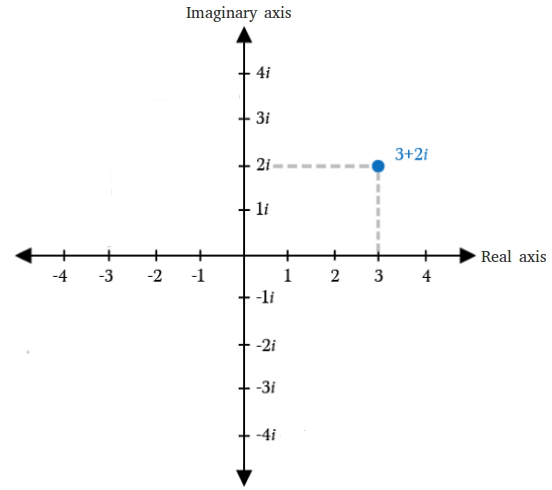
Plot the complex number \(3+2i\).
This number has a real part of \(3\) and an imaginary part of \(2\).
The Complex Plane, Example 2:
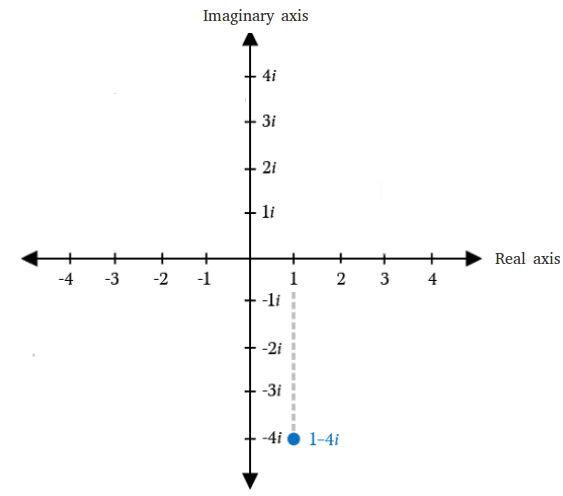
Plot the complex number \(1-4i\).
This number has a real part of \(1\) and an imaginary part of \(-4\).
Exercises for the Complex Plane
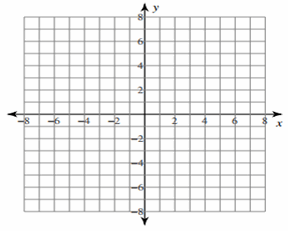
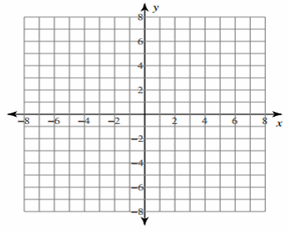
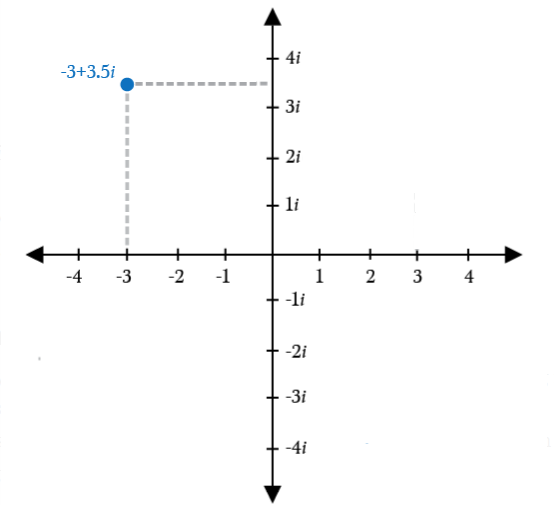
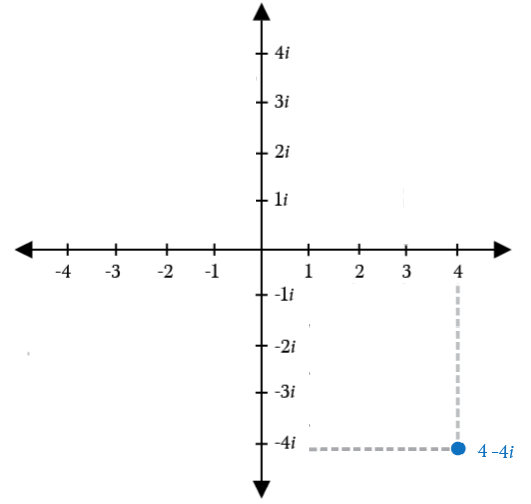
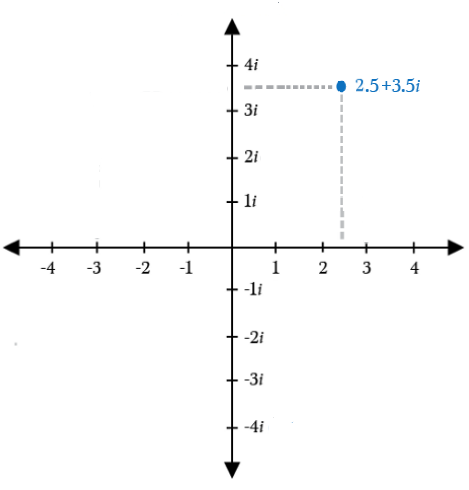
Graph these complex numbers.
- \(\color{blue}{-3+3.5i}\)
- \(\color{blue}{4-4i}\)
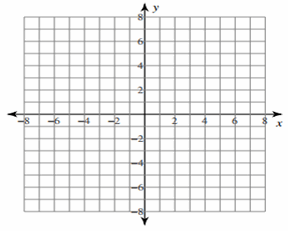

- \(\color{blue}{4-4i}\)

Related to This Article
More math articles
- 10 Most Common 5th Grade STAAR Math Questions
- The Best Algebra 1 Book for Arizona Students
- How to Graph the Cosine Function?
- How to Find Vague Limits by Change of Function’s Value
- CLEP U.S. History I 014: Dutch New Netherland and Plural Middle Colonies
- What Kind of Math Is on the Praxis Core Test?
- 4th Grade OST Math FREE Sample Practice Questions
- Place Value: The Hidden Foundation of All Math
- Ethnicity and Minority-Group Status
- Polarization, the 1994 Realignment, and Impeachment

What people say about "How to Solve the Complex Plane"?
No one replied yet.