Informal Work and Development Beyond Economic Growth
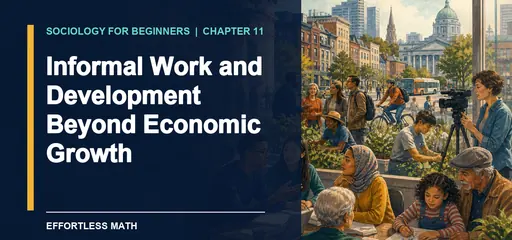
Chapter 11 of the Sociology for Beginners study guide on Effortless Math covers Informal Work and Development Beyond Economic Growth: the key terms, the core ideas, and worked examples showing how this topic is tested on this course.
Sociology for Beginners · Chapter 11
Informal Work and Development Beyond Economic Growth
The informal economy includes income-producing activity that falls outside some formal registration, taxation, labor protection, or regulation. Street vending, home-based production, day labor, domestic work, transport, and small repair can be informal. Informality is not the same as illegality or poverty. Some informal businesses earn substantial income, while many formal jobs remain low paid or dangerous.
Informal work can provide quick entry and flexibility where formal jobs are scarce. It can also leave workers without contracts, insurance, pensions, safety enforcement, or reliable legal remedy. Women, migrants, and marginalized groups may be concentrated in activities treated as extensions of household duty and therefore excluded from labor statistics or protection.
Measurement is difficult because workers and enterprises may be mobile, unregistered, or reluctant to report income. Household surveys, time-use studies, observation, worker organizations, and administrative records can provide different views. National accounts sometimes estimate informal production, but unpaid household care remains especially easy to undervalue despite its role in sustaining the paid economy.
The capability approach, associated with Amartya Sen and Martha Nussbaum, evaluates whether people have genuine opportunities to be and do things they have reason to value. Income matters because it supports choices, but the same income can translate into different opportunities depending on health, disability, public services, discrimination, safety, and social expectations.
Sustainable development seeks to meet present needs while preserving environmental and social capacity for future generations. A mine can raise exports and wages while contaminating water or displacing communities. A development account must therefore examine who receives the income, who bears environmental risk, what voice affected communities have, and whether damaged resources can recover.
Growth remains important where people lack food, shelter, electricity, health care, or safe transport. The sociological correction is that growth has a distribution, a labor process, an environmental cost, and a political setting. Development asks what kind of life new resources make possible and for whom.
A Global Inequality Audit
Use this sequence when a table, product, investment, or migration story feels too large.
Name the measure and what it leaves out. Locate the actors and places connected by the relationship. Trace ownership, labor, law, finance, or migration through the chain. Identify the historical institution that shaped the present options. Compare modernization, dependency, or world-systems mechanisms only where their evidence fits. Show how benefits and costs are distributed within each country. Limit the conclusion to the comparison and data actually available.
Watch the lesson connection
Theories of Global Stratification gives you a second explanation of the ideas surrounding this lesson. As you watch, pause when the lesson concept appears and explain how the example fits.
Try the idea yourself
Write one original example, one close nonexample, and one observation that would help you tell them apart. That small exercise turns a definition into a sociological tool you can use in daily life.

Related to This Article
More math articles
- Social Determinants, Public Health, and Unequal Exposure
- The Best Grade 4 ELA Practice Tests for Illinois Students
- The Best SAT Math Book for Students Starting From the Basics
- 10 Most Common 6th Grade Common Core Math Questions
- 3rd Grade FSA Math Practice Test Questions
- Major disputes at the convention
- How to Use Properties of Logarithms? (+FREE Worksheet!)
- How to Master Integrals
- How to Solve Special Systems
- 5th Grade NDSA Math Worksheets: FREE & Printable






















What people say about "Informal Work and Development"?
No one replied yet.