CLEP U.S. History I 016: Atlantic Trade, Mercantilism, and the Navigation Acts
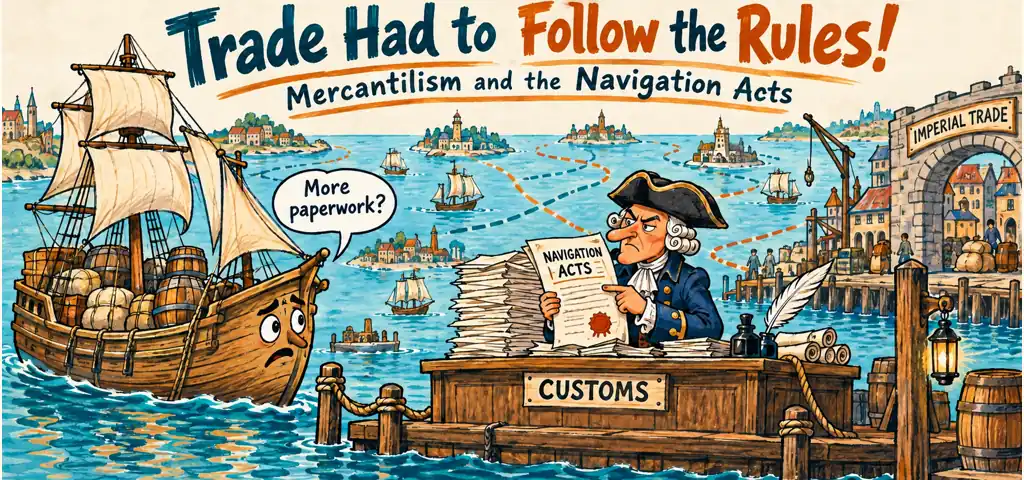
Lesson 4.1 of Chapter 4 of the U.S. History to 1877 study guide on Effortless Math covers CLEP U.S. History I 016: Atlantic Trade, Mercantilism, and the Navigation Acts: the key terms, the core ideas, and worked examples showing how this topic is tested on the exam.
U.S. History to 1877 | Chapter 4 | Lesson 4.1
Mercantilism described the assumption that imperial power and economic regulation belonged together. English leaders wanted colonial commerce to strengthen English shipping, customs revenue, manufacturing, and national power. Beginning in the 1650s and 1660s, Navigation Acts required much colonial trade to travel in English or colonial ships, listed certain “enumerated” products for shipment within the empire, and routed many European imports through England. Later laws tightened customs procedures and regulation.
The system did not prohibit trade. It channeled it. Chesapeake tobacco, Caribbean sugar, New England fish and ships, African captives, and British manufactures moved through an expanding Atlantic economy. Some colonial merchants profited from protected imperial markets and shipbuilding. Others smuggled or complained that rules raised costs. Enforcement varied, and merchants learned to work through family credit, bills of exchange, and far-flung port contacts.
The familiar “triangular trade” diagram can mislead if treated as a single fixed route. Actual voyages formed many overlapping circuits: fish might go to southern Europe or the Caribbean. Molasses to New England. Rum and goods to African ports. Captives to the Caribbean or mainland colonies. The Atlantic system also connected to Native trade and global silver markets. A network model is more accurate than one triangle.
Imperial regulation carried political consequences. Parliament asserted authority to legislate for colonial trade, while colonial assemblies raised local taxes and merchants defended customary practices. Before 1763, uneven enforcement often kept that tension manageable. The important prehistory of the Revolution is that colonists became economically tied to Britain and accustomed to considerable room within the empire at the same time.
Watch the topic in context
Use this lesson from Heimler's History to review the period and its central historical problem. Pause when the video reaches the turning point named above.
Video: The Trans-Atlantic Trade, Explained [APUSH Review], Heimler's History.
Check your understanding
- Navigation Acts were designed primarily to
- transfer customs authority to colonial assemblies
- give colonial merchants unrestricted access to rival empires
- direct trade for imperial benefit
- reduce the English merchant marine’s role in colonial shipping
- remove duties from enumerated colonial exports
- A network is better than one triangle for describing Atlantic trade because
- many routes and commodities overlapped
- every voyage completed the same three-leg circuit
- exchange linked only one African and two European ports
- commodity flows remained separate from coerced migration
- each colony traded chiefly within its own local market
- Select all that apply. Mercantilist rules affected
- all local worship
- enumerated goods
- customs collection
- European imports
- shipping nationality
- Explain one benefit and one cost of imperial trade regulation for colonists.
Write a brief response using a named fact from the lesson.
Open the answers and reasoning
Independent preparation. CLEP is a registered trademark of the College Board, which does not endorse this lesson.

Related to This Article
More math articles
- Idaho ISAT Grade 6 Math Free Worksheets: 72 Free PDF Worksheets, One Skill at a Time
- Amounts of Money Comparison
- CLEP U.S. History I 056: Roads, Canals, Steamboats, Railroads, and Telegraph
- How to Score High in SAT Math?
- SIFT Math Formulas
- Free Minnesota Grade 2 Math Worksheets
- Commerce Clause
- List Of the Best Middle School Math Supply for Learning
- Intelligent Math Puzzle – Challenge 91
- How to Pass the CLEP College Math Exam: Skip a Semester in 2026





















What people say about "Atlantic Trade and the Navigation Acts"?
No one replied yet.