Common Word Roots

Here is a secret that vocabulary-heavy exams do not advertise: you are not expected to have memorized every word they throw at you. You are expected to be able to take an unfamiliar word apart. Most long English words — and nearly all medical ones — are built from reusable pieces, and the most important piece is the root.
Learn a few dozen roots and you stop guessing. Incredulous stops being a mystery and becomes “not believing.” Cardiology reads as “the study of the heart” before you ever set foot in a clinic.
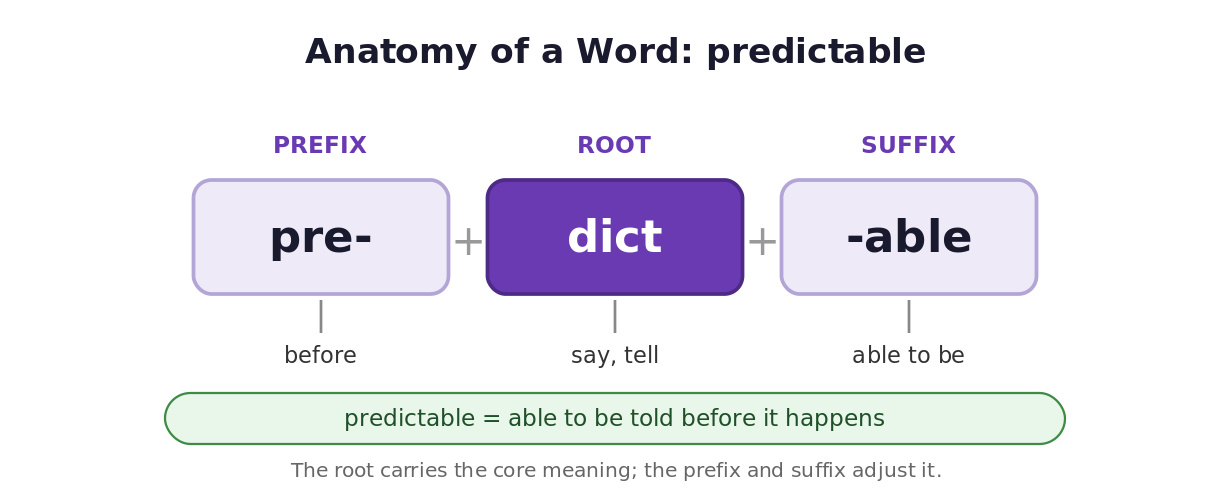
A word root is the part of a word that carries its core meaning. Most English roots come from Latin and Greek: dict means “say,” port means “carry,” cardi means “heart.” Prefixes and suffixes attach to a root and adjust it, but the root is the anchor — recognize it, and you can usually work out the whole word.

Why do roots matter so much for test day?
Because they multiply. One root unlocks an entire family of words: know scrib/script (“write”) and you own prescribe, describe, transcript, inscription, and scribble all at once. On a timed test, that means you can attack a vocabulary question about a word you have never seen by finding a piece you have. And if you are headed into a health-care program, roots are the operating system of the entire vocabulary you are about to learn — medical terms are assembled from Greek and Latin parts with almost mechanical regularity.
Which word roots should I learn first?
Start with the high-frequency academic roots, then add the health-care set. This table covers the ones that pay off fastest:
| Root | Meaning | Examples |
|---|---|---|
| bene | good, well | benefit, benevolent, benign |
| mal | bad, poorly | malfunction, malnourished, malignant |
| cred | believe | credible, credentials, incredulous |
| dict | say, tell | predict, dictate, verdict |
| scrib / script | write | prescribe, transcript, describe |
| port | carry | transport, portable, export |
| tract | pull, drag | traction, extract, distract |
| spect | look, watch | inspect, spectator, respect |
| ject | throw | inject, reject, projection |
| duc / duct | lead | conduct, educate, aqueduct |
| cardi | heart | cardiology, cardiac, tachycardia |
| derm | skin | dermatology, epidermis, dermatitis |
| neur | nerve | neuron, neurology, neuropathy |
| path | disease, feeling | pathology, pathogen, sympathy |
| hem / hemat | blood | hemorrhage, hematology, hemoglobin |
Notice how the two halves of the table cooperate: cardiology is just cardi (heart) plus the same “-ology” you see in ordinary academic words. Once the general roots feel natural, the medical ones follow the same rules.

How do I use a root to decode an unfamiliar word?
Example 1: incredulous. Strip the affixes: in- (not) + cred (believe) + -ulous (full of, tending to). Literally “not tending to believe” — skeptical. In “The nurse was incredulous when the patient claimed to feel no pain,” the pieces hand you the answer.
Example 2: retract. re- (back) + tract (pull) = pull back. A newspaper retracts a false claim; a cat retracts its claws. Same root, same core image of pulling.
Example 3: neuropathy. neur (nerve) + path (disease) + -y (condition) = a disease condition of the nerves. Two roots joined together — very common in medical terms — and each one carries its usual meaning.
What is my root-decoding routine?
- Cover the prefix and suffix; find the piece in the middle that looks familiar.
- Say the root’s meaning out loud (or in your head): “cred — believe.”
- Add back the prefix and suffix, translating each part.
- Assemble a literal meaning, then smooth it into natural English.
- Check the result against the sentence’s context — the context confirms or corrects your guess.
Watch: A Short Video Lesson
Khan Academy walks through this skill clearly in a few minutes. It is a helpful companion to the reading above:

Practice: take these words apart
- What does the root in credible mean, and what does the word literally say?
- Using the root port, what does export literally mean?
- Which two roots build cardiopathy, and what does the word mean?
- A benediction is literally a what?
- What is the shared root in inspect, spectator, and retrospect, and what does it mean?
- Decode dermatitis using its root.
Answers
- Cred means “believe”; credible literally means “able to be believed.”
- “To carry out” — goods carried out of a country.
- Cardi (heart) + path (disease): a disease of the heart.
- A “good saying” — bene (good) + dict (say): a blessing.
- Spect, meaning “look or watch.”
- Derm (skin) + -itis (inflammation): inflammation of the skin.
Where this fits in your prep
Roots are the first of three word-part lessons, and they work best as a set. Continue with common prefixes and suffixes and word families, then combine word parts with context clues for a complete decoding strategy. Words with several senses get their own treatment in multiple-meaning words, and the full study plan lives in our English and language usage hub.
Recommended Prep Books
These study guides and practice books help you keep building momentum as you prepare:




Related to This Article
More math articles
- Equality
- Digital Clocks
- Enlightenment and Print Culture: Ideas, Franklin and Zenger
- The Best Grade 7 ELA Practice Tests for North Dakota Students
- The Best Grade 4 ELA Practice Tests for Louisiana Students
- Fourteenth Amendment
- SAT Vs PSAT Tests
- Temperature for 5th Grade: Celsius and Fahrenheit
- Full-Length 7th Grade FSA Math Practice Test-Answers and Explanations
- Top 10 ParaPro Math Practice Questions






















What people say about "Common Word Roots: Decode Unfamiliar Words Fast"?
No one replied yet.