Common Prefixes
A prefix is a word part added to the front of a word to change its meaning. Number prefixes are some of the most useful: uni- (one), bi- (two), tri- (three), quad- (four), pent- (five), hex- (six), sept- (seven, from Latin septem, as in septet), oct- (eight), and dec- (ten). Others show position (sub-, inter-), time (pre-, post-), or degree (hyper-, hypo-).
Change three letters at the front of a word and you can reverse its meaning entirely: hypertension and hypotension are opposite medical emergencies. That is the power — and the danger — of prefixes. They are tiny, they come first, and they steer everything that follows.
The comforting part is that prefixes are a small, closed club. A few dozen of them cover the overwhelming majority of English words, and they keep their meanings with remarkable consistency. Learn them once and they work for life.
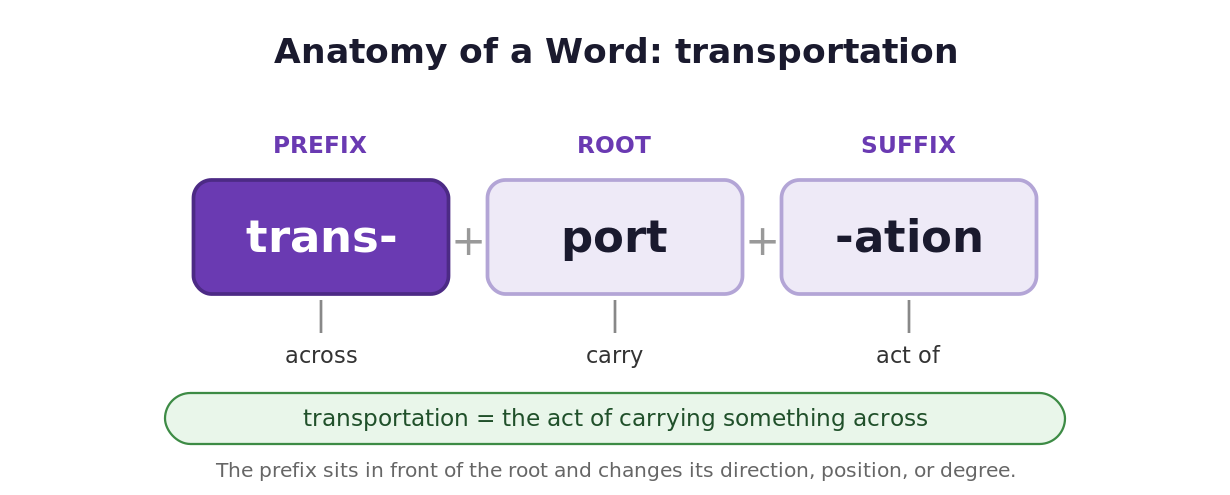
A prefix is a word part attached to the beginning of a root that changes the root’s meaning. Prefixes can reverse a word (misjudge), show position (submarine), time or order (preview, postpone), number (bicycle), or degree (hypersensitive). The root keeps its core meaning; the prefix adjusts direction, amount, or attitude.

Which prefixes should I learn first?
Group them by what they do — position, time, number, negation, degree — and each one becomes easier to file away:
| Prefix | Meaning | Examples |
|---|---|---|
| sub- | under, below | submarine, subzero, subconscious |
| trans- | across, through | transport, transfusion, translate |
| inter- | between | international, intervene, interstate |
| pre- | before | preview, precaution, preoperative |
| post- | after | postpone, postscript, postoperative |
| re- | again, back | rewrite, return, readmit |
| uni- / bi- / tri- | one / two / three | uniform, bilateral, triage area |
| semi- | half, partly | semicircle, semiconscious |
| mis- | wrongly, badly | misjudge, misdiagnose, misplace |
| contra- | against | contradict, contraindicated |
| un- / in- | not | unlikely, incomplete, inactive |
| hyper- | above, excessive | hyperactive, hypertension, hyperglycemia |
| hypo- | under, too little | hypothermia, hypotension, hypoglycemia |
| brady- | slow | bradycardia, bradypnea |
| tachy- | fast | tachycardia, tachypnea |
The last four rows are the health-care heavy hitters. They almost always appear in opposing pairs — hyper/hypo, brady/tachy — so learning one member of the pair buys you both.
How do prefixes change a word’s meaning? Worked examples
Example 1: contradict. contra- (against) + dict (say) = to speak against. When a witness contradicts earlier testimony, they are literally “saying against” it.
Example 2: preoperative vs. postoperative. The root part (operative) is identical; only the time changes. Preoperative instructions come before surgery, postoperative care comes after. Test questions love this pair because the prefix is the entire difference.
Example 3: bradycardia. brady- (slow) + cardi (heart) + -ia (condition) = a condition of a slow heart rate. Swap the prefix and tachycardia is a fast one. You did not memorize two words — you learned one root and two dials.

Do prefixes ever look alike but mean different things?
A few deserve caution. In- usually means “not” (incomplete) but sometimes means “into” (inject, inhale) — let the root and context decide. Hyper- and hypo- differ by one vowel yet point in opposite directions, so slow down when you see either. And re- can mean “again” (rewrite) or “back” (return); both senses share the idea of going over the same ground. When two answer choices differ only in their prefix, the question is really asking whether you know these small parts cold.
What is my prefix-reading routine?
- Spot the prefix at the front of the unfamiliar word.
- Name its meaning from the table: position, time, number, negation, or degree.
- Translate the root separately.
- Combine: prefix meaning + root meaning = literal sense.
- Test the literal sense in the sentence — if it fits, you are done; if not, check whether the prefix has a second meaning.
Watch: A Short Video Lesson
Khan Academy walks through this skill clearly in a few minutes. It is a helpful companion to the reading above:
Practice: let the prefix do the work
- What does subcutaneous literally mean, given that cutane refers to skin?
- Which prefix would turn “diagnose” into “diagnose wrongly”?
- A medication that is contraindicated is what?
- What is the difference between hypoglycemia and hyperglycemia?
- If pnea refers to breathing, what does tachypnea mean?
- Using trans-, what does a blood transfusion literally involve?
Answers
- “Under the skin” — sub- means under.
- Mis-: misdiagnose.
- Advised against — contra- means against; the treatment should not be used.
- Hypo- means too little (low blood sugar); hyper- means excessive (high blood sugar).
- Fast breathing — tachy- means fast.
- Pouring across — blood moved across from one person to another.
Where this fits in your prep
Prefixes are the middle lesson of the word-parts trio. Anchor them to common word roots and finish the set with suffixes and word families. Then let sentences confirm your decoding with context clues, and watch out for the lookalike traps in commonly confused words. The full sequence of lessons is laid out in our English and language usage hub.
Recommended Prep Books
These study guides and practice books help you keep building momentum as you prepare:




Related to This Article
More math articles
- The Best Grade 5 Math Book for Maine Students
- PSAT Math Worksheets: Free Topic Practice
- Understanding an Author’s Implicit Purpose
- SBAC Grade 6 Math Free Worksheets: Free Printable Smarter Balanced Practice with Keys
- How to Write Two-variable Inequalities Word Problems?
- How to Solve Logarithmic Equations? (+FREE Worksheet!)
- How to Find the Volume and Surface Area of a Triangular Prism?
- Math Games That Actually Teach: 12 Games Worth Your Time
- Pronoun Agreement and Reference
- New Hampshire NH SAS Grade 6 Math Free Worksheets: Printable Standards-Aligned Practice with Answers






















What people say about "Common Prefixes: Position, Time, Number and Degree (List)"?
No one replied yet.