Inflation, GDP, Unemployment, and Tariffs
How do we know whether an economy is healthy or struggling? Economists watch a few key measurements: GDP, inflation, and unemployment. Add in tariffs and you have the core vocabulary the test uses to describe the whole economy.
GDP measures the market value of final goods and services produced within a country during a stated period. Inflation is a sustained rise in the general price level. The unemployment rate is the share of the labor force that has no job and is actively seeking work. Together these measures describe different parts of economic performance.
GDP and the Business Cycle
Gross Domestic Product (GDP) is the market value of final goods and services produced within a country during a stated period. Economists use inflation-adjusted, or real, GDP to compare production across time: rising real GDP indicates expansion, while falling real GDP can be one sign of contraction. Economies move through a business cycle, growth, then a peak, then a downturn, then recovery.
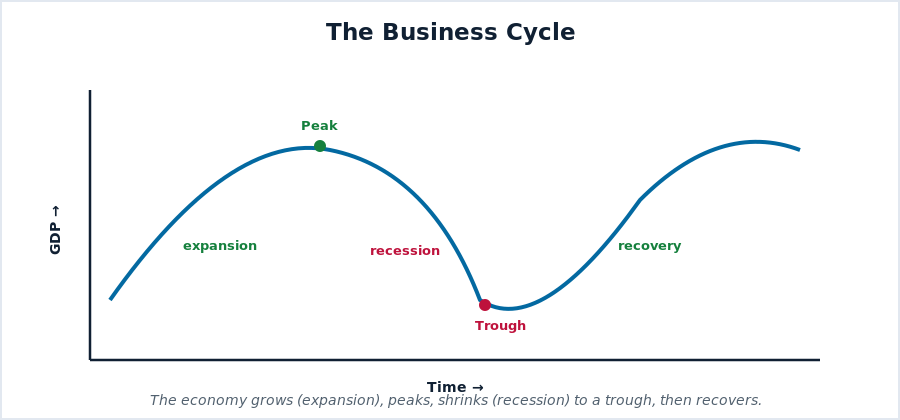
A recession is a broad decline in economic activity that lasts more than a few months; real GDP often falls and unemployment often rises during one.
Inflation and Unemployment
Inflation means prices are rising across the economy, so each dollar buys less than before. A little inflation is normal; high inflation hurts people because their money loses value. The unemployment rate measures the percentage of the labor force without a job who are available for work and actively seeking it. High unemployment signals a weak economy. Governments watch both closely and use fiscal and monetary policy to keep them in a healthy range.
Tariffs and Trade
A tariff is a tax on imported goods. Governments use tariffs to make foreign products more expensive, which can protect domestic industries and jobs — and it raises prices for consumers and can start trade disputes. Tariffs are a trade-off: they help some domestic producers while costing buyers more. When a question describes a tax on imports, that is a tariff, and its effects usually cut both ways.
Watch: A Short Video Lesson
CrashCourse gives a clear overview to go with this lesson:
A Routine for Economic-Measure Questions
- Real GDP tracks inflation-adjusted production within a country; rising real GDP indicates economic growth.
- A recession is a broad, sustained decline in economic activity, often including falling real GDP and rising unemployment.
- Inflation means rising prices; unemployment means workers can’t find jobs.
- A tariff is a tax on imports — it protects local industry but raises prices.
Practice
- What does GDP measure?
- What is a recession?
- What does inflation do to the value of money?
- What does the unemployment rate measure?
- What is a tariff?
- Name one downside of a tariff.
Answers
- The total value of all goods and services a country produces.
- A period when GDP falls and the economy shrinks.
- It reduces it — each dollar buys less.
- The percentage of the labor force without jobs who are available for work and actively seeking it.
- A tax on imported goods.
- It raises prices for consumers (or can start trade disputes).
Where This Fits in Your Social Studies Prep
These measures build on supply and demand and connect to government economic policy. See every topic on the Social Studies Prep Hub.

Related to This Article
More math articles
- Technology shifts the production relationship
- The Best Grade 5 ELA Practice Tests for Wyoming Students
- What Kind of Math Is on the GRE?
- 7th Grade Math Worksheets for Georgia (Milestones): 95 Free Printable PDFs
- CLEP U.S. History I 011: Puritans, Covenant Communities, and Massachusetts
- 5 Best Laptops for Math Teachers in 2026
- Grade 6 Math: Prime and Composite Numbers
- 8th Grade New York State Math Worksheets: Free Printable PDFs
- Full-Length 6th Grade ACT Aspire Math Practice Test-Answers and Explanations
- Institutional and legal barriers to participation





















What people say about "Inflation, GDP, Unemployment, and Tariffs"?
No one replied yet.