Grade 2 English Practice for Arkansas Second Graders
Grade 2 English Practice for Arkansas Second Graders: this Effortless Math guide explains the topic in plain language, shows how it works through solved examples, and gives you free practice to try immediately, so the idea sticks instead of staying abstract.
A free library of single-skill worksheets with answer keys, built for the year before ATLAS testing.
Ask a second grader what their story was about and you might get a beautiful, breathless ramble: “There was a dog and he got lost and then it rained and then a girl found him and her mom said yes and now they’re best friends.” It’s all in there. Order, characters, a problem, a happy ending. They’re not just reading anymore. They’re holding a whole story in their head and handing it back to you.
Second grade is the year that becomes possible. Kids move past sounding out words and start working with meaning, what a story teaches, what an article is for, why a character did the thing they did. It’s a foundation year, and a quietly important one.
These free Grade 2 English worksheets were gathered for Arkansas families and teachers. Each one is a printable PDF with a full answer key, and there’s no signup and no email required. Click the title, the file opens, you print. Use them at the kitchen table, in a classroom, or wherever the homework happens.
The skills here follow the Grade 2 English Language Arts standards Arkansas has adopted, so you’re practicing the same things your second grader’s teacher is covering right now.
A quick tour of what’s here
The worksheets are sorted into eight strands, the natural pieces of second-grade English. There’s reading literature and reading nonfiction. There’s the gritty work of decoding words. There’s writing, speaking and listening, grammar, the rules of capital letters and punctuation, and growing a vocabulary.
Every worksheet is built around one skill. That’s intentional. Second graders learn best when they can give all their attention to a single idea, not when they’re hurried through a big packet. So choose a strand, choose a page, and dive in.
Reading: Literature
- Asking and Answering Questions About Stories, answer who, what, where, when, and why
- Central Message, Lesson, or Moral, find the lesson a story leaves behind
- How Characters Respond to Events, see how a character feels and acts when things change
- Rhythm and Meaning in Stories, Poems, and Songs, hear how a beat or rhyme adds to the meaning
- The Structure of a Story, connect the start, the middle, and the finish
- Points of View of Characters, notice that characters can see things differently
- Using Illustrations to Understand Stories, use the pictures to understand the words
- Comparing Two Versions of the Same Story, spot what changes when a story is retold
Reading: Nonfiction
- Asking and Answering Questions About Nonfiction, find facts in a true-information text
- Main Topic and Focus of Paragraphs, say what a paragraph is mostly about
- Connections Between Events, Ideas, and Steps, follow how ideas and steps connect
- Nonfiction Vocabulary, learn the words that show up in science and history
- Text Features, use headings, captions, and bold words to find things
- The Author’s Main Purpose, figure out why the author wrote the text
- How Images Help a Text, see what a photo or diagram explains
- How Reasons Support the Author’s Points, match reasons to the points they hold up
- Comparing Two Texts on the Same Topic, compare two texts about one topic
Foundational Reading Skills
- Long and Short Vowels, hear the difference between pin and pine
- Vowel Teams, read vowel pairs like ee, oa, and ai
- Decoding Two-Syllable Words, break a long word into syllables
- Prefixes and Suffixes, read add-ons like re- and -ful
- Words with Tricky Spelling Patterns, handle spellings that don’t follow the rules
- Irregularly Spelled Words (Sight Words), memorize the words that can’t be sounded out
- Reading Fluency: Accuracy, Rate, and Expression, read smoothly, at a good pace, with expression
- Self-Correcting While You Read, catch a slip and fix it on your own
Writing
- Opinion Writing, say what you think and give a reason
- Informative and Explanatory Writing, explain a topic clearly to a reader
- Narrative Writing, write a story that moves in order
- Revising and Editing, return to a draft and make it better
- Shared Research Projects, learn about a topic together
- Gathering Information to Answer a Question, collect facts to answer a question
Speaking and Listening
- Recounting Ideas from a Read-Aloud, retell the ideas from something read aloud
- Asking and Answering Questions About a Speaker, listen carefully and ask back
- Telling a Story or Sharing an Experience, share out loud so others can follow
Grammar
- Collective Nouns, group words, like flock and family
- Irregular Plural Nouns, plurals like mice, geese, and children
- Reflexive Pronouns, using myself, yourself, and itself
- Past Tense of Irregular Verbs, come becomes came, say becomes said
- Adjectives and Adverbs, words that describe things and actions
- Expanding and Rearranging Sentences, stretch a sentence or rearrange it
Capitalization, Punctuation, and Spelling
- Capitalizing Holidays, Products, and Place Names, give capitals to the right names
- Commas in Greetings and Closings of Letters, place the comma in a friendly letter
- Apostrophes: Contractions and Possessives, won’t and the cat’s toy, made clear
- Spelling Patterns, spell new words using patterns you know
- Using Reference Materials to Check Spelling, check a spelling instead of guessing
Vocabulary and Word Study
- Formal and Informal English, knowing when to be casual and when to be careful
- Context Clues, use the sentence to figure out a new word
- Prefixes, how a beginning like un- changes a word
- Root Words and Word Endings, find the base word inside a bigger one
- Compound Words, two words joined into one, like campfire
- Using Glossaries and Dictionaries, look words up and use what you find
- Real-Life Word Connections, connect new words to everyday life
- Shades of Meaning, the difference between good, great, and amazing
- Using Describing Words and New Vocabulary, use lively new words when speaking and writing
How to make the most of these worksheets
Free worksheets are only useful if you use them in a way that fits how kids actually learn. A quick plan goes a long way.
Print just one. A single worksheet, one skill, is the right serving size for a second grader. A packet looks ambitious and ends up rushed.
Read the Quick Review box together before anything else. That little box is the lesson. Read it aloud, talk about the example with your child, and then hand over the pencil.
Once the page is finished, check the answer key together. Don’t make it about the score. When an answer is wrong, read the explanation side by side and figure out the snag. That conversation is the part that teaches.
When a skill is wobbly, set it down and revisit it about a week later with a fresh worksheet on the same idea. A gap between practice sessions helps the skill take root much better than back-to-back drilling.
A few honest words about ATLAS
If you came here searching for Grade 2 English practice, you may have ATLAS, Arkansas’s statewide assessment, somewhere on your mind. Here’s the part that should put you at ease: ATLAS starts in third grade. Second graders don’t take it.
That makes Grade 2 the foundation year, plain and simple. There’s no test pressure right now, just a whole year to build reading and writing skills steadily and calmly. Every worksheet your child works through, every main topic named, every two-syllable word decoded, becomes part of the groundwork. The kids who handle the Grade 3 ATLAS with confidence are almost always the ones who built piece by piece in second grade. No cramming needed. Just regular practice while there’s plenty of time.
Questions Arkansas families ask
Are these aligned with what’s taught in Arkansas? Yes. Each worksheet targets a skill from the Grade 2 English Language Arts standards Arkansas has adopted.
My second grader is ahead of grade level. What do I give them? Try Comparing Two Texts on the Same Topic and Using Describing Words and New Vocabulary. Both push a strong reader while staying age-appropriate.
Can these replace a reading workbook? They can fill the same job, targeted, skill-by-skill practice with answer keys, and they’re free. Many families use them alongside regular reading.
My child gets frustrated easily. Any tips? Keep sessions short, start with a skill they already feel okay about, and stop while it’s still going well. Confidence is its own lesson.
One last thing
If your child leaves a worksheet half-done and wanders off, that’s perfectly normal, second graders are like that. The win was never a finished page. It was the practice, the talking-it-through, the little “oh, I get it” moment. Print one whenever your week allows, and come back for the next. They’re free, and they’ll be right here when you need them.
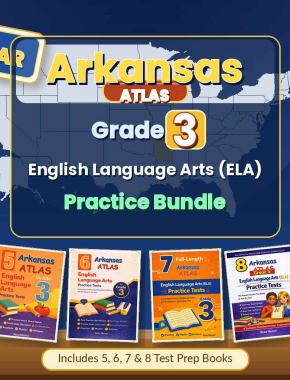
Ready for Grade 3 English? The Arkansas ATLAS Grade 3 English Bundle
Second grade is the build-up year, and when your child is ready for what comes next, this bundle makes the jump to Grade 3 English feel easy. It includes four full practice-test books (5 + 6 + 7 + 8 tests) covering the Grade 3 reading, writing, and language skills just ahead, with explained answer keys and an instant PDF download.
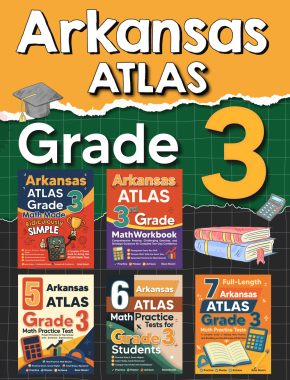
Getting Ready for Grade 3 Math, Too? The Arkansas ATLAS Grade 3 Math Bundle
The same jump to Grade 3 happens in math. If your second grader could use a head start there as well, this Arkansas ATLAS Grade 3 Math bundle is the shortest path, workbook, study guide, and full practice tests in one instant download, with answer keys throughout.

Related to This Article
More math articles
- Overview of the ACCUPLACER Math Test
- Deciphering the Dots: How to Recognizing and Understanding Graph Patterns
- How to Pass the SBAC Math Test (Smarter Balanced) in 2026
- How to Multiply Binomials? (+FREE Worksheet!)
- Top 10 Pre-Algebra Practice Questions
- Standard Deviation Calculator (Free)
- What are the four Branches of Mathematics?
- Students Make the Most Mistakes in These Math Topics
- Free Grade 3 English Worksheets for New Jersey Students
- Top 10 Tips You MUST Know to Retake the PERT Math











What people say about "Arkansas Grade 2 English Worksheets: Free PDFs"?
No one replied yet.