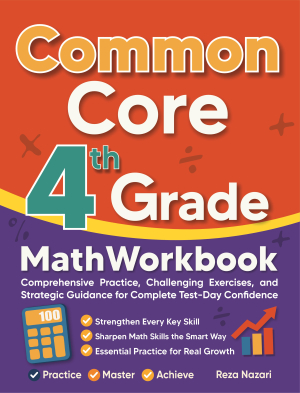
Grade 4 Math Free Worksheets: 72 Free Printable PDFs with Step-by-Step Answer Keys

There is a quiet shift that happens in fourth grade. Up to now, math has mostly asked children to count, recall, and compute with small, comfortable numbers. Fourth grade asks for something more: it asks them to work with big numbers, to handle longer procedures, and to reason about why an answer makes sense. A third grader knows that six times seven is forty-two. A fourth grader is asked to multiply 268 by 34, to divide and make sense of the remainder, and to read a number in the hundred-thousands and round it on purpose.
The year’s biggest theme is fractions. A fourth grader learns that two fractions can name the same amount, that fractions can be compared with reasoning instead of a guess, that they can be added and subtracted when the denominators match, and that a fraction can be multiplied by a whole number. Right alongside come the first decimals, tenths and hundredths, connected directly back to fractions. Then there is multiplicative comparison and multi-step word problems, number patterns, measurement and unit conversion, area and perimeter, line plots, angles measured in degrees, and the geometry of lines, rays, and two-dimensional shapes.
That is a genuinely full year for a nine- or ten-year-old. But it is not one enormous thing. It is a few dozen smaller things, each one learnable on its own. These worksheets are built for students everywhere, in any classroom or at any kitchen table, because they take that whole landscape and break it into one clear, practiceable skill at a time.
What’s on this page
You will find 43 single-skill PDFs, each aligned to Common Core-aligned Grade 4 mathematics standards, the shared framework behind fourth-grade math in classrooms across the country. Every file holds to exactly one skill, so a student practicing multi-digit multiplication is not also being quizzed on angles, and a student working on equivalent fractions is not pulled sideways into line plots.
Each PDF opens with a one-page Quick Review that explains the skill in plain language and walks through a worked example, step by step. Then come 20 practice problems that build gently from easy to harder, followed by 4 word problems that put the skill into a real situation. The final page is a student-facing answer key, written so a fourth grader can check their own work alone and understand where a wrong answer went off track, not just that it did.
Place Value & Multi-Digit Numbers
- Understanding Place Value Relationships, [4.NBT.A.1] each place is ten times the one to its right
- Reading and Writing Multi-Digit Numbers, [4.NBT.A.2] standard form, word form, and expanded form
- Comparing and Ordering Multi-Digit Numbers, [4.NBT.A.2] use place value and the symbols >, <, and =
- Rounding Multi-Digit Numbers, [4.NBT.A.3] round to any place from tens to hundred-thousands
Multi-Digit Arithmetic
- Adding Multi-Digit Whole Numbers, [4.NBT.B.4] the standard addition algorithm, with regrouping
- Subtracting Multi-Digit Whole Numbers, [4.NBT.B.4] the standard subtraction algorithm, including across zeros
- Multiplying by a One-Digit Number, [4.NBT.B.5] multiply up to four digits by a single digit
- Multiplying Two Two-Digit Numbers, [4.NBT.B.5] the area model and the standard algorithm side by side
- Dividing with Remainders, [4.NBT.B.6] divide and name the leftover as a remainder
- Finding Factors and Multiples, [4.OA.B.4] list every factor of a number and its first multiples
- Prime and Composite Numbers, [4.OA.B.4] exactly two factors means prime; more means composite
Operations & Problem Solving
- Multiplicative Comparisons, [4.OA.A.1] read ‘4 times as many’ as a multiplication statement
- Multiplicative Comparison Word Problems, [4.OA.A.2] solve ‘times as many’ stories with multiplication or division
- Multi-Step Word Problems, [4.OA.A.3] two or more operations in one real-world problem
- Interpreting Remainders, [4.OA.A.3] decide what the leftover means, round up, drop it, or use it
- Number and Shape Patterns, [4.OA.C.5] follow a rule and find the next terms in a pattern
Fractions
- Equivalent Fractions, [4.NF.A.1] the same amount written with different numbers
- Comparing Fractions, [4.NF.A.2] compare fractions with unlike denominators using benchmarks
- Adding Fractions with Like Denominators, [4.NF.B.3a] add the numerators, keep the denominator
- Subtracting Fractions with Like Denominators, [4.NF.B.3a] subtract the numerators, keep the denominator
- Decomposing Fractions, [4.NF.B.3b] break a fraction into a sum of unit fractions
- Adding and Subtracting Mixed Numbers, [4.NF.B.3c] work with the whole and fraction parts, including regrouping
- Multiplying a Fraction by a Whole Number, [4.NF.B.4b] repeated addition of a fraction, written as multiplication
- Fraction Word Problems, [4.NF.B.3d] real-world stories that call for adding or subtracting fractions
Decimals
- Fractions with Denominators 10 and 100, [4.NF.C.5] rename tenths as hundredths and add the two
- Decimal Notation for Fractions, [4.NF.C.6] write tenths and hundredths as decimals, and back
- Comparing Decimals to Hundredths, [4.NF.C.7] line up the place values and compare with >, <, =
- Adding Decimal Fractions, [4.NF.C.5] add decimals to the hundredths place
Measurement & Data
- Converting Measurement Units, [4.MD.A.1] change from a larger unit to a smaller one
- Measurement Word Problems, [4.MD.A.2] length, weight, volume, and time in real situations
- Area of Rectangles, [4.MD.A.3] length times width, the space inside a rectangle
- Perimeter of Rectangles, [4.MD.A.3] the distance all the way around a rectangle
- Area and Perimeter Word Problems, [4.MD.A.3] decide whether a problem needs area or perimeter
- Line Plots with Fractions, [4.MD.B.4] read and use a line plot of fraction measurements
Angles
- Angles as Fractions of a Circle, [4.MD.C.5] a full turn is 360 degrees, find a fraction of it
- Measuring Angles with a Protractor, [4.MD.C.6] name angles acute, right, or obtuse by their measure
- Drawing Angles with Given Measures, [4.MD.C.6] know what a given degree measure should look like
- Adding and Subtracting Angles, [4.MD.C.7] an angle split into parts, find the missing part
Geometry
- Points, Lines, Rays, and Angles, [4.G.A.1] the building blocks of geometry and how to tell them apart
- Parallel and Perpendicular Lines, [4.G.A.1] lines that never meet, and lines that cross at a square corner
- Classifying Triangles, [4.G.A.2] sort triangles by their angles and their sides
- Classifying Quadrilaterals, [4.G.A.2] name four-sided shapes by their sides and angles
- Lines of Symmetry, [4.G.A.3] find the lines that fold a shape onto itself
How to use these worksheets at home
Keep each sitting short. Fifteen minutes is genuinely enough for a fourth grader, and a calm fifteen minutes teaches far more than a frustrated forty-five. Pick a single PDF, sit nearby, and let your child do the work while you stay within reach for the stuck moments.
It helps to run related skills back to back, so each one reinforces the last. Try “Adding Multi-Digit Whole Numbers” one afternoon and “Subtracting Multi-Digit Whole Numbers” the next, the second arrives feeling familiar instead of brand new. The same pairing works for “Equivalent Fractions” followed by “Comparing Fractions,” or “Area of Rectangles” right before “Perimeter of Rectangles.” When skills travel in pairs, the connection between them does a real share of the teaching for you.
Save the answer key until the work is finished, then go through it together. That review step, reading and talking through why the right answer is right, is where the real learning settles, far more than in getting every problem correct on the first try.
A note about Grade 4 math standards
Fourth-grade math, almost everywhere in the country, is organized around the same set of ideas. Whether a state calls them by its own name or follows the Common Core directly, the Grade 4 standards group the year into clear strands: operations and algebraic thinking, multi-digit arithmetic in base ten, fractions and the first decimals, measurement and data, and geometry. The labels vary; the math underneath is remarkably consistent.
That consistency is what makes a single-skill approach so practical, no matter where a student goes to school or when their state happens to test. Because each PDF here is tied to one Grade 4 standard, the full set works as a year-long checklist. You can see exactly which skills your child has solid and which still need attention, and aim your practice precisely instead of reviewing everything at once. These worksheets are just as useful for a student getting ahead over the summer as for one shoring up a skill mid-year.
Want everything in one bundle?
If a single organized program sounds better than a folder of loose files, the bundle pulls everything together in sequence.
Grade 4 Math Preparation Bundle, practice-test books, full-length practice tests, and complete answer keys with step-by-step explanations.
A short closing
Fourth-grade math grows fast, but it grows in order, every skill leaning on the one before it. Bookmark this page, print a single PDF tonight, and let your child start somewhere small. Kids take on big new things well when the next step is clear, and a worksheet waiting on the kitchen table is about as clear as a next step gets.

Related to This Article
More math articles
- Grade 3 Math: Multiplying by 10s and 100s
- How to Decipher Limits and Function Values
- 6th Grade MAP Math Worksheets: FREE & Printable
- District of Columbia DC CAPE Grade 4 Math Free Worksheets: 72 Free Printable Math Practice PDFs
- Accuplacer Math: How to Place Out of Remedial Courses
- The Civil War and Reconstruction
- The Best Grade 3 ELA Practice Tests for Illinois Students
- The Best Grade 3 ELA Practice Tests for Minnesota Students
- CLEP College Math FREE Sample Practice Questions
- How to Solve Angle Measurements Word Problems










What people say about "Grade 4 Math: Free Worksheets"?
No one replied yet.