Independent and Dependent Variables
Almost every experiment question on the science test comes down to one skill: telling apart the thing the scientist changes from the thing the scientist measures. Get those two straight and questions about experiments suddenly feel easy. Miss them and even simple items get confusing.
The thing you change on purpose is the independent variable. The thing you measure to see what happened is the dependent variable. Its value depends on what you changed — that is how you remember which is which.
This lesson shows you how to spot both in any experiment, using the plainest examples possible.
Change vs. Measure
Picture a simple plant experiment. A student gives different amounts of water to several plants and then measures how tall each one grows. The amount of water is what the student changes on purpose — that is the independent variable. The height of the plants is what the student measures to see the effect — that is the dependent variable.
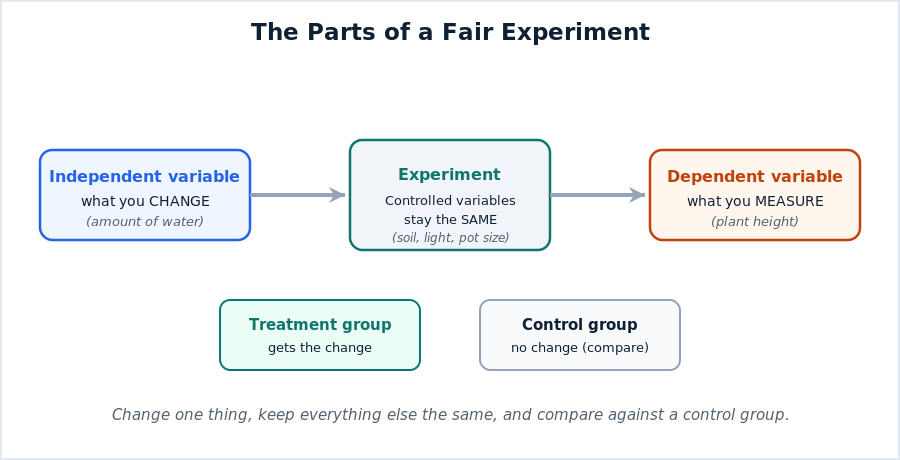
A quick sentence test locks it in: “I change the ______ to see how it affects the ______.” The first blank is the independent variable; the second is the dependent variable. “I change the amount of water to see how it affects plant height.”
Reading Variables Off a Graph
The test often shows results as a graph and asks you to identify the variables. There is a reliable rule: the independent variable almost always sits on the horizontal axis (the bottom), and the dependent variable sits on the vertical axis (the side). So a graph with “hours of sunlight” along the bottom and “plant height” up the side is showing sunlight as the independent variable and height as the dependent variable.
One Change at a Time
A fair experiment changes only one thing at a time. If the student changed the amount of water and the type of soil at once, and the plants grew differently, there would be no way to know which change caused it. That is why good experiments keep everything else the same — those held-steady factors are called controlled variables, and they get their own lesson.
For now, the habit to build is this: find the one factor being changed, find the one outcome being measured, and make sure nothing else is changing along with the independent variable.
Watch: A Short Video Lesson
Helpful Professor Explains! walks through this skill clearly in a few minutes. It is a helpful companion to the reading above:
A Routine for Variable Questions
- Ask: what did the scientist change on purpose? That is the independent variable.
- Ask: what did the scientist measure as a result? That is the dependent variable.
- Use the sentence: “I change the ___ to see how it affects the ___.”
- On a graph, read the independent variable off the bottom axis and the dependent variable off the side axis.
Practice
For each experiment, name the independent and dependent variables.
- A baker tests how oven temperature affects how much a loaf rises.
- A scientist measures how the amount of fertilizer changes tomato yield.
- A student times how far a toy car rolls from different ramp heights.
- On a graph, where does the independent variable usually go?
- Which variable “depends” on the other?
- Why should you change only one thing at a time?
Answers
- Independent: oven temperature. Dependent: how much the loaf rises.
- Independent: amount of fertilizer. Dependent: tomato yield.
- Independent: ramp height. Dependent: distance the car rolls.
- On the horizontal (bottom) axis.
- The dependent variable depends on the independent variable.
- So you can tell which change caused the result.
Where This Fits in Your Science Prep
Variables are the foundation of experimental design. Next, learn how to hold everything else steady with controlled variables and the control group, then how to judge whether an experiment is trustworthy in hypotheses and good experiments. See all topics on the Science Topics Hub.

Related to This Article
More math articles
- Alaska AK STAR Grade 3 Math Worksheets — 49 Free Printable Single-Skill PDFs
- ALEKS Math Practice Test Questions
- The Importance Of Mathematics For Students Pursuing STEM
- FTCE General Knowledge Test Review
- What is the Relationship between Dilations and Angles in Geometry
- Mastering the Basics: The Significance of “Algebra I for Beginners” in Your Back-to-School List
- Best Calculator for Calculus 2026
- Words for Work, Society, Science, and Health
- The Best Grade 4 ELA Practice Tests for North Dakota Students
- 7th Grade ACT Aspire Math Practice Test Questions





















What people say about "Independent and Dependent Variables"?
No one replied yet.