Genes, Alleles, and Punnett Squares

A Punnett square is a simple grid that predicts the possible traits of offspring from two parents. It is one of the most testable tools in genetics because it turns inheritance into something you can count. Once you can fill one in, a whole category of questions opens up.
This lesson covers the vocabulary you need and then walks through a Punnett square step by step.
The Words You Need First
Genes come in different versions called alleles. For many traits, one allele is dominant (shown with a capital letter, like B) and one is recessive (a lowercase letter, like b). A dominant allele shows its trait even if only one copy is present; a recessive trait appears only when both alleles are recessive. An organism with two matching alleles (BB or bb) is homozygous; with two different alleles (Bb) it is heterozygous.
Two more terms: your genotype is the pair of alleles you carry (like Bb); your phenotype is the trait you actually show (like brown eyes).
Filling In a Punnett Square
To predict offspring, put one parent’s alleles across the top and the other parent’s down the side, then combine them in each box. Here is a cross between two heterozygous parents, Bb and Bb:
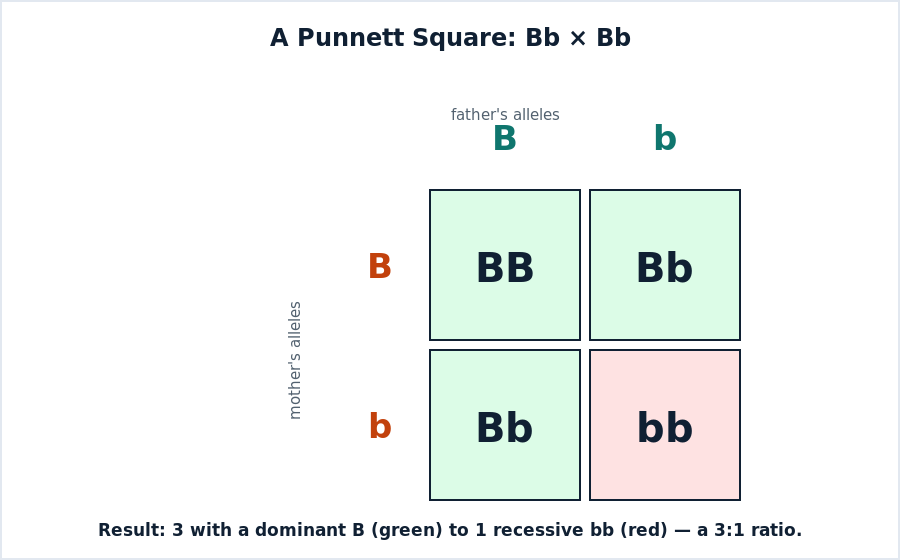
The four boxes come out BB, Bb, Bb, and bb. Three of the four have at least one dominant B, so they show the dominant trait; only the bb box shows the recessive trait. That is the classic 3:1 ratio — a result the test asks about again and again.
Reading the Results as Chances
Each box represents an equally likely outcome, so you can read the square as probability. In the cross above, there is a 3 out of 4 (75%) chance of the dominant trait and a 1 out of 4 (25%) chance of the recessive trait. This is where genetics meets probability — each offspring has these chances independently.
Watch: A Short Video Lesson
The Organic Chemistry Tutor walks through this skill clearly in a few minutes. It is a helpful companion to the reading above:
A Routine for Punnett Square Questions
- Write each parent’s alleles: capital = dominant, lowercase = recessive.
- Put one parent across the top, the other down the side.
- Combine the letters in each box.
- Count outcomes to get the ratio or the probability of each trait.
Practice
- What is an allele?
- Which allele shows its trait with only one copy: dominant or recessive?
- Is Bb homozygous or heterozygous?
- In a Bb x Bb cross, what is the ratio of dominant to recessive offspring?
- What is the chance of a recessive (bb) offspring in that cross?
- What is the difference between genotype and phenotype?
Answers
- A version of a gene.
- Dominant.
- Heterozygous.
- 3:1.
- 1 out of 4 (25%).
- Genotype is the allele pair; phenotype is the trait shown.
Where This Fits in Your Science Prep
Punnett squares build on heredity and DNA and are really a form of basic probability. See all topics on the Science Topics Hub.

Related to This Article
More math articles
- Free Grade 4 English Worksheets for Illinois Students
- Chapter 13: The Federal Bureaucracy
- ACT Calculators: Expert Tips
- Free Grade 5 English Worksheets for Texas Students
- Praxis Core Math Worksheets: Free Printable PDFs
- How to Prepare for the PSAT Math Test?
- Demographic Transition and the Population-Resource Debate
- Retracting and Exposing Instruments
- 7th Grade STAAR Math Practice Test Questions
- The Best Grade 4 Math Book for Rhode Island Students





















What people say about "Genes, Alleles, and Punnett Squares"?
No one replied yet.