The Electromagnetic Spectrum and Energy Sources
Visible light is only a tiny sliver of a much larger family of waves called the electromagnetic spectrum. From the radio waves that carry music to the gamma rays from space, all of these are the same kind of wave — they just differ in wavelength and energy. This lesson maps the spectrum and touches on where our energy comes from.
One Spectrum, Many Waves
The electromagnetic spectrum runs from long, low-energy waves to short, high-energy waves. In order of increasing energy: radio waves, microwaves, infrared, visible light, ultraviolet, X-rays, and gamma rays. The longer the wavelength, the lower the energy; the shorter the wavelength, the higher the energy.
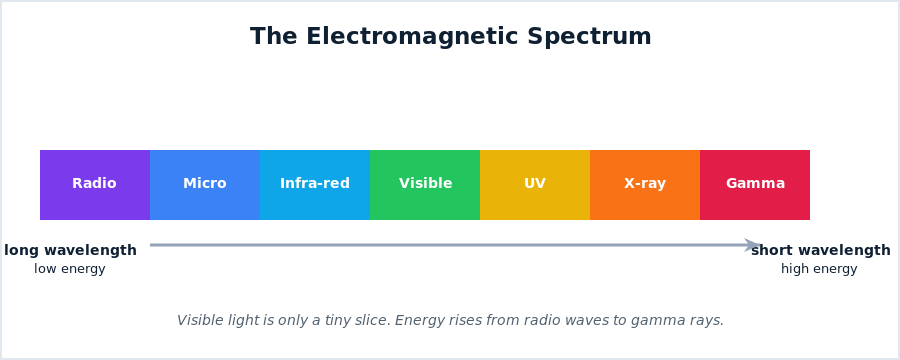
Two useful facts: visible light — the only part our eyes can see — is a very small band in the middle, and the high-energy waves like X-rays and gamma rays can be dangerous because they carry so much energy.
Everyday Examples
Each band has familiar uses. Radio waves carry broadcasts and phone signals. Microwaves cook food and carry data. Infrared is felt as heat and used in remote controls. Visible light lets us see. Ultraviolet causes sunburn. X-rays image bones. Gamma rays come from nuclear reactions and space. Matching a use to its band is a common test task.
Energy Sources
Finally, a note on where usable energy comes from. Renewable sources — solar, wind, hydroelectric, geothermal — are replaced naturally and do not run out. Nonrenewable sources — coal, oil, natural gas (fossil fuels) — exist in limited amounts and release pollution when burned. The Sun is the ultimate source of most of Earth’s energy, powering everything from plants to weather. Questions may ask you to sort a source as renewable or nonrenewable.
Watch: A Short Video Lesson
I Teach You Science walks through this skill clearly in a few minutes. It is a helpful companion to the reading above:
A Routine for These Questions
- Order the spectrum by energy: radio, microwave, infrared, visible, UV, X-ray, gamma.
- Longer wavelength = lower energy; shorter wavelength = higher energy.
- Visible light is a small band; high-energy waves can be harmful.
- Renewable sources refill naturally; nonrenewable (fossil fuels) run out.
Practice
- Which has more energy: radio waves or gamma rays?
- What part of the spectrum can our eyes see?
- Which type of wave is used to image bones?
- Does a longer wavelength mean higher or lower energy?
- Name one renewable energy source.
- Are fossil fuels renewable or nonrenewable?
Answers
- Gamma rays.
- Visible light.
- X-rays.
- Lower energy.
- Any of: solar, wind, hydroelectric, geothermal.
- Nonrenewable.
Where This Fits in Your Science Prep
The electromagnetic spectrum builds on waves, and energy sources connect to Earth science topics like natural resources. See all topics on the Science Topics Hub.

Related to This Article
More math articles
- Power Tool Care: Inspect Before You Use It
- World War I and World War II
- Top 10 Tips to Overcome CLEP College Math Anxiety
- How To Check Your Work During Math Exams?
- Kansas KAP Grade 8 Math Free Worksheets: 72 Free Printable Worksheets with Step-by-Step Keys
- 10 Most Common CBEST Math Questions
- The Ultimate PSAT Math Formula Cheat Sheet
- Growing Patterns
- Number Properties Puzzle – Challenge 8
- Strict and broad construction





















What people say about "The Electromagnetic Spectrum and Energy Sources"?
No one replied yet.