Channels and Carriers: Facilitated Diffusion and Saturation
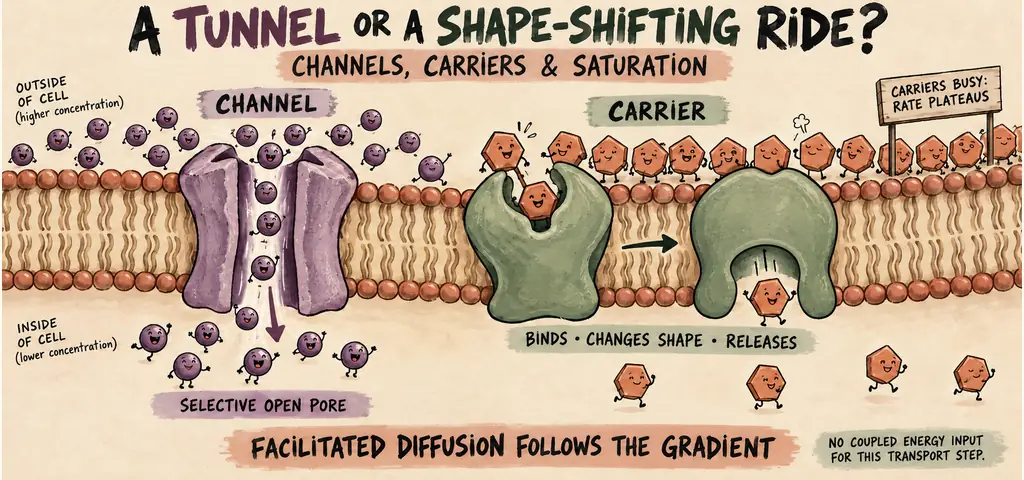
Facilitated diffusion uses a channel or carrier to move a substance down its electrochemical gradient without a coupled energy input. Channels provide pores; carriers bind solutes and alternate access between sides. A leveling rate curve supports a capacity limit, but cannot by itself prove active transport or establish an exact maximum.
A red blood cell uses glucose transport proteins to provide a faster route than glucose could take through the lipid bilayer alone. The glucose is still moving downhill, from a higher concentration in the plasma to a lower concentration inside the cell where it is immediately phosphorylated and consumed. The downhill carrier step does not hydrolyze ATP, although maintaining the cell and metabolizing glucose cost energy. Glucose transport proteins provide that faster route.
Watch the process
Transport Across Cell Membranes
Facilitated diffusion is passive movement of a substance down its electrochemical gradient through a membrane protein. For ions, the gradient has two components. An electrochemical gradient is the combined downhill direction for a particle, set by its concentration difference across the membrane and, if the particle carries a charge, by the voltage across the membrane as well. For an uncharged solute such as glucose the two collapse into one and the electrochemical gradient is just the concentration gradient; for an ion you have to consider both, so an ion’s direction of movement depends on concentration and voltage. Passive means the transport step requires no coupled energy input. Down its gradient means the direction is set by physics, not by the protein. Through a protein means the substance is one the bilayer would otherwise exclude: an ion, a large polar molecule, or water at a useful rate.
A transport protein can provide a passive route across the membrane. The electrochemical gradient supplies the driving force for net movement through that route. Making and maintaining the protein costs the cell energy, but the facilitated-diffusion step itself does not require a coupled energy input.
Two Kinds of Protein, Two Behaviors
Channel proteins form a hydrophilic pore straight through the membrane. The pore is lined with polar and charged residues, so an ion can pass without ever contacting the lipid core, and the protein does not change shape around each passenger. Open ion channels can transport ions rapidly and selectively; their rates depend on the channel and the electrochemical driving force. A potassium channel admits potassium and rejects sodium even though sodium is the smaller ion, because the pore’s geometry is tuned to replace potassium’s hydration shell exactly and cannot do the same for sodium.
Many channels are gated, meaning they open and close in response to a signal rather than standing permanently open. A voltage-gated channel responds to a change in the voltage across the membrane (the membrane potential) which is how a neuron fires. A ligand-gated channel opens when a specific molecule binds it, which is how a synapse works. A mechanically gated channel opens when the membrane is stretched or bent, which is how a hair cell in your ear reports sound. Gating gives the cell control over a process that is otherwise purely physical: the direction stays set by the gradient, but the cell decides when the route exists.
Carrier proteins work differently. A carrier binds its solute on one side, undergoes a conformational change, and releases it on the other side. It never forms an open tunnel; the binding site is exposed to one side at a time. This alternating-access cycle limits carrier throughput and allows saturation when substrate availability exceeds the carriers’ transport capacity.
Saturation, and the Graph That Tests It
Because a carrier has a finite number of binding sites, facilitated diffusion through a carrier saturates: raise the external concentration far enough and every site is occupied at essentially all times, so the transport rate levels off at a maximum set by how fast the protein can cycle. Simple diffusion has no carrier-binding-site saturation. Its rate is approximately proportional to the gradient while permeability and other conditions stay fixed.
Compare the shapes of the two curves. Two curves, transport rate on the \(y\) axis and external solute concentration on the \(x\) axis. One rises as a straight line and never bends. The other rises steeply, then bends over and flattens. The straight line is consistent with simple diffusion through lipid. The flattening curve suggests a saturable transport process, and its plateau depends on both transporter number and turnover rate. A carrier measured below saturation can also look approximately linear.
Reading Transport Kinetics from Numbers
A membrane’s uptake of solute Z is measured at five external concentrations. The rates, in arbitrary units, are: at \(1\ \text{mM}\), 18; at \(2\ \text{mM}\), 33; at \(4\ \text{mM}\), 55; at \(8\ \text{mM}\), 72; at \(16\ \text{mM}\), 78. A second solute, W, gives 5, 10, 20, 40, and 80 at the same concentrations. Identify the transport mechanism for each and estimate the maximum rate for Z.
Test each data set for proportionality before interpreting anything. For W, doubling the concentration doubles the rate every single time: 5 to 10, 10 to 20, 20 to 40, 40 to 80. That is a straight line through the origin with no sign of bending, which is consistent with simple diffusion over this range, although an unsaturated carrier could also give a nearly linear response.
Now do the same arithmetic for Z. From 1 to 2 mM the rate goes from 18 to 33, a factor of 1.8 rather than 2. From 2 to 4 it goes 33 to 55, a factor of 1.7. From 4 to 8, 55 to 72, a factor of 1.3. From 8 to 16, 72 to 78, a factor of only 1.08. The returns are shrinking toward nothing, which is the signature of saturation.
The last doubling adds only 6 units, so the data suggest an approaching plateau. Roughly 80 units is a visual estimate for this classroom example, not a measured maximum or a fitted asymptote. These five points alone do not establish the true ceiling or the rate at 32 mM. Further concentrations, replicate measurements and assay controls would help test the saturation model.
One inference you may not draw: saturation does not tell you the transport was active. Both carriers and pumps saturate. A plateau supports a capacity limit; controls are needed to distinguish carrier saturation from another limitation in the assay.
Answer
W is consistent with simple diffusion, shown by proportionality within the tested range. Z is consistent with saturable protein-mediated transport, shown by diminishing returns, with a tentative visual plateau estimate near 80 units under the assumed saturation model. The data do not distinguish a passive carrier from a pump.
A Competitor for the Transporter
A carrier that imports glucose is presented with glucose alone, and then with glucose plus galactose, a similar sugar that the same carrier also binds. Glucose uptake falls. A student concludes that galactose has poisoned the carrier. Evaluate that, then predict what raising the glucose concentration would do.
Start from what the carrier is doing mechanically. It has a binding site with a shape that fits certain sugars. Galactose fits it. So at any instant, some fraction of the carriers are occupied by galactose rather than glucose, and those carriers are unavailable to glucose. Uptake falls without anything being damaged.
Shared binding sites make competition a plausible explanation without requiring carrier damage. The term “poison” does not identify a specific molecular mechanism.
If the sugars compete for the same sites, adding excess glucose should make glucose more likely to occupy a newly available site. Uptake should therefore recover toward the original maximum. This response supports competition, but does not prove that every carrier is undamaged or exclude every other mechanism.
Answer
Shared carrier sites make competition plausible. Recovery of glucose uptake with excess glucose would support that explanation; the uptake experiment alone does not directly measure carrier structure.
The Confusion to Clear Up Here
The presence of a transport protein does not establish active transport. Facilitated diffusion moves a solute downhill without a coupled energy input. To classify an unfamiliar carrier, inspect both gradient direction and energy coupling. Primary active transport couples transport to an energy source such as ATP hydrolysis. Secondary active transport couples one solute’s downhill movement to another solute’s uphill movement. One downhill passenger does not make the entire coupled process passive.
A channel provides a route; a pump couples transport to an energy source. Both are membrane proteins and both can be regulated, which is why the words blur. A channel provides an open route and the gradient does the work. A pump binds, spends energy, and forces the solute the other way. A useful check: a channel opening lets the system move toward equilibrium, while a pump running moves the system away from equilibrium.
Review: Facilitated Diffusion: Channels, Carriers, and Saturation
A passive channel or carrier provides a route through a barrier; the solute’s gradient drives its net movement.
With gradients and other conditions held fixed, changing the number of open channels changes conductance, while changing carrier number changes transport capacity. A passive route does not set the equilibrium; actual cells can maintain gradients through metabolism and active transport.
Do not classify transport as active because a protein is named. Check the solute’s gradient and whether transport is coupled to an energy source or another gradient.
Facilitated diffusion
Practice question 1
As external solute concentration rises, the uptake rate through a carrier protein levels off while simple diffusion of a nonpolar molecule keeps rising. The leveling off occurs because
-
the carrier runs out of ATP
-
the concentration gradient reverses direction
-
all carrier binding sites become occupied
-
the membrane loses fluidity at high concentration
Practice question 2
Glucose enters a red blood cell through a GLUT carrier, moving from a higher glucose concentration in the plasma to a lower concentration in the cytosol without coupling to ATP hydrolysis or another solute gradient. This transport is best classified as
-
primary active transport, because a protein is required
-
facilitated diffusion, because the movement is down the gradient and this transport step requires no coupled energy input
-
secondary active transport, because the sodium gradient supplies the energy
-
simple diffusion, because glucose is uncharged
Practice question 3
A potassium channel admits potassium ions but excludes sodium ions, which are smaller. The best explanation is that
-
sodium ions are repelled by the negative charge of the cell interior
-
the pore’s dimensions and lining match the energy cost of stripping potassium’s hydration shell but not sodium’s
-
sodium ions are too large to fit through the pore
-
the channel hydrolyzes ATP only when potassium binds
Practice answer key
1. C; 2. B; 3. B.
Practice answer explanations
-
Facilitated diffusion, Question 1. Choice C is correct. A carrier has a finite number of binding sites, so once every site is occupied the rate cannot rise further and the curve plateaus. Choice A imports ATP into a process that does not use it. Choice B contradicts the stated rise in external concentration. Choice D invents a concentration-dependent change in fluidity.
-
Facilitated diffusion, Question 2. Choice B is correct. The glucose moves down its concentration gradient without a coupled energy input to this transport step, so it is passive even though a protein provides the route. Maintaining the cell and metabolizing glucose still require energy. Choice A is the central misconception of this topic, that requiring a protein makes transport active. Choice C invokes coupling to a sodium gradient that the stem explicitly excludes. In secondary active transport, downhill movement of one solute can drive uphill movement of another. Choice D calls it simple diffusion, but glucose is large and polar and does not cross the lipid core at any useful rate.
-
Facilitated diffusion, Question 3. Choice B is correct. The pore’s geometry replaces potassium’s hydration shell at low energy cost and cannot do the same for sodium, so selectivity comes from the fit between the pore lining and the hydrated ion. Choice A appeals to interior negative charge, which would attract both cations rather than sorting them. Choice C claims sodium is too large, but sodium is the smaller ion, which is the point of the question. Choice D gives a channel an ATP-hydrolyzing activity that belongs to pumps.
Continue your review at the AP Biology study hub.
Connect Transport to Other Biology Models
For water moving through a membrane, work through calculating water potential. To compare saturation and competition in another protein system, review enzyme kinetics and inhibition; similar curve shapes do not prove identical mechanisms.
Sources for Further Study
OpenStax covers passive transport, channels and carrier proteins. Molecular Biology of the Cell explains membrane transport principles and energy coupling.

Related to This Article
More math articles
- How to Pass the GED Math Test in 30 Days (A Realistic Plan, Not a Cram Session)
- How to Find Volume by Spinning: Disk Method
- The Ultimate CLEP College Algebra Course (+FREE Worksheets & Tests)
- Relationships and Populations
- Top 10 5th Grade MAP Math Practice Questions
- Algebra Puzzle – Challenge 45
- How to Identify Shop Tools From Their Shapes
- 7th Grade MCA Math Worksheets: FREE & Printable
- Georgia Georgia Milestones Algebra 1 Free Worksheets: Free Printable Algebra 1 PDFs Covering Every Skill
- Grade 6 Math: Dot Plots








What people say about "Channels and Carriers: Facilitated Diffusion and Saturation"?
No one replied yet.