Society and Social Structure
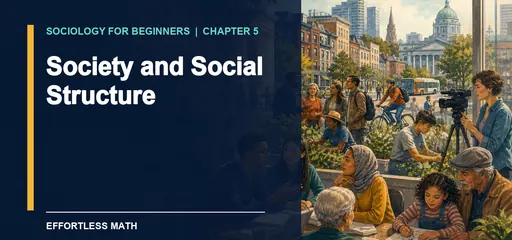
Chapter 5 of the Sociology for Beginners study guide on Effortless Math covers Society and Social Structure: the key terms, the core ideas, and worked examples showing how this topic is tested on this course.
Sociology for Beginners · Chapter 5
Society and Social Structure
A society is a population whose members share a territory or social world, interact through enduring institutions, and recognize an organized life together. A country may contain more than one cultural community, and a cultural community may cross several countries. Society therefore points to an organized web of relationships rather than a claim that everyone shares one identity or agrees on every value.
Social structure is the recurring arrangement of institutions, positions, roles, networks, and inequalities that shapes social life. Structure becomes visible when a pattern survives the arrival and departure of particular people. Students graduate, teachers retire, and principals change, yet the school still has grade levels, schedules, credentials, authority, and funding rules. Those recurring relations form a structure.
Structure sets conditions without writing a script for every action. A bus route makes some trips easier, a credential rule opens some jobs, and a family obligation changes the cost of an evening shift. People interpret those conditions, improvise, resist, and sometimes change them. Sociology studies that meeting between patterned arrangements and agency.
Societies have changed as people developed new ways of producing food, organizing work, and coordinating large populations. Hunting-and-gathering societies generally rely on small mobile groups and flexible divisions of labor. Horticultural and pastoral societies use cultivated plants or domesticated animals. Agrarian societies organize intensive agriculture, larger settlements, political hierarchy, and surplus. Industrial societies use mechanized production and expand wage labor, cities, schools, corporations, and bureaucratic states. In a postindustrial society, service, knowledge, information, and professional work occupy a larger share of employment, though material production, farming, energy, and transport remain essential.
These categories are ideal types. Real societies combine forms. A software engineer may use cloud computing built on mined minerals, factory-made devices, electrical grids, and agricultural systems. Calling an economy postindustrial describes a shift in employment and value creation. It does not mean that physical labor has vanished. Some production may have moved to other countries, which can hide industrial dependence rather than end it.
Technology alone does not create a social type. Property, law, kinship, power, education, and culture shape how a tool is adopted. Irrigation can support shared management in one setting and concentrated control in another. A sociological explanation names the institution that turns a technical possibility into a recurring social arrangement.
Quick review: Ask what persists when the people change. A recurring position, rule, network, or institution points toward structure. Then ask how a person acts within it and what evidence would show the structure changing.
Watch the lesson connection
How Society Shapes Everyday Life gives you a second explanation of the ideas surrounding this lesson. As you watch, pause when the lesson concept appears and explain how the example fits.
Try the idea yourself
Write one original example, one close nonexample, and one observation that would help you tell them apart. That small exercise turns a definition into a sociological tool you can use in daily life.

Related to This Article
More math articles
- Algebra Puzzle – Challenge 38
- How to Get a GED Certificate?
- Rounding Numbers
- Schools
- How to Write Two-variable Inequalities Word Problems?
- Free Grade 4 English Worksheets for Louisiana Students
- The Best Grade 8 Math Book for Idaho Students
- Best Calculator For 8th Grade Students
- Civil service
- Question Types and the Test Interface






















What people say about "Society and Social Structure"?
No one replied yet.