Fluid Mosaic Model: Membrane Structure and Fluidity
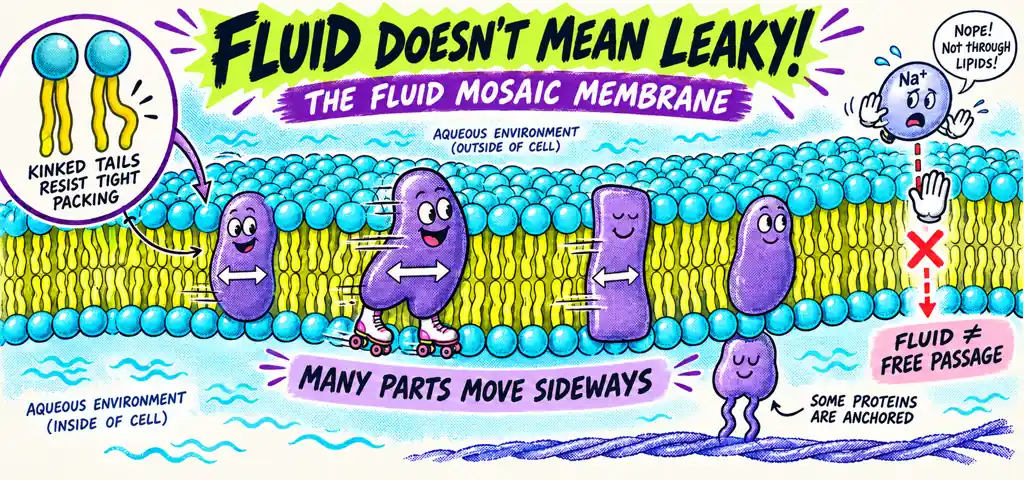
The fluid mosaic model describes a phospholipid bilayer with mobile lipids and many mobile proteins. Some proteins are anchored or confined, and the two membrane faces have different compositions. Fluidity describes movement within the membrane; permeability describes passage across it.
Separate Structure, Motion and Passage
- Identify the component: lipid tails, cholesterol, a membrane protein or an external carbohydrate chain.
- Ask which property was measured: lateral mobility, packing, transport rate or permeability to a particular solute.
- Keep temperature and lipid composition in the comparison. Cholesterol’s familiar buffering rule is a teaching model, not a universal numerical temperature threshold.
- Distinguish an observation from a prediction. Protein-label mixing supports mobility; water temperature alone does not measure a fish’s lipid composition.
The fluid mosaic model describes a cell membrane as a phospholipid bilayer in which proteins drift laterally rather than sitting in fixed positions. Below: why the bilayer forms at all, the evidence that it is fluid rather than rigid, and how cold water changes a fish’s membranes.
Watch the process
Cell Membranes
A phospholipid has a polar head and nonpolar hydrocarbon tails. In water, suitable phospholipids can form a bilayer with the heads exposed to water on both sides and the tails sheltered between them.
This self-assembly helps explain the phospholipid bilayer. A living cell also synthesizes lipids, inserts proteins, and maintains membrane composition. The bilayer’s basic arrangement follows from molecular interactions; building and maintaining a working plasma membrane involves cellular machinery too.
The fluid mosaic model names two facts about that sheet. It is fluid: the phospholipids drift laterally within their leaflet, and most embedded proteins drift with them, so the membrane behaves like a two-dimensional liquid rather than a wall. It is a mosaic: proteins, cholesterol, and carbohydrate groups are distributed unevenly rather than arranged in a rigid repeating lattice. Their proportions differ among membranes. Cells can also organize membrane domains and anchor particular proteins, so fluid does not mean completely random or freely moving in every location.
Tail structure and cholesterol are two important influences on fluidity; temperature, tail length and the rest of the lipid mixture also matter. Unsaturated fatty-acid tails carry cis double bonds that kink the chain and prevent close packing, so a membrane rich in them stays fluid at lower temperatures. Saturated tails are straight, pack tightly, and stiffen the membrane. Cholesterol does something less intuitive: it is a fluidity buffer. At high temperature it restrains phospholipid movement and reduces fluidity; at low temperature it wedges between tails, prevents them from packing into a gel, and maintains fluidity. One molecule, two opposite effects, depending on which way the temperature is pushing.
Self-assembly also helps explain how a small bilayer defect can close. Because the bilayer is held together by hydrophobic exclusion rather than by covalent bonds between neighbors, a small defect in a simple bilayer can seal itself; larger wounds in living cells often require active repair. The exposed tails at the edge of a hole are in exactly the situation water will not tolerate, so the sheet flows shut. A membrane is self-healing for the same reason it is self-assembling.
How We Know the Membrane Is Fluid (Science Practice 4)
Consider this simplified classroom scenario inspired by the classic mouse–human cell-fusion experiment of Frye and Edidin. The colors, times and temperatures below define the teaching example; they are not a reproduction of the original paper’s full data set. Researchers fuse a mouse cell with a human cell and follow labeled surface proteins. Mouse membrane proteins were tagged with a green fluorescent marker and human membrane proteins with a red one. Immediately after fusion, the hybrid cell showed a green half and a red half with a sharp boundary. Forty minutes later at \(37^\circ\text{C}\), green and red were evenly intermixed over the whole surface. When the same experiment was repeated at \(1^\circ\text{C}\), the two halves stayed separate. What claim do these data support, and what does the cold control add?
Claim. Membrane proteins are not fixed in place; they can move laterally within the membrane, consistent with fluid behavior.
Evidence. An initially sharp boundary between two protein populations disappeared within forty minutes at body temperature, and the same mixing failed to occur at \(1^\circ\text{C}\).
Reasoning. Intermixing is consistent with lateral diffusion of existing membrane proteins. Cooling slows the mixing, supporting temperature-dependent mobility. The cold comparison alone does not rule out active transport, protein turnover, or label redistribution, because those processes can also be temperature-sensitive. Additional controls, such as testing label stability and monitoring mixing while new protein synthesis is blocked, help distinguish the alternatives.
Note the limit. These data show that many proteins can move. They do not show that all of them do, and in fact some membrane proteins are anchored to the cytoskeleton and stay put, which later work established.
Conclusion
Lateral intermixing of two labeled protein populations after fusion, abolished by cold, supports a fluid bilayer in which proteins diffuse rather than a static one in which they are fixed.
Cold Water and a Fish’s Membranes
Two populations of the same fish species live in water at \(4^\circ\text{C}\) and at \(24^\circ\text{C}\). Predict how their membrane phospholipids differ, and explain how adding cholesterol to an otherwise matched cold membrane could affect its tendency to gel.
Start from the failure mode you are trying to avoid. Cold packs phospholipid tails tightly and pushes the membrane toward a gel, and a gelled membrane cannot let transport proteins change shape or let vesicles fuse. The cold-water fish therefore needs something that prevents close packing.
That points at tail structure. A cis double bond puts a permanent kink in a hydrocarbon tail, and kinked tails cannot stack neatly against one another. A reasonable prediction is a higher proportion of cis unsaturated fatty-acid tails in the cold-water population. Shorter tails could also reduce packing interactions, but the temperatures alone do not establish its actual tail lengths or composition; lipid measurements would test these predictions.
Consider how cholesterol affects fluidity at the stated temperature. Cholesterol is a buffer, not a fluidizer. At high temperature it restrains movement and lowers fluidity; at low temperature it inserts between tails and prevents them from packing into a gel, so it raises fluidity. In a matched cold-membrane comparison, adding cholesterol can oppose tight packing. The data do not establish that a natural fish population must change its cholesterol content; other compositional changes can also maintain fluidity.
Answer
For the \(4^\circ\text{C}\) population, increased cis unsaturation is a plausible cold-adaptation prediction; shorter tails are another possible adjustment, not an observed result. In an otherwise matched bilayer tending to gel, cholesterol can oppose tight packing. The fish’s actual response requires composition measurements.
What the Proteins Do
Membrane proteins carry out most of the membrane’s specific work. Integral proteins are embedded in the bilayer; transmembrane proteins span it, held there by a stretch of nonpolar amino acids that matches the hydrophobic core. Peripheral proteins sit on one face, bound to the lipid heads or to an integral protein. Common membrane-protein functions include transport, enzymatic activity, signal reception, cell-to-cell recognition, intercellular joining, and attachment to the cytoskeleton or extracellular matrix. In the plasma membrane, carbohydrate chains on glycoproteins and glycolipids face the extracellular side, and their specific patterns are what one cell reads on another during recognition. That asymmetry is real and worth remembering: the two faces of a membrane are chemically different, and a protein inserted one way stays that way.
The Confusion to Clear Up Here
Fluidity and permeability describe different membrane properties. Fluidity is about whether the components of the membrane can move within the plane of the sheet. Permeability is about whether a substance can pass through the sheet from one side to the other. A membrane can be extremely fluid and still refuse to let a sodium ion across, and that is in fact the normal condition. When a stem tells you a treatment increased fluidity, do not conclude that ions now leak in. Look for evidence about lateral mobility. A fluidity change may affect protein activity or membrane fusion, but does not by itself measure those outcomes or prove that ions cross the bilayer.
Cholesterol’s effect depends on temperature: at high temperature cholesterol decreases fluidity, and at low temperature it increases it. One molecule, opposite effects, because in both cases it is resisting whatever the temperature is doing.
Review: The Fluid Mosaic Membrane
The membrane is a self-assembling two-dimensional fluid whose lipid composition sets how easily its parts move.
Change tail saturation, tail length, cholesterol content, or temperature and you change fluidity, which can affect the activity and mobility of embedded proteins.
Do not read “fluid” as “leaky.” Fluidity describes movement within the sheet, not passage across it.
Membrane structure and fluidity
Practice question 1
Two membrane samples are held at \(8^\circ\text{C}\). Sample 1 stays fluid while sample 2 becomes gel-like. The most likely difference is that sample 1 has
-
a higher proportion of cis unsaturated fatty-acid tails
-
longer and more fully saturated tails
-
more carbohydrate groups on its outer face
-
fewer integral proteins spanning the bilayer
Practice question 2
In a simplified comparison where the phospholipid bilayer is in its fluid state at 40°C, a membrane rich in cholesterol is warmed from \(20^\circ\text{C}\) to \(40^\circ\text{C}\). Compared with an otherwise identical membrane containing no cholesterol, the cholesterol-rich membrane at \(40^\circ\text{C}\) will be
-
less fluid, because cholesterol restrains phospholipid movement at high temperature
-
more fluid, because cholesterol wedges the tails apart and so raises fluidity at every temperature
-
identical in fluidity, because cholesterol changes permeability rather than lipid movement
-
less fluid, because cholesterol converts unsaturated tails into saturated ones
Practice question 3
A transmembrane protein has a central stretch of about twenty nonpolar amino acids. That stretch most likely
-
binds the protein to extracellular carbohydrate
-
forms the water-filled pore through which ions pass
-
anchors the protein within the hydrophobic core of the bilayer
-
marks the protein for digestion by a lysosome
Practice answer key
1. A; 2. A; 3. C.
Practice answer explanations
-
Membrane structure and fluidity, Question 1. Choice A is correct. Cis double bonds kink the tails, prevent close packing, and keep a membrane fluid as temperature falls. Choice B describes the composition that stiffens a membrane. Choice C attributes fluidity to external carbohydrate tags, which do not sit in the hydrophobic core. Choice D confuses protein content with lipid packing.
-
Membrane structure and fluidity, Question 2. Choice A is correct. Under the fluid-state conditions specified in the question, cholesterol restrains phospholipid movement, so the cholesterol-rich membrane is the less fluid of the two at \(40^\circ\text{C}\). Choice B states the low-temperature effect as though it ran in one direction at every temperature, which is the standard misreading of cholesterol. Choice C assigns cholesterol to permeability alone and denies its effect on lipid packing. Choice D reaches the right direction by the wrong route, since cholesterol sits between the tails and changes how they pack rather than changing the tails themselves; cholesterol itself does not chemically convert the tails from unsaturated to saturated.
-
Membrane structure and fluidity, Question 3. Choice C is correct. A run of nonpolar residues matches the hydrophobic interior of the bilayer and anchors the protein there, which is what makes a protein transmembrane. Choice A would require polar or charged residues to bind carbohydrate. Choice B describes a hydrophilic pore, which nonpolar residues cannot line. Choice D invents a degradation signal unrelated to hydrophobicity.
Continue your review at the AP Biology study hub.
Follow Structure into Transport
See how membrane proteins provide selective routes in channels, carriers and saturation. For the direction of net water movement, use water-potential calculations; membrane fluidity alone does not supply that direction.
Sources for Further Study
OpenStax explains membrane components, asymmetry and fluidity. The original Frye and Edidin cell-fusion study is a historical source for lateral intermixing of surface antigens.

Related to This Article
More math articles
- Full-Length 8th Grade Common Core Math Practice Test
- Chapter 24: Equal Protection and Civil Rights
- Magic Square Puzzle — Make Every Line Equal
- Indeterminate vs. Undefined Limits: 0/0, Infinity and DNE
- How Right Triangles Demonstrate Similarity
- 6th Grade NSCAS Math Worksheets: FREE & Printable
- Integrals: Complete Explanation of the Applications and Use
- PERT Math Formulas
- How Does ALEKS Grading Work?
- 6th Grade SBAC Math Worksheets: FREE & Printable









What people say about "Fluid Mosaic Model: Membrane Structure and Fluidity"?
No one replied yet.