Cell Communication: Contact, Local and Endocrine Signals
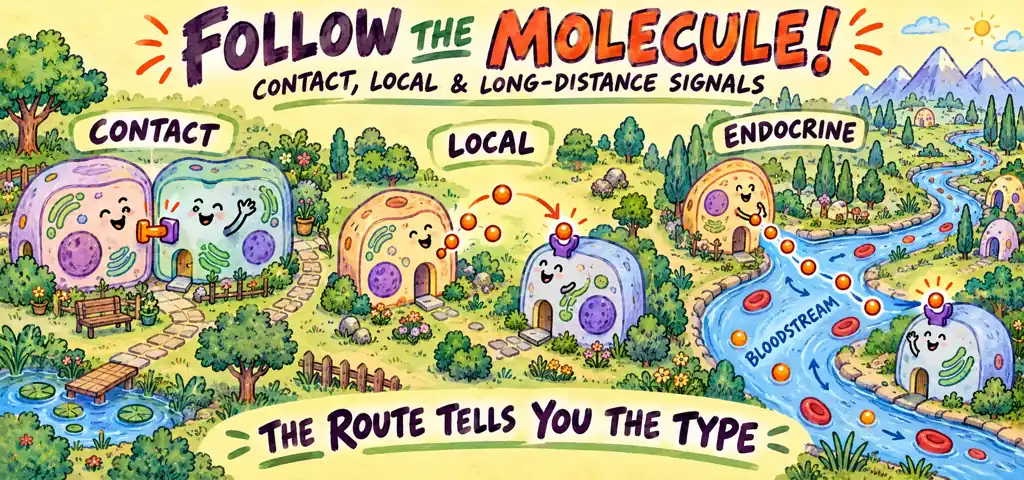
Contact, paracrine, synaptic and endocrine signaling describe different routes of cell communication. Direct contact connects adjacent cells; paracrine signals act nearby; neurotransmitters cross a synaptic cleft; endocrine hormones travel through circulation. Receptor and pathway differences help explain which cells respond.
When you stand up, pressure changes detected in blood vessels can trigger a rapid adjustment of heart activity. Electrical signals travel along neurons, and chemical messengers transmit signals between cells. The coordinating information is carried by physical changes in molecules and ion movement; it does not travel independently of matter.
Watch the process
Cell Communication
Cells coordinate their activities through signals. In chemical signaling, one cell releases or displays a molecule that another cell detects. The signaling molecule is a ligand; the protein that recognizes it is a receptor. The responding cell also needs the internal machinery that links detection to a response.
Distinguish signaling modes by the route taken by the chemical messenger and the relationship between the sending and receiving cells.
Signaling by Direct Contact
Adjacent cells can communicate through direct cytoplasmic connections or through contact between surface molecules. In animals, gap junctions are protein channels that connect the cytoplasm of adjacent cells, so ions and small molecules pass directly from one interior to the other. Plants do the same thing through plasmodesmata, channels through adjacent cell walls. A second contact mechanism uses no channel at all: a membrane-bound molecule on one cell binds a receptor on the surface of another. Immune cells recognize one another this way, and developing tissues use it to tell neighboring cells apart.
Contact signaling requires physical adjacency, so it cannot reach a distant cell no matter how many receptors that cell carries.
Local Signaling
A cell can also secrete a ligand into the extracellular fluid, where it diffuses a short distance and acts on nearby cells. This is paracrine signaling. Some growth factors act locally and can stimulate nearby responsive cells to divide; the outcome depends on the signal and the receiving cell.
Synaptic signaling releases a neurotransmitter close to a particular target cell. A neuron releases a neurotransmitter into the synaptic cleft, a gap of a few tens of nanometers, and the transmitter binds receptors on the target cell almost immediately. The signal is chemical and local, but because the neuron’s axon can be a meter long, the effect reaches a distant part of the body. In this classification, the chemical step at the synapse is local even when the neuron carries an electrical signal over a long distance. The neurotransmitter travels across the cleft.
Long-Distance Signaling
In endocrine signaling, specialized cells release a hormone into the circulatory system, and circulation distributes the hormone to distant tissues; actual exposure depends on blood flow, transport and tissue access. Insulin, glucagon, testosterone, and epinephrine all work this way. Because the route is the bloodstream, endocrine responses often begin more slowly and persist longer than rapid synaptic responses, although timing depends on the particular pathway. It also raises a question about target-cell specificity: if a hormone is widely distributed, why do different tissues respond differently or show no measured response?
Receptors and Target-Cell Specificity
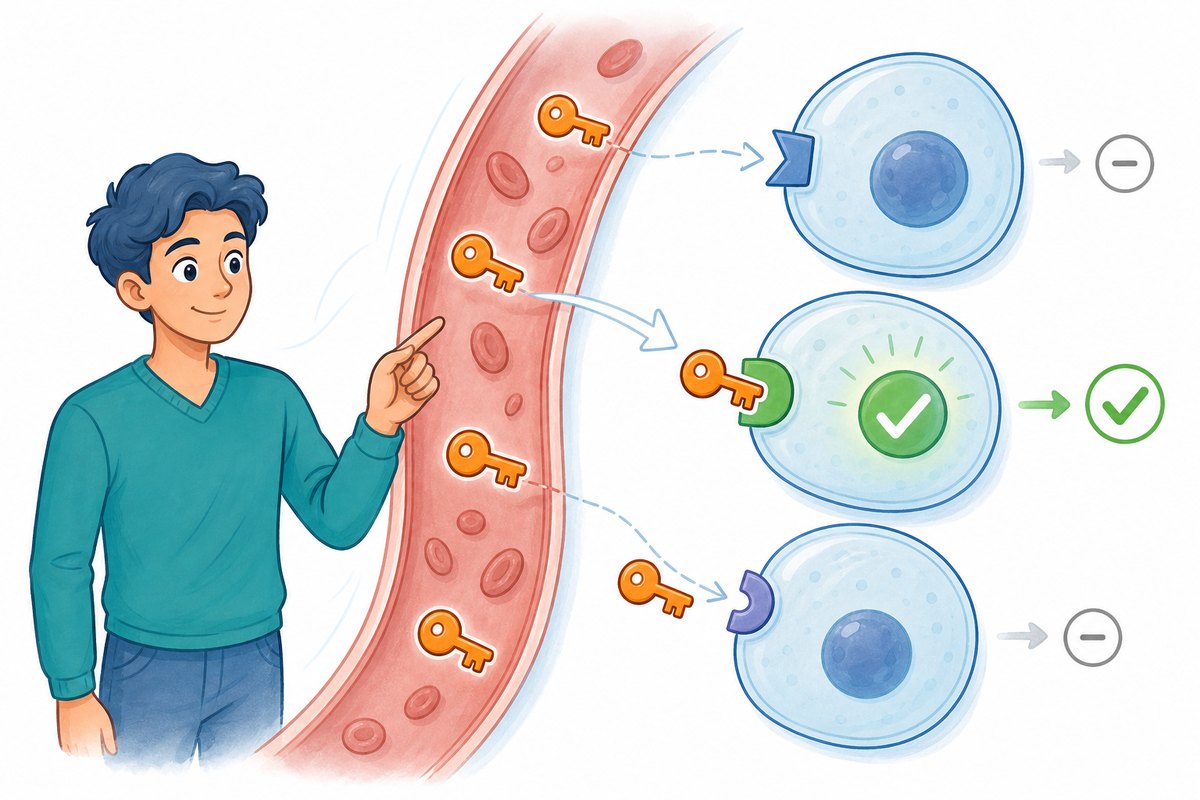
The answer is that the ligand carries no address. A cell responds to insulin only if it has an insulin receptor and the downstream machinery that receptor talks to. A cell lacking a receptor capable of detecting that hormone will not initiate that receptor-dependent response. This is ligand-receptor specificity, and it follows from the same shape-and-chemistry logic that also explains enzyme-substrate binding. Binding depends on molecular shape and chemical interactions. Receptors are selective, but a receptor can recognize more than one related ligand, and one ligand can act through different receptor subtypes.
Specificity has a second layer. Two cells can carry the same receptor and respond differently, because the response depends on the relay proteins and genes available inside each one. Epinephrine can trigger glycogen breakdown in liver and relaxation of certain blood-vessel smooth muscle. Receptor subtypes as well as downstream proteins can differ between these tissues. Interpret the response using the receptor subtype and downstream pathway in the particular tissue.
Quorum Sensing in Bacteria
Signaling is not an invention of multicellular life. In quorum sensing, bacteria produce and detect chemical signals called autoinducers. Signal concentration can reflect population density, but it also depends on production, transport, degradation and confinement. When the population is sparse, the autoinducer diffuses away and its concentration stays low. As the population grows in a confined space, the molecule accumulates, and changes in signal concentration can regulate genes involved in behaviors such as biofilm formation, bioluminescence or virulence, depending on the species and system. The response need not be identical or all-or-none in every cell.
Read that mechanism as a concentration measurement rather than a head count. The bacterium has no way to count neighbors. It measures one number, the local concentration of a molecule it makes itself, and that number happens to track density. Single-cell experiments with particular bacterial species have demonstrated signaling responses under strong confinement. Reduced signal loss can permit accumulation even at a low cell count; this is not a universal response of every bacterium in every droplet. Confinement can therefore change signaling even without a larger population.
Signals Also Build Bodies
The same three signaling ranges operate during development. A patch of embryonic tissue secretes a diffusible protein, and cells near the source see a high concentration while cells farther away see less. Different concentrations switch on different genes, so one secreted molecule produces a graded map of cell types across a field of tissue. In the immune system, a helper T cell and an antigen-presenting cell hold surface proteins against one another for minutes at a time, which is contact signaling with a long dwell time. In plants, ethylene gas diffuses from ripening fruit to neighboring fruit and accelerates their ripening too, which is why one over-ripe apple can affect the rest of the bag.
Classifying a Signal You Have Not Seen Before
A researcher describes a molecule called ATX. Cells in a damaged patch of tissue release ATX into the interstitial fluid, the fluid in the spaces between cells. It is detected by receptors on immune cells located within about 200 micrometers of the damage. ATX does not enter the bloodstream in measurable amounts, and immune cells outside that radius do not respond. Classify the signaling and defend the classification.
Start with the question that decides every one of these items: how far does the ligand itself travel? The stem gives you the answer directly, about 200 micrometers. The exact number of cell diameters depends on cell size. Here, the described local extracellular route supports a paracrine classification.
Now test each category against that number. Direct contact signaling requires the two cells to touch, either through gap junctions or through a membrane-bound ligand binding a receptor on an adjoining membrane. The responding immune cells are up to two hundred micrometers away and are not touching the damaged cells, so contact signaling is out. Endocrine signaling requires the ligand to enter the circulation and reach tissues body-wide; the stem rules this out explicitly by saying ATX does not enter the bloodstream in measurable amounts. Synaptic signaling requires a neuron and a synaptic cleft, neither of which appears here.
What is left is paracrine signaling: secretion into extracellular fluid, diffusion over a short distance, response by nearby cells that carry the receptor. Notice the second half of the evidence, which is easy to skip. Cells outside the radius do not respond, and that is what you would predict from diffusion, because concentration falls off steeply with distance from a point source. A distant response would justify checking for circulation, a relayed signal, or greater ligand spread; distance alone would not identify the route.
Answer
Paracrine signaling. The ligand is secreted, travels a short diffusion distance, and acts on nearby receptor-bearing cells. The stated route and nearby targets support this classification; a distance limit alone would not prove the transport mechanism.
Distinctions to keep clear
Distinguish how far the ligand travels from how far its effect reaches. These are not the same measurement. Use the ligand’s route to classify the signaling mode.
A motor neuron whose cell body sits in your spinal cord can contract a muscle in your foot. The effect crosses most of your body. The neurotransmitter crosses about thirty nanometers. That is synaptic, and therefore local, signaling. Epinephrine released from the adrenal gland reaches your foot as well, but it does so by traveling there in blood, which makes it endocrine. Same destination, different classification, because the classification tracks the molecule.
Response speed alone does not distinguish local from endocrine signaling. Speed is a consequence, not a definition. The timing of a response depends on release, transport, receptor activity and downstream events. If a stem describes a hormone traveling through blood, classify that route as endocrine even when the observed response is rapid.
Review: Signal Types: Contact, Local, and Long Distance
A signal is detected by a matching receptor, and the receiving cell supplies the meaning.
Change the receptor or the relay proteins and the same signal produces a different response, or none.
Do not say a hormone “tells the cell what to do.” A response depends on the target cell’s receptor and downstream pathway.
Two Tissues, One Hormone, Two Answers
A researcher exposes cultured liver cells, cells from a skeletal-muscle arteriole, and a third cell type to equal measured concentrations of epinephrine. The liver cells release glucose, the arteriole cells relax, and the third cell type shows neither measured response. Explain how receptor and pathway differences could account for these observations.
The experiment controls hormone exposure, so differences in receptor abundance, receptor subtype, or downstream machinery are candidate explanations. In the liver cell, the receptor is coupled to a pathway that activates the enzymes of glycogen breakdown, so glucose is released. In the arteriole, the receptor is coupled to a pathway that lowers smooth-muscle tension, so the vessel dilates. The third cell type may lack an appropriate receptor or downstream component, or it may produce a response the researcher did not measure. No measured response does not by itself prove that a receptor is absent. The pattern is target-cell specificity at two levels: whether the receptor is present, and what the receptor is wired to.
Answer
One circulating ligand produces three outcomes because each tissue supplies its own receptor and its own downstream pathway.
Signaling modes and specificity
Practice question 1
A neuron releases acetylcholine into a synaptic cleft 30 nanometers wide, and the transmitter binds receptors on a muscle fiber. This is best classified as
-
long-distance signaling, because the neuron’s axon extends far from the cell body
-
local signaling, because the ligand diffuses only across a very short gap to reach its target
-
direct contact signaling, because the two cells are close together
-
endocrine signaling, because the response occurs in a distant tissue
Practice question 2
A hormone circulates through the entire body, but only liver and muscle cells respond to it. The best explanation is that
-
the hormone is degraded before it reaches other tissues
-
the hormone is actively transported only into liver and muscle cells
-
only liver and muscle cells carry a receptor that binds the hormone and a pathway connected to it
-
other tissues are separated from the blood by a barrier the hormone cannot cross
Practice question 3
Gap junctions and plasmodesmata are alike in that both
-
bind soluble ligands outside the cell and activate internal kinases
-
join cells mechanically without allowing cytoplasmic exchange
-
move materials between cells only inside membrane-bound vesicles
-
allow small substances to pass between adjacent cytoplasms
Practice answer key
1. B; 2. C; 3. D.
Practice answer explanations
-
Signaling modes and specificity, Question 1. Choice B is correct. Signaling type is classified by how far the ligand itself travels, and acetylcholine crosses a gap of 30 nanometers, which is local. Choice A classifies by the length of the axon rather than by the distance the ligand moves. Choice C requires cytoplasmic continuity or membrane-to-membrane binding, and a synaptic cleft is neither. Choice D would require the ligand to enter the bloodstream and reach distant tissues.
-
Signaling modes and specificity, Question 2. Choice C is correct. A hormone carries no address, so specificity comes from which cells have a matching receptor and a pathway connected to it. Choice A proposes tissue-specific exposure differences that the stem does not establish; receptor and pathway differences are the best-supported explanation among the choices. Choice B invents an uptake step that endocrine signaling does not require. Choice D proposes a barrier that would have to exclude the hormone from most of the body’s capillary beds.
-
Signaling modes and specificity, Question 3. Choice D is correct. Gap junctions and plasmodesmata provide channels connecting adjacent cytoplasms. Choice A describes surface-receptor signaling. Choice B confuses communicating junctions with structures serving primarily mechanical attachment. Choice C substitutes vesicle transport for direct channel exchange.
Continue your review at the AP Biology study hub.
Source notes: OpenStax cell-signaling overview; single-cell confinement study in Staphylococcus aureus. The confinement result is evidence from a particular experimental system, not a universal bacterial rule.

Related to This Article
More math articles
- The 96% Slot Promise Decoded: Where the Other $4 Actually Goes
- How to Understand Vocabulary of Financial Institutions
- Pre-Algebra Formulas
- How to Find the Surface Area of Spheres?
- Socialization, the Self, and the Life Course
- The Best Grade 7 Math Book for Idaho Students
- Splitting Pairs: Eight Decisions Where Math Disagrees With Intuition
- How to Graph the Cosine Function?
- The Bay of Pigs, Berlin, and the Cuban Missile Crisis
- Using Properties to Convert Traditional and Metric Units








What people say about "Cell Communication: Contact, Local and Endocrine Signals"?
No one replied yet.