The 96% Slot Promise Decoded: Where the Other $4 Actually Goes
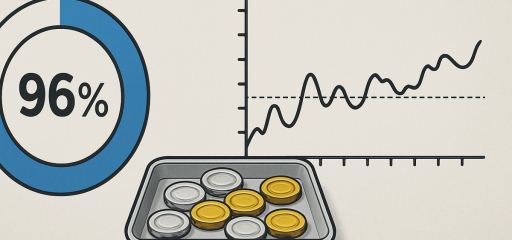
Look at any online slot listing and you’ll find the same number floating near the title: 96% RTP. Sometimes 95.5%, sometimes 96.8%, but always something close. Marketing copy treats it like a fairness badge. Players treat it like a refund schedule, drop in $100, walk out with $96, lose only the $4 you “paid for the entertainment.” That math is clean. It’s also wrong in almost every meaningful way.
What 96 percent RTP actually says is far more abstract, and far less comforting to a player who’s expecting it to behave like a tax. The number describes a game’s design behavior across an enormous sample of total wagering, the kind of sample no individual session ever reaches. Where the other $4 actually goes, how a single evening can swing thousands of dollars away from the average, why the casino loves this number more than the player should. That’s the rest of this piece.
Quick note before the math: this is educational, not gambling advice. Real-money play is for adults where it’s legal, and no statistic on a slot screen makes risk smaller than it is. If gambling stops feeling like fun, the National Council on Problem Gambling has help resources in the U.S.
What 96 Percent RTP Literally Promises
Return to player is an average. Specifically: total prizes paid out divided by total stakes wagered, measured across a huge run of plays. The UK Gambling Commission spells this out in its public guidance on return-to-player: RTP is an average achieved over a significant number of plays, not the amount a player should expect to win each time the machine is played. Their own example uses 85% to illustrate that nobody should expect 85p back from every £1 stake during a session.
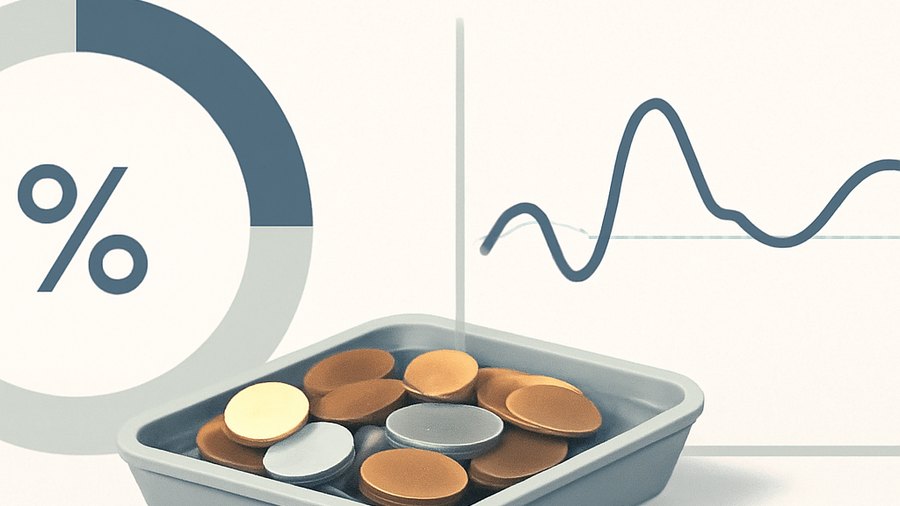
The same logic applies to 96%. The game isn’t keeping a personal ledger of your $100 with a planned $96 refund. It’s running an outcome distribution where, summed across millions or billions of spins, total prizes settle near 96% of total stakes. Your evening of 150 spins barely registers in that math.
If “expected value” sounds abstract, Effortless Math’s guide to expected value of random variables walks the concept with cleaner examples. RTP is just expected value expressed as a percentage of the wagered amount.
Deposit Size vs. Total Wagered (the $4 Trap)
Here’s where most “I lost more than I should have” stories actually live. Players quietly assume RTP applies to their deposit. It doesn’t. It applies to total wagered, also called turnover, which is usually a much larger number.
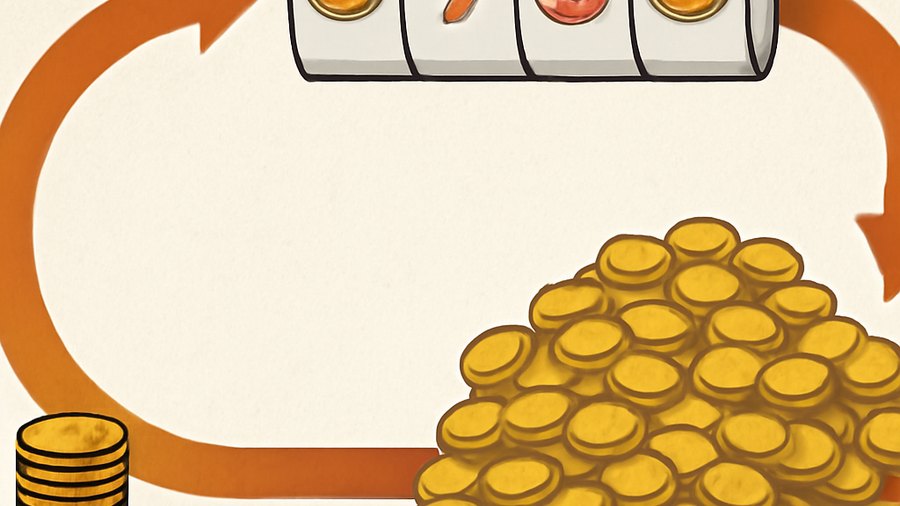
Picture a $100 deposit on a 96 percent RTP slot at $1 stakes. The first thirty spins might leave you down $20, then a couple of small wins recycle some credits, and suddenly you’ve spun ninety times instead of seventy. By the time the bankroll runs out, you might have wagered $250 total, not $100. The 4% house edge applies to that $250, so the expected long-run cost is $10, not $4. And your actual session can still be much worse, because the actual is not the expected.
| Total Wagered (Turnover) | RTP | Expected Return | Long-Run Expected Cost |
|---|---|---|---|
| $100 | 96% | $96 | $4 |
| $500 | 96% | $480 | $20 |
| $1,000 | 96% | $960 | $40 |
| $5,000 | 96% | $4,800 | $200 |
These rows aren’t promises. They’re long-run averages, the actual session result still rides on volatility. But the table makes one thing visible: a 4% house edge looks tiny on $100 and very different on $5,000 of cumulative wagering. Modern online slots can move you up that column faster than most players realize.
One Session Is a Postage Stamp on a Wall Map
A modern slot has so many possible outcome sequences that 50 or 100 spins barely sample the space. In a sample that small, the actual result can land far from the theoretical average, not because anything’s broken, but because that’s what small-sample statistics do.
Effortless Math has a useful primer on the difference between theoretical and empirical probability distributions. The theoretical version is the model: what the game’s math says happens on average. The empirical version is what you actually see in your spins. They converge only over enormous samples.
Flip a fair coin ten times and getting 8 heads doesn’t mean the coin is loaded. Spin a 96 percent RTP slot a hundred times and getting back 35% doesn’t mean the RTP is fake. You’d need orders of magnitude more spins before “what you got” would meaningfully line up with “what the design predicts.”
Volatility Is Where the Emotional Gap Lives
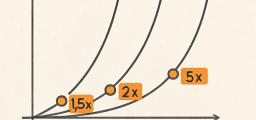
Two slots can advertise the same 96% RTP and feel like completely different games. The reason is volatility, the spread of outcomes around the average, not the average itself.
A low-volatility 96 percent RTP slot delivers most of its return through many small wins. Sessions feel steadier. Cash burns more slowly. A high-volatility 96 percent RTP slot, on the other hand, hides most of its return in rare bonus rounds or jackpot events that almost no individual session sees. Same advertised return, totally different ride.
Imagine two games that each return $960,000 from a million dollars of wagering in theory. Game A pays mostly through small symbol wins. Game B pays mostly through occasional $10,000 bonus triggers. Sit down at Game B for 100 spins and miss the bonus and you’ll feel like the 96% number is a lie. It isn’t. You just sampled the part of the distribution that doesn’t include the rare-but-large events.
Where the Other $4 Actually Lives
So if a slot is designed to keep about 4% of every dollar staked, where does that 4% physically go? Not directly to a vault marked “yours.” That 4% spreads across several things: operator profit margin, software vendor licensing fees, regulator levies and taxes, marketing and bonus costs, and the operational cost of running the game. None of which the player sees on the screen.
What matters mathematically is that the 4% isn’t a session fee deducted from your $100. It’s a long-run average margin extracted across the operator’s enormous total volume. The operator gets the law of large numbers working in their favor. You get a small slice of it, full of variance.
The asymmetry is the whole story. The casino plays with millions of spins behind it. You play with however many your bankroll supports. One side gets the predictable average. The other side lives in the noise.
Why RTP Helps the Operator More Than the Player
RTP is genuinely useful, to the operator. Across thousands of cabinets and millions of players, the theoretical return predicts revenue with enough precision to plan a quarterly budget. The UK Gambling Commission’s technical guidance on calculating RTP spells out the volume thresholds operators are supposed to use. They are large.
An individual player almost never sees a sample large enough for RTP to predict their result. The casino gets the average. The player gets variance. Believing the average will appear in your evening is the source of most “this RTP is lying” frustration online, and the math doesn’t say what the angry forum posts think it says.
The UK Gambling Commission also addresses how truly random games can take many cycles to actually settle near their target RTP, see the August 2020 LA bulletin on how machines meet RTP if random. Translation: “long run” is genuinely long.
How to Read 96% Correctly
A correct, careful reading: for every $100 wagered across a very large sample, this game’s outcome distribution is designed to return about $96 in prizes and keep about $4 as theoretical margin. Notice the load-bearing words, wagered, very large sample, designed, about, theoretical.
It is not: “If I deposit $100, I should end with $96.” It is not: “The game owes me a hot streak after losing.” It is not: “A 96% RTP slot is safer in any one session than a 92% RTP slot.” Short-term variance can flip those rankings completely.
For students who want a calmer place to practice percentage and probability thinking, Effortless Math’s free worksheet library is a much cheaper classroom.
Frequently Asked Questions
Is 96% RTP “good”?
It’s better than 92%, sure. It’s still a negative expected value for the player, about a 4% long-run house edge before factoring in volatility, promotions, or jackpot mechanics. “Better than bad” is not the same as “favorable.”
Can I lose my whole bankroll on a 96 percent RTP slot?
Yes, easily. RTP says nothing about a short session. High volatility plus a moderate stake plus fast play can drain $100 in under twenty minutes on a game that’s designed to return 96% across millions of spins.
Does a slot pay more after a cold streak?
No. For random games, previous results don’t influence the next spin. The long-run average gets maintained across enormous total volume, not through personal refunds after bad luck.
Why does my actual return feel nothing like 96%?
Because you sampled a tiny slice of the game’s outcome distribution, and that slice usually doesn’t include the rare events the 96% number depends on. Volatility is the answer to almost every “this can’t be 96%” complaint.
The Honest Reading of the Number
96 percent RTP isn’t a promise to refund $96 from your $100. It’s a description of how the game behaves across more wagering than you’ll ever do personally. The gap between that average and your actual session is where volatility lives, and where most of the disappointment comes from when players read the number too generously.
Read carefully, 96% is informative. Read carelessly, it’s a comfort number that misleads. The math doesn’t change either way. Just your relationship with it.
Sources

Related to This Article
More math articles
- Prepositions, Conjunctions, and Interjections
- Urbanization, Urban Growth, Suburbanization, and Metropolitan Regions
- Full-Length TABE 11 & 12 Math Practice Test-Answers and Explanations
- Why the Articles of Confederation Failed
- Atoms and Their Parts
- How to Take Better Math Notes: Cornell, Maps & More
- Balancing Math Assignments and Academic Papers: Tips for Busy Students
- Algebra Puzzle – Challenge 40
- 7th Grade SC Ready Math Worksheets: FREE & Printable
- The AFL, Craft Unionism, Debs, and Industrial Unionism








What people say about "The 96% Slot Promise Decoded: Where the Other $4 Actually Goes - Effortless Math"?
No one replied yet.