Photorespiration, C4 and CAM Photosynthesis Explained
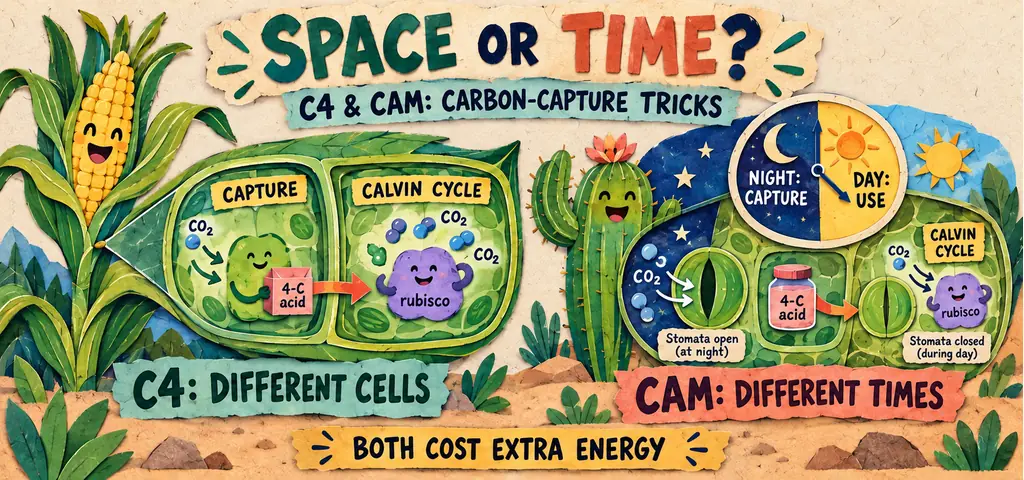
Photorespiration begins when rubisco reacts with oxygen. It uses energy and releases some fixed carbon. C4 and CAM pathways concentrate carbon dioxide around rubisco: the common C4 pathway separates stages between cells, while CAM separates night uptake from daytime use. Both involve trade-offs.
C4 grasses such as crabgrass can gain a growth advantage over C3 grasses in hot conditions. Their carbon-concentrating pathway reduces the cost of photorespiration, a process initiated when rubisco reacts with oxygen. CAM plants address a related water-conservation problem by taking in carbon dioxide at night. Both strategies have energy costs, so their advantages depend on the environment.
Watch the process
C-4 Photosynthesis
Rubisco catalyzes both carboxylation and oxygenation. Its active site does not discriminate perfectly between carbon dioxide and oxygen, and when it binds \(\text{O}_2\) instead of \(\text{CO}_2\) it starts a pathway called photorespiration. That pathway consumes ATP, releases previously fixed \(\text{CO}_2\), and produces no sugar. It reduces net carbon gain, although the salvage pathway is necessary to recover carbon from products of rubisco oxygenation and can have protective roles.
Rubisco’s balance between oxygenation and carboxylation depends on gas availability and enzyme specificity. In hot, dry conditions, stomatal closure or partial closure reduces carbon-dioxide entry. Ongoing fixation can lower internal \(\text{CO}_2\), favoring oxygenation relative to carboxylation. Temperature also affects rubisco specificity and the relative solubility of the gases. Photorespiration therefore occurs beyond drought conditions, although heat and restricted carbon-dioxide supply can increase its relative importance in C3 plants.
Compare C3, C4 and CAM
Two adaptations reduce the loss, and both work the same way: concentrate \(\text{CO}_2\) around rubisco so oxygenation becomes less frequent. They differ in whether the separation is spatial or temporal.
In the common two-cell C4 pathway found in corn and sugarcane, initial carbon fixation occurs in mesophyll cells. PEP carboxylase adds bicarbonate, \(\text{HCO}_3^-\), derived from carbon dioxide, to the three-carbon molecule PEP, producing four-carbon oxaloacetate. Four-carbon acids carry carbon to bundle-sheath cells, where decarboxylation releases \(\text{CO}_2\) near rubisco. This concentrates carbon dioxide for the Calvin cycle. PEP carboxylase does not catalyze rubisco’s competing oxygenation reaction.
In the usual CAM pattern, plants such as cacti and pineapple take up carbon dioxide at night and use PEP carboxylase to store carbon in organic acids, commonly in vacuoles. During the day, acid decarboxylation supplies \(\text{CO}_2\) to the Calvin cycle while stomata can remain closed, reducing water loss. CAM activity and stomatal schedules can vary with species and conditions; night uptake and daytime use describe the central comparison.
Carbon concentration requires additional energy. Its benefits depend on light, temperature, water supply and species. C4 plants can gain an advantage when photorespiration would be costly, while the additional energy requirement can reduce that advantage under cooler or low-light conditions. CAM can conserve water, but carbon uptake and storage capacity can limit growth. Neither pathway guarantees faster growth in every environment.
Why Heat Makes the Problem Worse Twice Over
A C3 plant loses a larger share of its fixed carbon to photorespiration at \(35^{\circ}\text{C}\) than at \(20^{\circ}\text{C}\), even when its stomata stay open. Give two independent reasons, and identify which one the stomatal response adds on top.
First, rubisco’s specificity for carbon dioxide relative to oxygen generally decreases as temperature rises. Oxygenation can therefore become more important relative to carboxylation even without a change in the external gas mixture. Distinguish this relative specificity from an unlimited increase in either reaction rate.
Second reason: the gases themselves change. Both gases become less soluble in water as it warms, but carbon dioxide’s solubility falls faster than oxygen’s. Inside a leaf’s wet cell walls, the dissolved \(\text{CO}_2\) to \(\text{O}_2\) ratio therefore drops with heat, handing rubisco a worse mixture to choose from.
Stomatal closure in dry conditions adds a supply limitation: less atmospheric \(\text{CO}_2\) enters while fixation can continue drawing down the internal supply. The resulting gas availability favors oxygenation. The light reactions, fixation and gas exchange are regulated, so they should not be described as continuing unchanged indefinitely behind completely closed stomata.
Connect each cause to its mechanism. Temperature influences rubisco specificity and gas solubility; stomatal behavior influences carbon-dioxide supply. Together these can increase photorespiration relative to carboxylation. Measurements of the gases and photosynthetic reactions are needed to quantify the contribution in a particular plant.
Answer
Higher temperature can reduce rubisco’s carbon-dioxide/oxygen specificity and reduce carbon-dioxide solubility more strongly than oxygen solubility. Stomatal closure in dry conditions can further restrict carbon-dioxide entry.
Comparing a C3 and a C4 Grass Across Two Climates
In this hypothetical data set, two grasses are grown at two temperatures under the same stated light, water and nutrient conditions. Net carbon fixation is reported in micromoles of \(\text{CO}_2\) per square meter of leaf per second. The pathway identities are supplied; they are not inferred from the rates alone.
| Species | \(20^{\circ}\text{C}\) | \(35^{\circ}\text{C}\) |
|---|---|---|
| Species 1 (C3) | 22 | 14 |
| Species 2 (C4) | 18 | 33 |
Use the stated pathway identities to explain the observed reversal in rank; decide what the two-temperature data alone can establish.
Claim. Species 1 has the higher reported net fixation at the cooler temperature, while Species 2 has the higher reported rate at the warmer temperature. The stated C3/C4 identities provide a possible mechanistic explanation for this pattern.
Evidence. Compute the change for each species across the fifteen-degree rise. \[\text{Species 1: } 14-22 =-8, \qquad \text{Species 2: } 33-18 = +15 .\] As a percentage of each species’ own cool-chamber rate, Species 1 falls by \((8/22)\times100\approx36\) percent while Species 2 rises by \((15/18)\times100\approx83\) percent. The ranking reverses between chambers.
Reasoning. Carbon concentration around rubisco can reduce the photorespiratory cost of warm conditions in a C4 plant. A C3 plant may experience a larger oxygenation cost when carbon dioxide is less available relative to oxygen. The extra energy requirement of C4 concentration may help explain a lower rate under conditions where photorespiration is less costly. These mechanisms are consistent with the supplied pattern; the two rates do not measure photorespiration, ATP use or the thermal optimum directly.
Limits. Two temperatures do not locate a crossover point or establish the response at every intermediate or higher temperature. Equal water supplied to the chambers does not demonstrate equal leaf water status or water-use efficiency. Replication, humidity and water-status measurements, and direct estimates of photorespiration would help test the explanation.
Conclusion
In the hypothetical data, Species 1 falls by about 36% and Species 2 rises by about 83%. The ordering reverses between the two temperatures. The supplied C3/C4 mechanisms suggest an explanation, but the table alone does not prove that pathway energy cost caused the difference or establish drought tolerance.
Distinctions to keep clear
The name photorespiration invites the wrong association. It is not cellular respiration and it makes no ATP; it consumes ATP. It shares with respiration only that it takes in oxygen and gives off carbon dioxide, and that superficial similarity is where the name came from. An item offering “photorespiration produces ATP for the plant” is offering a distractor built on the name.
Both C4 and CAM use initial carbon fixation followed by carbon-dioxide release near rubisco, and both retain the Calvin cycle. In the standard textbook comparison, C4 separates these stages mainly between mesophyll and bundle-sheath cells; CAM separates night-time uptake from daytime use within the same cells. This is the central distinction, rather than the only biochemical difference between all C4 and CAM plants.
Neither adaptation eliminates rubisco or photorespiration entirely. They reduce the oxygenation rate by improving the gas ratio at the active site. Answers claiming a C4 plant “does not use rubisco” are wrong.
Review: Photorespiration and the C4 and CAM Adaptations
Rubisco cannot fully distinguish \(\text{CO}_2\) from \(\text{O}_2\), and binding oxygen starts a pathway that costs ATP and releases fixed carbon without making sugar.
Hot, dry conditions can cause stomatal closure, restricting \(\text{CO}_2\) entry and favoring photorespiration relative to carboxylation in C3 plants.
C4 and CAM both concentrate carbon dioxide around rubisco and both cost extra ATP; the difference is spatial versus temporal separation, not the presence of rubisco.
Photorespiration, C4, and CAM
Practice question 1
Photorespiration reduces a C3 plant’s productivity because it
-
prevents the light reactions from producing ATP and NADPH
-
consumes ATP and releases fixed carbon as \(\text{CO}_2\) without producing sugar
-
blocks stomata from opening during the day
-
converts rubisco into PEP carboxylase
Practice question 2
On a hot, dry afternoon a C3 plant closes its stomata. The change inside the leaf that most directly increases photorespiration is
-
a rise in temperature that denatures rubisco
-
a decrease in the ratio of \(\text{CO}_2\) to \(\text{O}_2\) in the leaf’s air spaces
-
a loss of water from the thylakoid lumen
-
an increase in the number of chloroplasts per cell
Practice question 3
C4 and CAM plants both limit photorespiration, but they differ in that
-
C4 plants use rubisco while CAM plants do not use rubisco at all
-
CAM plants open their stomata during the day and C4 plants open theirs at night
-
C4 plants fix carbon without spending any additional ATP
-
C4 plants separate initial fixation from the Calvin cycle in different cells, while CAM plants separate them at different times of day
Practice answer key
1. B; 2. B; 3. D.
Practice answer explanations
-
Photorespiration, C4, and CAM, Question 1. Choice B is correct. Rubisco oxygenation initiates a salvage pathway that uses energy and releases some previously fixed carbon. Choice A incorrectly makes the primary mechanism a block of the light reactions. Choice C does not describe the direct reason for the loss of fixed carbon. Choice D proposes an enzyme conversion that does not occur.
-
Photorespiration, C4, and CAM, Question 2. Choice B is correct. Stomatal closure restricts carbon-dioxide entry. A lower \(\text{CO}_2\)-to-\(\text{O}_2\) ratio at rubisco favors oxygenation. Choice A assumes enzyme denaturation without evidence. Neither the thylakoid-water change in C nor the chloroplast-count change in D is established by the stem.
-
Photorespiration, C4, and CAM, Question 3. Choice D is correct. C4 plants separate preliminary fixation and the Calvin cycle spatially, in mesophyll and bundle-sheath cells, while CAM plants separate the same two steps temporally, at night and by day. Choice A is false, since both use rubisco for the Calvin cycle. Choice B reverses the two stomatal schedules. Choice C denies the ATP cost that both strategies pay.
Continue your review at the AP Biology study hub.
Sources: OpenStax photosynthesis overview; temperature and rubisco specificity study; PEP carboxylase substrate study.

Related to This Article
More math articles
- The Best Algebra 1 Book for Tennessee Students
- The Best Grade 5 ELA Practice Tests for California Students
- Free Grade 3 English Worksheets for Wyoming Students
- Religion and Society
- How to Compare Linear Functions Graphs and Equations
- Reaganomics, Union Decline, Inequality, and Deregulation
- The Missouri MAP Grade 3 Math Worksheet Set — 49 Free Printable PDFs
- The Best Grade 8 Math Book for Georgia Students
- Algebra Puzzle – Challenge 55
- CLEP U.S. History I 052: Implied Powers and Interstate Commerce











What people say about "Photorespiration, C4 and CAM Photosynthesis Explained"?
No one replied yet.