CLEP · Earn College Credit by Exam
CLEP American Government Practice Test: Free Questions, Flashcards & Quick Review
Review Clep American Government with the independent study resources available on this page. Explore the official assessment, choose a focused topic, and use review or flashcards to strengthen your understanding.
CLEP American Government Practice Tests
Open the existing practice form and review its explanations. Its results are study feedback, not official scores.
CLEP American Government Flashcards
Recall a term, then connect it with an example.
CLEP American Government Study Guides
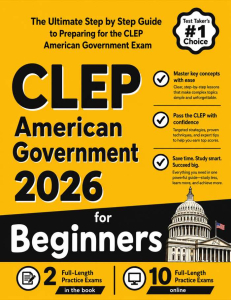
CLEP American Government for Beginners
A subject-specific CLEP American Government guide. Compare its contents with the current official outline and your study needs.
View book & purchase options →CLEP American Government Quick Review
Choose a concept or lesson to refresh before another practice activity.
Open this resource →MEET THE ASSESSMENT · CHOOSE YOUR NEXT SKILL
Know CLEP American Government before you start.
College Board lists approximately 100 questions in 90 minutes, including some unscored pretest questions. The exam covers federal institutions and policy, constitutional foundations, rights, political parties, and political behavior. Independent review and flashcards here provide study support, not an official CLEP score. Check your college’s required score and credit policy.
Official assessment information ↗Constitutional foundations
Connect a constitutional principle with its practical effect.
Explore this study route →Institutions and policy
Identify who has authority and how a policy moves through the system.
Explore this study route →Civil liberties and rights
Distinguish the relevant right, government action, and legal context.
Explore this study route →Political participation
Use the official outline to review parties, groups, beliefs, and behavior.
Explore this study route →CLEP American Government Practice Center
Take a full practice test, review the explanations, then use the flashcards to repair the terms and ideas that slowed you down.
CLEP American Government Study Blueprint
Open each area to see what to master. The bars show how this Online Center distributes its study units, so you can plan study time without mistaking the map for an official exam weighting.
01 Constitutional foundationsBegin with political ideas, founding debates, federalism, and constitutional structure. 6study units
- Origins, ratification, and governing principles
- Federalism, separation of powers, and checks
02 Institutions and public policyCompare the powers, incentives, and interactions of national institutions. 12study units
- Congress, presidency, bureaucracy, and courts
- Policy development, implementation, and oversight
03 Civil liberties and civil rightsApply constitutional protections and legal standards to concrete disputes. 7study units
- First Amendment and rights of the accused
- Privacy, equal protection, and civil-rights development
04 Parties, elections, and interest groupsUnderstand how organized political activity connects citizens to government. 9study units
- Party systems, campaigns, elections, and finance
- Interest groups, media, and participation strategies
05 Political beliefs, behavior, and dataInterpret political culture, opinion, participation, and evidence. 8study units
- Socialization, ideology, and public opinion
- Polling, voting behavior, and data analysis
06 Cumulative applicationCombine institutions, rights, behavior, and policy in mixed exam-style situations. 16study units
- Constitutional and institutional comparisons
- Source interpretation and full-course review
Study-map shares describe the learning resources on this page. They are not presented as official test percentages.
CLEP American Government Study Online Center: a single starting point that brings together the lessons, worksheets, practice tests, and review material for this subject, arranged in a sensible order so you can work through it from start to finish.
College-credit exam preparation
Learn the ideas in plain language, check your recall with focused flashcards, and use realistic practice tests to find exactly what to review next.
41 chapters | 539 lessons | 397 flashcards
397FlashcardsFive-domain American Government review
15% to 20% of the exam
Constitutional Underpinnings of American Democracy
Founding ideas, constitutional design, federalism, separation of powers, checks and balances, majority rule, and minority rights.
Chapter 1: Origins of American Government
- Natural rights and social-contract theory
- Enlightenment thinkers, especially John Locke
- Republicanism and representative government
- Limited government
- Popular sovereignty
- Rule of law
- Majority rule and minority rights
- The Declaration of Independence
- Colonial government and political traditions
- Theories and forms of democracy
Chapter 2: The Articles of Confederation
Chapter 3: The Constitutional Convention
Chapter 4: Ratification and Constitutional Principles
- Federalists and Anti-Federalists
- The Federalist Papers
- Federalist No. 10 and factions
- Federalist No. 51 and checks and balances
- Federalist No. 70 and executive power
- Federalist No. 78 and the judiciary
- The ratification process
- The demand for a Bill of Rights
- Formal constitutional amendment process
- Informal constitutional change
Chapter 5: Separation of Powers and Checks and Balances
Chapter 6: Federalism
- Delegated, expressed, implied, inherent, reserved, and concurrent powers
- Supremacy Clause
- Necessary and Proper Clause
- Commerce Clause
- Full Faith and Credit Clause
- Privileges and Immunities Clause
- Dual federalism
- Cooperative federalism
- Fiscal federalism
- Grants-in-aid
- Categorical grants
- Block grants
- Unfunded mandates
- Devolution
- Intergovernmental relations
- Conflicts between national and state authority
30% to 35% of the exam
Institutions and Policy Processes
Congress, the presidency, the bureaucracy, the federal courts, their relationships, and the public-policy process.
Chapter 7: Congress-Structure and Membership
- Bicameralism
- House of Representatives
- Senate
- Constitutional qualifications
- Terms of office
- Apportionment and reapportionment
- Redistricting
- Gerrymandering
- Majority-minority districts
- Constituency representation
- Incumbency advantage
- Descriptive and substantive representation
- Delegate, trustee, and politico models of representation
Chapter 8: Congressional Organization
- Speaker of the House
- Senate majority leader
- Majority and minority parties
- Whips
- President pro tempore
- Party caucuses and conferences
- Standing committees
- Select and special committees
- Joint committees
- Conference committees
- Committee chairs
- Seniority
- House Rules Committee
- Congressional staff
- Congressional caucuses
Chapter 9: The Legislative Process
- Bill introduction
- Committee referral
- Hearings and markups
- Committee reports
- Floor debate
- House and Senate voting
- Conference committees
- Presidential action
- Vetoes and veto overrides
- Pocket veto
- Filibuster
- Cloture
- Unanimous consent
- Holds
- Discharge petitions
- Logrolling
- Pork-barrel legislation
- Earmarks
- Legislative gridlock
Chapter 10: Congressional Powers
- Taxing and spending
- Regulation of interstate commerce
- War powers
- Advice and consent
- Confirmation of appointments
- Treaty ratification
- Impeachment
- Oversight and investigations
- Necessary and Proper Clause
- Congressional control of the budget
- Congressional limits on the executive
- Casework and constituency service
- Federal budget and appropriations process
Chapter 11: The Presidency
- Constitutional qualifications
- Election and succession
- Twenty-Second Amendment
- Twenty-Fifth Amendment
- Formal presidential powers
- Informal presidential powers
- Chief executive
- Commander in chief
- Chief diplomat
- Chief legislator
- Head of state
- Party leader
- Economic leadership
- Appointment and removal powers
- Pardon power
- Executive orders
- Executive agreements
- Signing statements
- Presidential veto
- Bargaining and persuasion
- Public appeals and the “bully pulpit”
Chapter 12: Presidential Organization and Decision-Making
- Cabinet
- Executive Office of the President
- White House staff
- National Security Council
- Office of Management and Budget
- Vice presidency
- Presidential management styles
- Divided government
- Unified government
- Executive privilege
- Presidential approval and political capital
- Presidential relations with Congress
- War Powers Resolution
Chapter 13: The Federal Bureaucracy
- Cabinet departments
- Independent executive agencies
- Independent regulatory commissions
- Government corporations
- Bureaucratic hierarchy
- Civil service
- Merit system
- Patronage and the spoils system
- Pendleton Civil Service Reform Act
- Rulemaking
- Administrative discretion
- Implementation
- Regulation
- Adjudication
- Bureaucratic expertise
- Red tape
- Agency capture
- Privatization
- Principal-agent problems and bureaucratic models
Chapter 14: Bureaucratic Accountability
Chapter 15: The Federal Courts
Chapter 16: Supreme Court Processes and Power
- Judicial review
- Marbury v. Madison
- Writ of certiorari
- Rule of Four
- Standing
- Mootness
- Ripeness
- Amicus curiae briefs
- Oral arguments
- Majority opinions
- Concurring opinions
- Dissenting opinions
- Precedent and stare decisis
- Judicial restraint
- Judicial activism
- Strict and broad construction
- Solicitor general
- Supreme Court implementation and enforcement
- Limits on judicial power
Chapter 17: Public Policy Process
- Agenda setting
- Policy formulation
- Policy adoption
- Policy implementation
- Policy evaluation
- Incremental policymaking
- Distributive, redistributive, regulatory, and constituent policies
- Domestic policy
- Economic policy
- Fiscal policy
- Monetary policy
- Social welfare policy
- Foreign and defense policy
- Roles of institutions, parties, groups, media, and public opinion
Chapter 18: The Bill of Rights and Incorporation
10% to 15% of the exam
Civil Liberties and Civil Rights
The Bill of Rights, incorporation, due process, equal protection, civil liberties, and civil-rights development.
Chapter 19: Freedom of Religion
Chapter 20: Freedom of Speech and Press
Chapter 21: Assembly, Association, and Petition
Chapter 22: Rights of the Accused
- Fourth Amendment
- Search and seizure
- Warrants and probable cause
- Exclusionary rule
- Fifth Amendment
- Self-incrimination
- Double jeopardy
- Due process
- Sixth Amendment
- Right to counsel
- Speedy and public trial
- Impartial jury
- Confrontation of witnesses
- Eighth Amendment
- Bail
- Cruel and unusual punishment
- Death penalty
- Miranda rights
- Habeas corpus
Chapter 23: Privacy and Personal Liberty
Chapter 24: Equal Protection and Civil Rights
- Equal Protection Clause
- Standards of judicial scrutiny
- Rational-basis review
- Intermediate scrutiny
- Strict scrutiny
- Race discrimination
- Sex discrimination
- Affirmative action
- Disability rights
- LGBTQ+ rights
- Voting rights
- Civil Rights Act of 1964
- Voting Rights Act of 1965
- Civil rights enforcement
- State action requirement
Chapter 25: Development of Civil Rights
- Slavery and constitutional conflict
- Reconstruction Amendments
- Thirteenth Amendment
- Fourteenth Amendment
- Fifteenth Amendment
- Segregation and Jim Crow
- Plessy v. Ferguson
- Brown v. Board of Education
- Civil Rights Movement
- School desegregation
- Civil disobedience
- Expansion of equality through legislation and judicial interpretation
Chapter 26: Political Parties
- Functions of political parties
- Recruiting candidates
- Nominating candidates
- Mobilizing voters
- Organizing government
- Developing platforms
- Party identification
- Party organization
- National, state, and local party structures
- Party-in-the-electorate
- Party organization
- Party-in-government
- Issue ownership and party cues
15% to 20% of the exam
Political Parties and Interest Groups
Party organization and change, interest-group activity, campaigns, elections, and the electoral process.
Chapter 27: Development of the Party System
- First Party System
- Federalists and Democratic-Republicans
- Jacksonian Democrats and Whigs
- Emergence of the Republican Party
- New Deal coalition
- Party realignment
- Critical elections
- Dealignment
- Divided government
- Party polarization
- Regional party change
- Third parties and minor parties
- Barriers to third-party success
- Two-party system and electoral rules
- Party sorting, negative partisanship, and affective polarization
Chapter 28: Interest Groups
Chapter 29: Interest-Group Strategies
- Lobbying
- Direct lobbying
- Grassroots lobbying
- Litigation
- Amicus curiae briefs
- Electioneering
- Political action committees
- Campaign contributions
- Issue advocacy
- Public-relations campaigns
- Protest and civil disobedience
- Revolving door
- Iron triangles and issue networks
- Information subsidies and venue shopping
Chapter 30: Campaigns and Nominations
- Candidate recruitment
- Primary elections
- Open, closed, and blanket primaries
- Caucuses
- Front-loading
- National conventions
- Delegates
- Superdelegates
- Party platforms
- Candidate-centered campaigns
- Campaign organizations
- Consultants and polling
- Media strategy
- Presidential nomination process
- Nomination electorates and delegate allocation
Chapter 31: General Elections
- Congressional elections
- Presidential elections
- Electoral College
- Winner-take-all allocation
- Battleground states
- Popular vote versus electoral vote
- Midterm elections
- Coattail effects
- Incumbency advantage
- Retrospective voting
- Prospective voting
- Rational-choice voting
- Split-ticket voting
- Straight-ticket voting
- Electoral systems and direct democracy
Chapter 32: Campaign Finance
Chapter 33: The Media and Politics
Chapter 34: American Political Culture
15% to 20% of the exam
Political Beliefs and Behavior
Political culture, socialization, public opinion, participation, voting behavior, and interpretation of political data.
Chapter 35: Political Socialization
Chapter 36: Public Opinion
Chapter 37: Measuring Public Opinion
Chapter 38: Political Participation
Chapter 39: Voting Behavior
- Voting-age population
- Voting-eligible population
- Registered voters
- Voter turnout
- Demographic influences
- Education
- Income
- Age
- Race and ethnicity
- Gender
- Religion
- Region
- Party identification
- Candidate characteristics
- Issue voting
- Economic conditions
- Mobilization
- Political efficacy
- Pocketbook and sociotropic economic voting
Chapter 40: Voting Rights and Electoral Participation
- Expansion of suffrage
- Fifteenth Amendment
- Seventeenth Amendment
- Nineteenth Amendment
- Twenty-Fourth Amendment
- Twenty-Sixth Amendment
- Voting Rights Act
- Registration requirements
- Motor Voter Act
- Voter identification laws
- Early voting
- Absentee and mail voting
- Felony disenfranchisement
- Institutional and legal barriers to participation
Chapter 41: Political Behavior and Data Analysis
- Reading political maps
- Interpreting election returns
- Comparing demographic groups
- Reading tables, charts, and graphs
- Identifying correlations
- Distinguishing correlation from causation
- Drawing conclusions from survey data
- Identifying patterns in turnout and party support
- Evaluating claims supported by political data
Every lesson in one place
Open a lesson in a new tab and keep this Online Center nearby as your study home.
Browse the complete lesson directory
A USEFUL NEXT STEP
CLEP American Government: study questions
What is the official CLEP American Government exam format?
College Board lists approximately 100 questions in 90 minutes, including some unscored pretest questions. The exam covers federal institutions and policy, constitutional foundations, rights, political parties, and political behavior. Independent review and flashcards here provide study support, not an official CLEP score. Check your college’s required score and credit policy.
Official source ↗How should I use these independent CLEP American Government study tools?
Start with a practice activity, review explanations for missed questions, and use quick review or flashcards for one weak topic. The practice results are study feedback, not official exam scores. Compare a book’s contents with your course or test requirements before buying.
Resources from Effortless Math · Editorial standards