LEARN · PRACTICE · EXPLORE
New Mexico Grade 3 English
Read an original Grade 3 story about a display plan, explain motivation and consequences, and find New Mexico English references, worksheets, and further practice.
Focused lessons · Useful practice · Clear next steps
What do New Mexico 3rd graders learn in ELA?
In 3rd grade, New Mexico English language arts centers on main idea and details, vocabulary from context, and writing organized paragraphs. Students take the NM-MSSA grade 3 ELA test in the spring. This page explains each New Mexico grade 3 ELA standard and pairs it with short lessons, printable worksheets and a full-length practice test.
Printable New Mexico grade 3 ELA books:
- New Mexico NM-MSSA Grade 3 ELA: 8 Full Practice Tests
- New Mexico NM-MSSA Grade 3 ELA: 7 Full Practice Tests
- New Mexico NM-MSSA Grade 3 ELA: 5 Full Practice Tests
- 6 New Mexico NM-MSSA English Language Arts (ELA) Grade 3: Full Practice Tests
- New Mexico Grade 3 English Language Arts (ELA) Preparation Bundle
Standards source: New Mexico adopted content standards.
Separate a character’s goal from the action that changes events
Read an original Grade 3 story about a display plan, explain motivation and consequences, and find New Mexico English references, worksheets, and further practice. New Mexico uses Common Core English expectations together with state additions. This activity addresses selected skills; use the full requirements and the school’s sequence for broader planning.
Curriculum reference: 2010 Common Core ELA/literacy standards, current New Mexico state-hosted copy, from the New Mexico adopted content standards directory.
New Mexico Grade 3 references for this activity
New Mexico uses the Common Core English language arts standards together with additional state expectations in NMAC 6.29.13. The selected Common Core references below identify this activity’s focus. The linked state additions include further cultural, oral-source, writing, and discussion work appropriate to each grade; read the full requirements and the school’s sequence.
| Selected Common Core reference | Activity focus | State-hosted standards document |
|---|---|---|
| RL.3.1 | Refer explicitly to the text when explaining an answer | Read the state-hosted document (PDF page 12) |
| RL.3.3 | Explain how a character’s actions shape events | Read the state-hosted document (PDF page 12) |
NMAC 6.29.13.8(B)(4)(b)–(c) adds Grade 3 cultural and oral-history expectations. The activity here selects Common Core character and evidence work. It does not represent a tribal history or satisfy the state’s wider oral-history expectations; use teacher- and community-approved sources for that instruction. Read New Mexico’s additional English requirements (NMAC 6.29.13, PDF).
These selected reference labels identify an activity focus, with the grade column and PDF page linked separately. Read the complete standards selected by the school and its learning sequence, including reading, writing, language, speaking, and listening. This short original example does not fulfill the entire curriculum or establish a student’s grade-level proficiency.
The model behind the label
This original classroom example is separate from official assessment questions.
Luis wanted visitors to see every piece of his model bridge. He placed a large title card in front of it. When Sam came to look, she bent sideways. “I can see the words, but the card hides the bridge,” she said.
Luis moved the card behind the model. Now Sam could see the bridge, but its tallest tower covered part of the title. Luis looked at the space beside the model. He folded a small stand and put the card there.
Sam read the title and pointed to the bridge’s supports. Luis added a short arrow on the card to show which model it described. At the class display, visitors could read the title and examine the bridge.
Try the activity
What does Luis want visitors to do? Explain how each placement of the card affects that goal. Use details to show why the final arrangement helps. Can you infer that Luis becomes willing to revise his plan?
Follow the reasoning
Luis wants visitors to see every piece of his model. Putting the card in front conflicts with that goal because it hides the bridge; Sam’s sideways look and comment identify the problem. Moving it behind makes the model visible but lets a tower cover the title. The final side placement allows both to be seen, and the arrow connects the card with the model. His changes support the inference that he is willing to revise a plan when another person points out a difficulty. The plot develops through two imperfect placements before a workable arrangement. A response should link each action with its consequence, rather than simply list where the card goes. Nothing in the story proves that every future display will need the same solution.
Notice what needs more practice
The title is not removed. It is moved to the side and linked with an arrow. Sam notices the difficulty; the text assigns the folded stand and arrow to Luis. His goal is stated, while willingness to revise is an inference supported by actions. Keep those kinds of evidence distinct.
Grade 3 English worksheets
Choose printable practice that matches the skill being taught. Check the task, reading difficulty, and directions before assigning it; the collection is independently published.
Use the next session to build independence
- Locate the sentence stating Luis’s goal.
- Match each placement with its visible result.
- Explain how the final action changes what visitors can do.
Write two sentences about a different solution, marking them as your own continuation. Explain how it would affect the original goal. For the broader New Mexico curriculum, teachers should also select appropriate literature, media, and oral-history sources; use their provenance and cultural context rather than treating invented classroom fiction as historical testimony.
For more general reading and writing resources, visit the Grade 3 English Online Center.
New Mexico Grade 3 English: useful planning questions
Is a goal the same as a character trait?
No. A goal states what the character wants. A trait interprets a pattern of behavior and needs supporting actions from the text.
Which standards does the school use?
New Mexico uses the Common Core English language arts standards together with additional state expectations in NMAC 6.29.13. The selected Common Core references below identify this activity’s focus. The linked state additions include further cultural, oral-source, writing, and discussion work appropriate to each grade; read the full requirements and the school’s sequence. The school’s sequence also includes reading, writing, speaking, listening, and language work beyond this example.
Sources checked October 6, 2026. The current NM-MSSA resource page describes statewide ELA and mathematics assessment at the end of Grades 3–8, including Grade 3. Results are one measure and should be considered alongside classroom and other assessment evidence. Confirm the learner’s assigned pathway and current school directions. Read the official NM-MSSA resource page, state standards directory, and additional New Mexico English requirements. The state assessment directory is updating resources for 2026–2027; this page does not claim later-year timing, tool, or administration details from a Spring 2026 manual. Independently published practice has its own directions and scoring and does not predict a state performance level. This original activity is not an official assessment item.
Grade 3 English in other states
When moving between school systems, compare the official curriculum and the school’s learning sequence. Use the national Online Center’s map to find another state’s resources.
Recommended New Mexico Grade 3 resources
Build a Strong New Mexico Grade 3 NM-MSSA English Practice Library
These independently published resources have their own coverage and editions. Check the contents alongside New Mexico’s current English standards before choosing assessment preparation.
Use these New Mexico Grade 3 resources for reading comprehension, language, writing, and full-length practice where available. Click any cover to open the resource page.
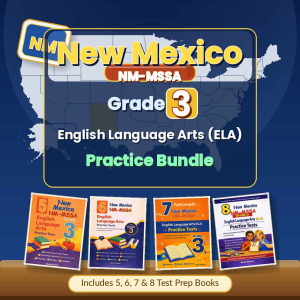 New Mexico Grade 3 English Language Arts (ELA) Preparation Bundle
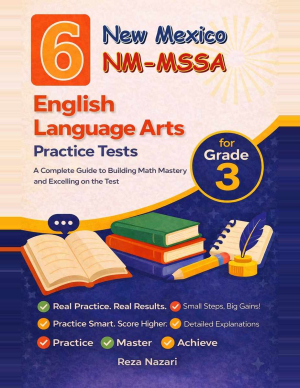 6 New Mexico NM-MSSA English Language Arts (ELA) Grade 3: Full Practice Tests
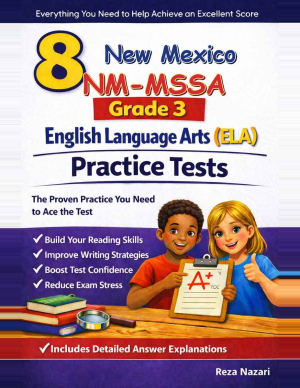 New Mexico NM-MSSA Grade 3 ELA: 8 Full Practice Tests
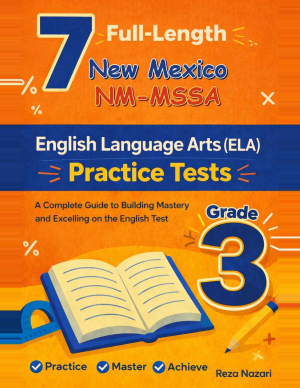 New Mexico NM-MSSA Grade 3 ELA: 7 Full Practice Tests
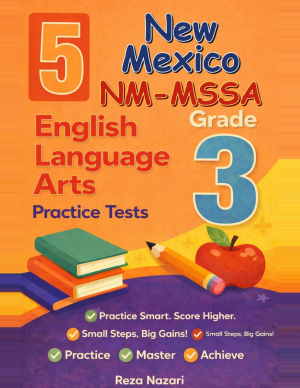 New Mexico NM-MSSA Grade 3 ELA: 5 Full Practice Tests
More Grade 3 resources
A USEFUL NEXT STEP
New Mexico Grade 3 English: study questions
Is a goal the same as a character trait?
No. A goal states what the character wants. A trait interprets a pattern of behavior and needs supporting actions from the text.
Where are the complete New Mexico Grade 3 requirements?
New Mexico uses the Common Core English language arts standards together with additional state expectations in NMAC 6.29.13. The selected Common Core references below identify this activity’s focus. The linked state additions include further cultural, oral-source, writing, and discussion work appropriate to each grade; read the full requirements and the school’s sequence.
Official source ↗Resources from Effortless Math · Editorial standards