LEARN · PRACTICE · EXPLORE
Missouri Grade 3 English
Practice Missouri Grade 3 English with an original character traits and evidence lesson, worked response, state references, worksheets and study guidance.
Focused lessons · Useful practice · Clear next steps
What do Missouri 3rd graders learn in ELA?
In 3rd grade, Missouri English language arts centers on main idea and details, vocabulary from context, and writing organized paragraphs. Students take the Missouri MAP grade 3 ELA test in the spring. This page explains each Missouri grade 3 ELA standard and pairs it with short lessons, printable worksheets and a full-length practice test.
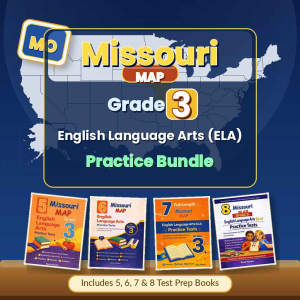
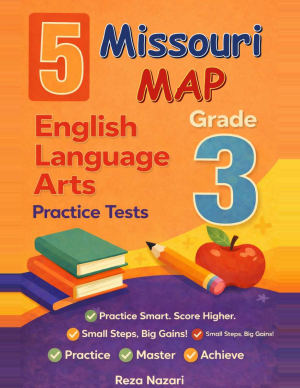
Printable Missouri grade 3 ELA books:
Standards source: Missouri English Language Arts, Missouri Department of Elementary and Secondary Education.
Support a character trait with words and actions
A trait describes a pattern in how a character behaves; a feeling can describe a single moment. Read this original scene and decide which description has support. Students should connect their chosen word to details rather than guessing from a character’s name.
Curriculum reference: Missouri K–5 English Language Arts expectations, from the Missouri Department of Elementary and Secondary Education ELA directory.
Missouri Grade 3 references for this activity
DESE’s current directory links the Missouri English Language Arts expectations adopted in April 2016. The Grades 6–12 PDF identifies a June 2020 update. References here name the selected strand, section, letter, and grade column in the state document; the 2026 download path is not a new adoption date. Read the complete expectations and the school’s curriculum to plan beyond this activity.
| Grade-level expectation | Activity focus | Official requirement |
|---|---|---|
| Reading 2A(b) · Grade 3 | Character traits and evidence | Read the state framework (PDF page 7) |
These selected reference labels identify an activity focus, with the grade column and PDF page linked separately. Read the complete state requirements and the school’s sequence, including reading, writing, language, speaking, and listening. This short original example does not fulfill the entire curriculum or establish a student’s grade-level proficiency.
A worked Grade 3 reading investigation
This original classroom example is separate from official assessment questions.
Omar’s paper tower tipped over twice. He frowned, then looked carefully at the folded base. “I will make the bottom wider,” he said. He tried another fold and set the tower down again. When it leaned, he changed one side and tried once more. At cleanup time, his tower was still standing.
Try the activity
Choose a trait supported by Omar’s words and actions. Give two details that support it. Explain how frowning and continuing to work tell different things about him.
Follow the reasoning
Persistent is a supported trait: Omar keeps working after more than one unsuccessful attempt. His statement about widening the bottom shows a plan, and his repeated adjustments show that he acts on it. Careful or willing to improve can also be supported with a clear explanation. Frowning suggests a feeling of frustration at that moment, although the narrator does not name his exact feeling. It does not cancel the evidence that he continues trying. The final standing tower describes the result at cleanup time. A strong response might say, “Omar is persistent because he changes the base after it falls and tries again when it leans.”
Notice what needs more practice
One successful tower does not prove that Omar always succeeds or never asks for help. The story does not say that he wins a contest, ignores classmates, or builds the tallest tower. Do not choose selfish simply because he works on his own tower; there is no event about refusing to share. If a student chooses frustrated as a trait, discuss the difference between a temporary reaction and the repeated behavior shown here. More than one trait word can be reasonable when its explanation uses the passage.
Grade 3 English worksheets
Choose printable practice that matches the skill being taught. Check the task, reading difficulty, and directions before assigning it; the collection is independently published.
Use the next session to build independence
- List one thing Omar says and two things he does; keep observations separate from your labels.
- Choose a trait and connect it to at least two relevant details.
- Describe his possible feeling separately, explaining what the text shows and what you infer.
In a new story, check whether a later action supports or complicates your first description. A character can show different traits in different situations. Revise a label when the evidence changes rather than treating your first impression as a fact.
For more general reading and writing resources, visit the Grade 3 English Online Center.
Missouri Grade 3 English: useful planning questions
Is a character’s feeling always a trait?
No. Frowning can suggest a moment of frustration, while continuing through several attempts supports persistence. Explain each using the relevant details.
Where are the complete state requirements?
DESE’s current directory links the Missouri English Language Arts expectations adopted in April 2016. The Grades 6–12 PDF identifies a June 2020 update. References here name the selected strand, section, letter, and grade column in the state document; the 2026 download path is not a new adoption date. Read the complete expectations and the school’s curriculum to plan beyond this activity. The school’s sequence also includes reading, writing, speaking, listening, and language work beyond this example.
Sources checked October 6, 2026. DESE lists MAP grade-level ELA assessments in Grades 3–8, including Grade 3. Follow the school’s assigned assessment pathway and current administration directions. Read the Missouri MAP grade-level overview and the DESE ELA directory for current guidance. Independently published practice may use its own timer, question count, and scoring; those features are not official administration specifications or a prediction of a state performance level. Use the complete standards and the school’s learning sequence to choose further reading, writing, speaking, listening, and language work. This original classroom activity is not an official assessment item.
Grade 3 English in other states
When moving between school systems, compare the official curriculum and the school’s learning sequence. Use the national Online Center’s map to find another state’s resources.
Recommended Missouri Grade 3 resources
Build a Strong Missouri Grade 3 MAP English Practice Library
These independently published resources have their own coverage and editions. Check the contents alongside Missouri’s current English standards before choosing assessment preparation.
Use these Missouri Grade 3 resources for reading comprehension, language, writing, and full-length practice where available. Click any cover to open the resource page.
More Grade 3 resources
A USEFUL NEXT STEP
Missouri Grade 3 English: study questions
Is a character’s feeling always a trait?
No. Frowning can suggest a moment of frustration, while continuing through several attempts supports persistence. Explain each using the relevant details.
Where are the complete Missouri Grade 3 requirements?
DESE’s current directory links the Missouri English Language Arts expectations adopted in April 2016. The Grades 6–12 PDF identifies a June 2020 update. References here name the selected strand, section, letter, and grade column in the state document; the 2026 download path is not a new adoption date. Read the complete expectations and the school’s curriculum to plan beyond this activity.
Official source ↗Resources from Effortless Math · Editorial standards