LEARN · PRACTICE · EXPLORE
Texas Grade 3 English
Texas Grade 3 English: plan reading, writing, vocabulary, and discussion practice. Use learning references and the state curriculum source to choose a target.
Focused lessons · Useful practice · Clear next steps
What do Texas 3rd graders learn in ELA?
In 3rd grade, Texas English language arts centers on main idea and details, vocabulary from context, and writing organized paragraphs. Students take the STAAR grade 3 ELA test in the spring. This page explains each Texas grade 3 ELA standard and pairs it with short lessons, printable worksheets and a full-length practice test.
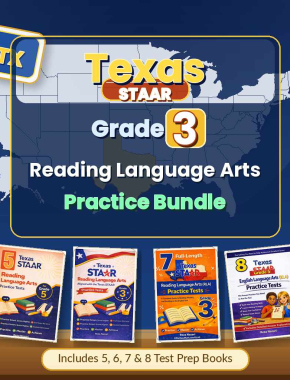
Printable Texas grade 3 ELA books:
Standards source: Texas Essential Knowledge and Skills (TEKS), Texas Education Agency.
Texas Grade 3 English is where students read more complex texts, explain ideas with evidence, grow vocabulary, and write organized responses. This guide gives Texas families and educators a practical reading and writing roadmap without the official-document fog: 98 rewritten skill targets across 11 ELA strands, with emphasis on phonics, word parts, spelling patterns, and fluent decoding; planning, drafting, revising, editing, grammar, and publishing; genre features, literary forms, informational structures, and text purposes. For classroom progress, tutoring, homeschool planning, or STAAR review, the best practice uses balanced practice that asks students to read carefully, write clearly, and explain their thinking.
Use this Texas Grade 3 English page for teacher planning, parent support, independent reading, and writing conferences. The explanations are written for planning and learning support, not copied from official standards language.
Free Grade 3 ELA Checklist + Practice Plan
Use this Texas Grade 3 English language arts guide as a printable standards checklist. Start with the overview, mark the skills your student already handles, then choose one weak area for focused review before STAAR or classroom assessments.
Texas Grade 3 English Standards Overview
For Texas, Grade 3 English helps students read more complex texts, explain ideas with evidence, grow vocabulary, and write organized responses. This overview organizes Texas Essential Knowledge and Skills (TEKS) into plain-language strands so you can quickly see what to teach, review, or reteach.
Oral Language and Discussion
For Texas Grade 3, this strand supports planning around active listening, clear speaking, group conversation, and respectful discussion. Includes 5 quick skill targets.
Foundational Reading and Word Study
For Texas Grade 3, this strand supports planning around phonics, word parts, spelling patterns, and fluent decoding. Includes 18 quick skill targets.
Vocabulary
For Texas Grade 3, this strand turns daily practice toward word meaning, context clues, roots, affixes, and precise language. Includes 6 quick skill targets.
Comprehension Skills
For Texas Grade 3, this strand keeps lessons anchored in questioning, predicting, inferring, synthesizing, and monitoring meaning. Includes 9 quick skill targets.
Response to Text
For Texas Grade 3, this strand turns daily practice toward written responses, text evidence, connections, and personal interpretation. Includes 7 quick skill targets.
Reading Literature
For Texas Grade 3, this strand makes room for short checks on theme, character, plot, point of view, and literary craft. Includes 4 quick skill targets.
Genre Study
For Texas Grade 3, this strand turns daily practice toward genre features, literary forms, informational structures, and text purposes. Includes 12 quick skill targets.
Author's Craft
For Texas Grade 3, this strand helps review stay focused on author's purpose, structure, language choices, and craft moves. Includes 7 quick skill targets.
Grade 3 STAAR English Practice Plan
A useful Texas Grade 3 plan should balance reading, writing, language, and speaking. Start with Oral Language and Discussion, Foundational Reading and Word Study, Vocabulary; then rotate shorter review tasks so skills stay connected.
For Texas Grade 3, a strong weekly rhythm can be simple: a literature or nonfiction passage, a discussion prompt, a short written answer, and a focused editing minute.
Need Focused Grade 3 STAAR English Practice?
Pair this Texas Grade 3 standards guide with targeted ELA practice so students can move from knowing the expectations to answering reading, writing, vocabulary, and language questions with confidence.
All Texas Grade 3 English Standards, Rewritten
The codes below follow the Texas Grade 3 source standards structure. Each skill label is intentionally short, original, and written for fast planning.
Texas Grade 3 3.1 Oral Language and Discussion
Use these Grade 3 expectations as learning references. Common Core-style codes refer to the Common Core standards; they do not certify a complete match to Texas’s current curriculum. State-specific references also need to be checked against the current official document. Follow your teacher’s assigned targets when wording, codes, or grade placement differ.
| Code | Learning reference |
|---|---|
| 3.1(A) | Listen actively, ask relevant questions to clarify information, and make pertinent comments |
| 3.1(B) | Follow, restate, and give oral instructions that involve a series of related sequences of action |
| 3.1(C) | Speak coherently about the topic under discussion, employing eye contact, speaking rate, volume, enunciation, and the conventions of language to communicate ideas effectively |
| 3.1(D) | Work collaboratively with others by following agreed-upon rules, norms, and protocols; and |
| 3.1(E) | Develop social communication such as conversing politely in all situations |
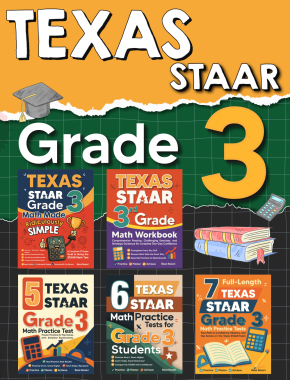
Also Reviewing Texas Grade 3 Math?
Many Texas families prepare English and math together. If your Grade 3 student also needs math support, this matching resource can help keep review organized.
Texas Grade 3 3.2 Foundational Reading and Word Study
| Code | Learning reference |
|---|---|
| 3.2(A) | Demonstrate and apply phonetic knowledge by |
| 3.2(A)(i) | Decoding multisyllabic words with multiple sound-spelling patterns such as eigh, ough, and en |
| 3.2(A)(ii) | Decoding multisyllabic words with closed syllables; open syllables; VCe syllables; vowel teams, including digraphs and diphthongs; r-controlled syllables; and final stable syllables |
| 3.2(A)(iii) | Decoding compound words, contractions, and abbreviations |
| 3.2(A)(iv) | Decoding words using knowledge of syllable division patterns such as VCCV, VCV, and VCCCV with accent shifts |
| 3.2(A)(v) | Decoding words using knowledge of prefixes |
| 3.2(A)(vi) | Decoding words using knowledge of suffixes, including how they can change base words such as dropping e, changing y to i, and doubling final consonants; and |
| 3.2(A)(vii) | Identifying and reading high-frequency words from a research-based list |
| 3.2(B) | Demonstrate and apply spelling knowledge by |
| 3.2(B)(i) | Spelling multisyllabic words with closed syllables; open syllables; VCe syllables; vowel teams, including digraphs and diphthongs; r-controlled syllables; and final stable syllables |
| 3.2(B)(ii) | Spelling homophones |
| 3.2(B)(iii) | Spelling compound words, contractions, and abbreviations |
| 3.2(B)(iv) | Spelling multisyllabic words with multiple sound-spelling patterns |
| 3.2(B)(v) | Spelling words using knowledge of syllable division patterns such as VCCV, VCV, and VCCCV |
| 3.2(B)(vi) | Spelling words using knowledge of prefixes; and |
| 3.2(B)(vii) | Spelling words using knowledge of suffixes, including how they can change base words such as dropping e, changing y to i, and doubling final consonants |
| 3.2(C) | Alphabetize a series of words to the third letter; and |
| 3.2(D) | Write complete words, thoughts, and answers legibly in cursive leaving appropriate spaces between words |
Texas Grade 3 3.3 Vocabulary
| Code | Learning reference |
|---|---|
| 3.3(A) | Use print or digital resources to determine meaning, syllabication, and pronunciation |
| 3.3(B) | Use context within and beyond a sentence to determine the meaning of unfamiliar words and multiple-meaning words |
| 3.3(C) | Identify the meaning of and use words with affixes such as im- (into), non-, dis-, in- (not, non), pre-, -ness, -y, and -ful; and |
| 3.3(D) | Identify, use, and explain the meaning of antonyms, synonyms, idioms, homophones, and homographs in a text |
| 3.4 | Listening, speaking, reading, writing, and thinking–fluency. The student reads grade-level text with fluency and comprehension. The student is expected to use appropriate fluency (rate, accuracy, and prosody) when reading grade-level text |
| 3.5 | Listening, speaking, reading, writing, and thinking–self-sustained reading. The student reads grade-appropriate texts independently. The student is expected to self-select text and read independently for a sustained period of time |
Texas Grade 3 3.6 Comprehension Skills
| Code | Learning reference |
|---|---|
| 3.6(A) | Establish purpose for reading assigned and self-selected texts |
| 3.6(B) | Generate questions about text before, during, and after reading to deepen understanding and gain information |
| 3.6(C) | Make, correct, or confirm predictions using text features, characteristics of genre, and structures |
| 3.6(D) | Create mental images to deepen understanding |
| 3.6(E) | Make connections to personal experiences, ideas in other texts, and society |
| 3.6(F) | Make inferences and use evidence to support understanding |
| 3.6(G) | Evaluate details read to determine key ideas |
| 3.6(H) | Synthesize information to create new understanding; and |
| 3.6(I) | Monitor comprehension and make adjustments such as re-reading, using background knowledge, asking questions, and annotating when understanding breaks down |
Texas Grade 3 3.7 Response to Text
| Code | Learning reference |
|---|---|
| 3.7(A) | Describe personal connections to a variety of sources, including self-selected texts |
| 3.7(B) | Write a response to a literary or informational text that demonstrates an understanding of a text |
| 3.7(C) | Use text evidence to support an appropriate response |
| 3.7(D) | Retell and paraphrase texts in ways that maintain meaning and logical order |
| 3.7(E) | Interact with sources in meaningful ways such as notetaking, annotating, freewriting, or illustrating |
| 3.7(F) | Respond using newly acquired vocabulary as appropriate; and |
| 3.7(G) | Discuss specific ideas in the text that are important to the meaning |
Texas Grade 3 3.8 Reading Literature
| Code | Learning reference |
|---|---|
| 3.8(A) | Infer the theme of a work, distinguishing theme from topic |
| 3.8(B) | Explain the relationships among the major and minor characters |
| 3.8(C) | Analyze plot elements, including the sequence of events, the conflict, and the resolution; and |
| 3.8(D) | Explain the influence of the setting on the plot |
Texas Grade 3 3.9 Genre Study
| Code | Learning reference |
|---|---|
| 3.9(A) | Demonstrate knowledge of distinguishing characteristics of well-known children's literature such as folktales, fables, fairy tales, legends, and myths |
| 3.9(B) | Explain rhyme scheme, sound devices, and structural elements such as stanzas in a variety of poems |
| 3.9(C) | Discuss elements of drama such as characters, dialogue, setting, and acts |
| 3.9(D) | Recognize characteristics and structures of informational text, including |
| 3.9(D)(i) | The central idea with supporting evidence |
| 3.9(D)(ii) | Features such as sections, tables, graphs, timelines, bullets, numbers, and bold and italicized font to support understanding; and |
| 3.9(D)(iii) | Organizational patterns such as cause and effect and problem and solution |
| 3.9(E) | Recognize characteristics and structures of argumentative text by |
| 3.9(E)(i) | Identifying the claim |
| 3.9(E)(ii) | Distinguishing facts from opinion; and |
| 3.9(E)(iii) | Identifying the intended audience or reader; and |
| 3.9(F) | Recognize characteristics of multimodal and digital texts |
Texas Grade 3 3.10 Author's Craft
| Code | Learning reference |
|---|---|
| 3.10(A) | Explain the author's purpose and message within a text |
| 3.10(B) | Explain how the use of text structure contributes to the author's purpose |
| 3.10(C) | Explain the author's use of print and graphic features to achieve specific purposes |
| 3.10(D) | Describe how the author's use of imagery, literal and figurative language such as simile, and sound devices such as onomatopoeia achieves specific purposes |
| 3.10(E) | Identify the use of literary devices, including first- or third-person point of view |
| 3.10(F) | Discuss how the author's use of language contributes to voice; and |
| 3.10(G) | Identify and explain the use of hyperbole |
Texas Grade 3 3.11 Writing Process and Conventions
| Code | Learning reference |
|---|---|
| 3.11(A) | Plan a first draft by selecting a genre for a particular topic, purpose, and audience using a range of strategies such as brainstorming, freewriting, and mapping |
| 3.11(B) | Develop drafts into a focused, structured, and coherent piece of writing by |
| 3.11(B)(i) | Organizing with purposeful structure, including an introduction and a conclusion; and |
| 3.11(B)(ii) | Developing an engaging idea with relevant details |
| 3.11(C) | Revise drafts to improve sentence structure and word choice by adding, deleting, combining, and rearranging ideas for coherence and clarity |
| 3.11(D) | Edit drafts using standard English conventions, including |
| 3.11(D)(i) | Complete simple and compound sentences with subject-verb agreement |
| 3.11(D)(ii) | Past, present, and future verb tense |
| 3.11(D)(iii) | Singular, plural, common, and proper nouns |
| 3.11(D)(iv) | Adjectives, including their comparative and superlative forms |
| 3.11(D)(ix) | Capitalization of official titles of people, holidays, and geographical names and places |
| 3.11(D)(v) | Adverbs that convey time and adverbs that convey manner |
| 3.11(D)(vi) | Prepositions and prepositional phrases |
| 3.11(D)(vii) | Pronouns, including subjective, objective, and possessive cases |
| 3.11(D)(viii) | Coordinating conjunctions to form compound subjects, predicates, and sentences |
| 3.11(D)(x) | Punctuation marks, including apostrophes in contractions and possessives and commas in compound sentences and items in a series; and |
| 3.11(D)(xi) | Correct spelling of words with grade-appropriate orthographic patterns and rules and high-frequency words; and |
| 3.11(E) | Publish written work for appropriate audiences |
Texas Grade 3 3.12 Composition
| Code | Learning reference |
|---|---|
| 3.12(A) | Compose literary texts, including personal narratives and poetry, using genre characteristics and craft |
| 3.12(B) | Compose informational texts, including brief compositions that convey information about a topic, using a clear central idea and genre characteristics and craft |
| 3.12(C) | Compose argumentative texts, including opinion essays, using genre characteristics and craft; and |
| 3.12(D) | Compose correspondence such as thank you notes or letters |
Texas Grade 3 3.13 Inquiry and Research
| Code | Learning reference |
|---|---|
| 3.13(A) | Generate questions on a topic for formal and informal inquiry |
| 3.13(B) | Develop and follow a research plan with adult assistance |
| 3.13(C) | Identify and gather relevant information from a variety of sources |
| 3.13(D) | Identify primary and secondary sources |
| 3.13(E) | Demonstrate understanding of information gathered |
| 3.13(F) | Recognize the difference between paraphrasing and plagiarism when using source materials |
| 3.13(G) | Create a works cited page; and |
| 3.13(H) | Use an appropriate mode of delivery, whether written, oral, or multimodal, to present results |
Recommended Texas Grade 3 resources
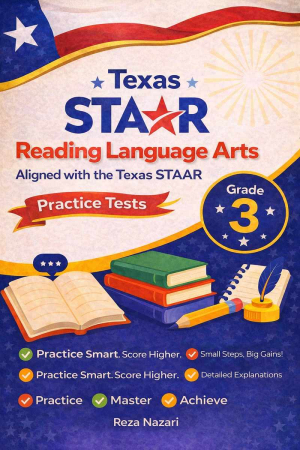
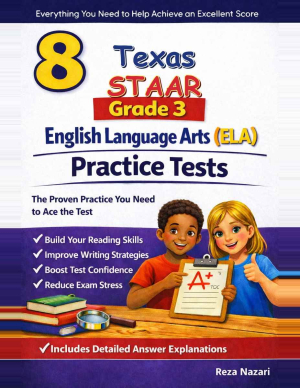
Build a Strong Texas Grade 3 STAAR English Practice Library
Use these Texas Grade 3 resources for reading comprehension, language, writing, and full-length practice where available. Click any cover to open the resource page.

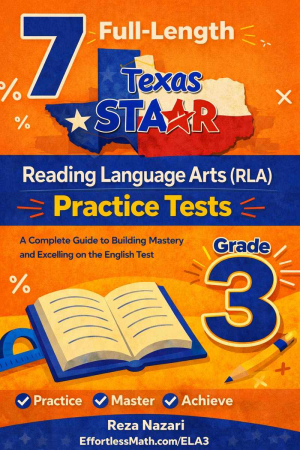
Free Texas Grade 3 English Worksheets
Looking for printable practice that lines up with Texas Grade 3 English standards? Our companion worksheets page collects 42 single-skill PDFs aligned to the STAAR, reading, writing, grammar, vocabulary, and fluency, each with a Quick Review and an answer key. No login, no email required.
How to Use This Texas Grade 3 English Checklist
- Choose one Grade 3 English strand. Start with the current Texas unit, a recent assessment, or the skill that needs the most support.
- Use a real text. Practice Texas Grade 3 reading standards with literary excerpts, science or history articles, poems, interviews, and everyday texts.
- Ask for evidence. Texas Grade 3 students should point to words, sentences, or details that support the answer.
- Write a short response. Turn Texas Grade 3 reading work into a quick paragraph, a claim-evidence note, a summary, or a revised sentence.
- Spiral for Texas STAAR review. Revisit Grade 3 vocabulary, grammar, comprehension, and writing each week so skills stay active.
Texas Grade 3 English Standards FAQ
What does this page cover?
This page provides Grade 3 English Language Arts learning references and links to Texas curriculum resources in clear, original language for families, teachers, tutors, and homeschool planners.
Is this official standards wording?
No. This Texas Grade 3 page is an independent, student-friendly guide for planning and practice. Use the official standards source for formal policy wording.
How should students practice English standards?
For Texas Grade 3, pair real reading passages with short written responses, vocabulary study, grammar review, discussion, and revision. Strong English practice connects skills instead of isolating them.
How does this connect to testing?
The Grade 3 standards describe what students learn; STAAR is the assessment context students may encounter in Texas. Strong preparation comes from careful reading, evidence-based answers, clear writing, and command of language conventions.
Source Note
This independent Texas guide paraphrases Grade 3 English Language Arts expectations for readability and learning support. It is not official wording and is not affiliated with the state education agency. Always consult official standards documents for formal language, updates, and compliance decisions.
For more Texas Grade 3 support, visit the Grade 3 Learning Center.
A USEFUL NEXT STEP
Texas Grade 3 English: study questions
How should I choose a Grade 3 english study target?
Choose a current classroom target, find the matching learning reference, and use a lesson or available practice resource to check understanding. State documents control local wording and placement; shared reference codes are not a certified crosswalk.
Official source ↗Are these activities official state assessments?
These are independently published learning resources. A practice score does not predict or replace an official state score. Use the directions in each activity and consult your school for official testing and accommodation rules.
Resources from Effortless Math · Editorial standards