Free Grade 3 English Worksheets for Texas Students

Anyone who has watched a Texas third grader pick up STAAR Reading Language Arts for the first time has seen the same reaction, wide eyes when the second long passage shows up, slumped shoulders when the third one appears. STAAR is famous for being a passage marathon, especially compared to tests in other states. Third grade is when that kind of sustained reading really starts being asked of kids, and it doesn’t develop on its own.
This page is a free collection of Grade 3 English worksheets that practice the underlying reading and writing skills Texas classrooms work on year-round. Quick note that’s worth saying upfront: Texas runs its own standards framework, the Texas Essential Knowledge and Skills, TEKS, for English Language Arts and Reading. That’s *not* Common Core; it’s the state’s own thing, with its own organization and language. The good news is that universal Grade 3 reading skills don’t change at the state line. Main idea is main idea. Context clues are context clues. The worksheets below cover those universal skills, which line up neatly with what TEKS asks third graders to demonstrate.
There’s no login. No email capture. Click the worksheet title, the PDF opens, you print it. Share it with anyone who’s helping your kid, tutor, grandparent, the family across the street whose kid is in the same class.
A note on the count
You’ll notice this Texas page has fewer worksheets than the pages for some other states. That’s intentional. We’ve included the 42 worksheets that genuinely match what TEKS asks at Grade 3 ELAR, and skipped the ones built around standards that don’t appear in the Texas framework in the same way. The goal is relevance, not volume.
What’s in here
The worksheets below practice the reading, writing, grammar, and vocabulary skills built into the Texas TEKS for Grade 3 English Language Arts and Reading. Reading literary stories. Reading informational texts. Decoding longer words. Writing in different modes. Grammar that shows up on STAAR and on real fourth-grade work next year.
Each worksheet sticks to one skill. That’s intentional. A focused ten or fifteen minutes on one thing beats forty minutes on five, and especially for a kid who’s going to face the long-passage format on STAAR, learning to *concentrate* on one chunk of reading is itself part of the practice.
Reading: Literature
- Text Evidence in Stories, [3.6(F)] find proof in the story for what you say about it
- Central Message, Lesson, or Moral, [3.8(A)] figure out the lesson a story teaches
- Describing Characters in a Story, [3.8(B)] traits, feelings, motivations
- Parts of Stories, Dramas, and Poems, [3.8(C)] chapters, scenes, stanzas
Reading: Nonfiction
- Text Evidence in Nonfiction, [3.6(F)] back up answers with the article itself
- Main Idea and Key Details, [3.6(G)] what the passage is mostly about, and the facts that support it
- Sequence, Steps, and Cause & Effect, [3.9(D)(ii)] first, next, because, so
- Text Features in Nonfiction, [3.9(D)(i)] headings, sidebars, captions
- Author’s Point of View in Nonfiction, [3.6(B)] what the writer thinks vs. Plain facts
- Logical Connections in Nonfiction, [3.9(E)(ii)] how paragraphs connect
Foundational Reading Skills
- Prefixes and Suffixes, [3.2(A)] word parts that change meaning
- Words with Latin Suffixes, [3.2(A)] -tion, -sion, -able
- Decoding Multisyllable Words, [3.2(A)] break the long ones into pieces
- Irregularly Spelled Words (Sight Words), [3.2(B)] the tricky words that just have to be memorized
- Self-Correcting While You Read, [3.5(C)] fix it when the sentence stops making sense
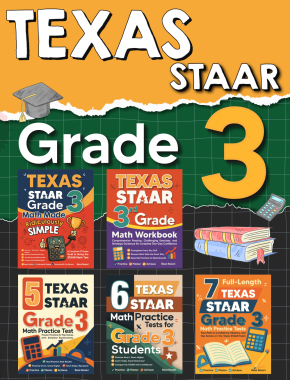
Working on Math Too? Try the Texas STAAR Grade 3 Math Bundle
Many third graders are getting ready for the STAAR in both subjects. If your child also needs math practice that matches the same standards, this companion bundle is the shortest path, workbook, study guide, and full practice tests in one download.
Writing
- Opinion Writing, [3.12(A)] say what you think and back it up
- Narrative Writing, [3.11(A)] tell a story in order, with details
- Editing and Revising, [3.11(C)] make a draft better, one pass at a time
- Gathering Information and Taking Notes, [3.13(D)] write down what you find, not everything you see
Listening and Speaking
- Asking Questions of a Speaker, what to ask after a presentation
- Reporting on a Topic, telling a class about something, clearly
Grammar
- Parts of Speech, nouns, pronouns, verbs, adjectives, adverbs
- Regular and Irregular Plural Nouns, [3.11(D)(viii)] tables; geese; children
- Abstract Nouns, [3.11(D)(viii)] words for ideas and feelings
- Regular and Irregular Verbs, [3.11(D)(iv)] walked vs. Went
- Simple Verb Tenses, past, present, future
- Subject, Verb and Pronoun, Antecedent Agreement, [3.11(D)(viii)] the dog barks; the dogs bark
- Comparative and Superlative Adjectives and Adverbs, [3.11(D)(viii)] fast, faster, fastest
- Coordinating and Subordinating Conjunctions, [3.11(D)(viii)] and, but, because, when
- Simple, Compound, and Complex Sentences, [3.11(D)(viii)] all three sentence types
Capitalization, Punctuation, and Spelling
- Capitalizing Words in Titles, [3.11(D)(x)] title-case rules
- Commas in Addresses and Dates, [3.11(D)(ix)] where the commas go
- Commas and Quotation Marks in Dialogue, [3.11(D)(ix)] punctuating what characters say
- Possessives, [3.11(D)(ix)] showing that something belongs
- Conventional Spelling, common words you’ll spell often
- Spelling Patterns and Generalizations, [3.2(C)] the rules behind the spellings
- Using Reference Materials to Check Spelling, [3.3(A)] look it up to confirm
Vocabulary and Word Study
- Context Clues, [3.3(B)] use surrounding words to find meaning
- Affixes for Vocabulary, [3.3(C)] use word parts to figure out meaning
- Root Words, [3.3(C)] the base word inside a longer one
- Using Glossaries and Beginning Dictionaries, [3.3(A)] look up words to confirm meaning
- Figurative Language: Similes, Metaphors, and Idioms, [3.10(D)] read figurative phrases with confidence
How to actually use these
A worksheet won’t fix anything by itself. A worksheet plus five honest minutes of conversation can do a lot. Here’s the approach I’d suggest, especially for Texas third graders:
Choose one, not five. Print a single sheet that lines up with what your kid is working on this week. The presence of a stack of additional sheets is a guarantee they’ll feel rushed and skip the thinking step.
Read the Quick Review out loud first. That box at the top of the PDF is the actual lesson. Most parents miss it. Slow down on it, work through the example, and only *then* hand over the pencil.
Use the answer key as a teacher, with your kid sitting next to you. Each explanation is written for a real third grader. When something’s wrong, read the explanation aloud, then ask them to redo the problem out loud, this time using the explanation in their own words.
Build reading stamina deliberately. STAAR’s passage-heavy design rewards kids who can stay focused through a longer text. Once a week, separate from the worksheet, pick a short article and ask your kid to read it through without stopping, then tell you the gist. Five minutes. That habit will pay off more than any prep packet by April.
Space things out. If your kid missed three out of ten on Main Idea, don’t redo the same sheet. Wait five or six days, then try a different worksheet on the same skill. The brain does its consolidation work in between sessions, not in the moment.
A word about STAAR
Texas’s State of Texas Assessments of Academic Readiness, STAAR, is the test that families ask about most. The Grade 3 Reading Language Arts portion is rigorous: multiple long passages, multiple-choice questions, and short constructed responses. It was redesigned to be fully online and to add some short writing prompts, which raised the demand on stamina and on actual writing skill.
What STAAR rewards isn’t a cram weekend in March. It’s months of careful, slow reading and writing. Worksheets aren’t a magic prep tool. What they *can* do is build the specific skills STAAR draws on, one at a time, in short sessions a few times a week.
If you want the two highest-use starting points for STAAR prep this year, I’d pick Main Idea and Key Details and Context Clues. Together those skills carry an enormous share of the reading section. After those, Text Evidence in Nonfiction is the next-best place to go.
Questions Texas parents ask
Are these worksheets TEKS-aligned? The worksheets practice universal Grade 3 reading and writing skills that map well onto Texas TEKS for English Language Arts and Reading. Each worksheet stays at the same grade level and rigor TEKS expects at Grade 3.
My kid panics on long passages. Common at this age, and especially with STAAR’s format. Build stamina the way you build running endurance: short reads first, then slightly longer, with a short break, then back in. Don’t make every reading session feel like a test.
My child is reading way above grade level. What now? Author’s Point of View in Nonfiction and Figurative Language stretch strong readers in ways that still belong at Grade 3.
My child is behind grade level. Where do we start? Start with Decoding Multisyllable Words and Prefixes and Suffixes. STAAR’s reading volume is brutal for kids who are still working hard at word level; fixing decoding first makes comprehension less expensive cognitively.
Are these usable for charter or private schools that use STAAR? Yes, and for homeschool families too. The TEKS framework is what most Texas schools work from regardless of district type.
Before you print
If your kid resists the first sheet, that’s not failure. That’s information. Try a shorter one. Try a different skill. Try a Saturday morning instead of a Tuesday night. The goal isn’t a heroic single session; it’s steady habits across the months that lead up to STAAR. Print whatever fits this week. Come back next week when you need the next one. Everything here is free, and it’ll stay that way.
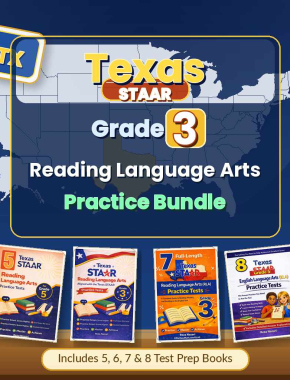
Best Bundle to Ace the Texas STAAR Grade 3 ELA
Looking for the best resource to help your kid ace the Texas STAAR? Try this bundle, four full practice-test books (5 + 6 + 7 + 8 tests) covering the same Grade 3 reading, writing, and language skills your child is already learning. Instant PDF download, answer keys included.

Related to This Article
More math articles
- Citizenship, Participation, and Civil Society
- How to Solve Unknown Angles? (+FREE Worksheet!)
- 6th Grade IAR Math Practice Test Questions
- How to Calculate the Area, Perimeter, and Radius of Quarter Circles
- Selective incorporation
- 6th Grade Math Worksheets for Florida (FAST): 72 Free Printable PDFs
- The Ultimate 7th Grade Scantron Math Course (+FREE Worksheets)
- Framing
- Advanced Vocabulary Words: Emit to Fanatic
- Top 10 Praxis Core Math Prep Books (Our 2023 Favorite Picks)









What people say about "Free Grade 3 English Worksheets for Texas"?
No one replied yet.