LEARN · PRACTICE · EXPLORE
Kentucky Grade 3 English
Analyze an original classroom report’s problem-and-solution structure, explain sentence connections, and use current Kentucky Grade 3 reading references.
Focused lessons · Useful practice · Clear next steps
What do Kentucky 3rd graders learn in ELA?
In 3rd grade, Kentucky English language arts centers on main idea and details, vocabulary from context, and writing organized paragraphs. Students take the KSA grade 3 ELA test in the spring. This page explains each Kentucky grade 3 ELA standard and pairs it with short lessons, printable worksheets and a full-length practice test.
Standards source: Kentucky English Language Arts, Kentucky Department of Education.
Explain how a problem-and-solution paragraph connects its sentences
This original classroom report supplies a problem, a proposed change, and a later observation. Identify each sentence’s job, then explain how the parts work together. Keep the report’s limited observation separate from a claim about every classroom.
Curriculum reference: Kentucky Academic Standards for Reading and Writing, October 2025, from the Kentucky Department of Education standards directory.
Kentucky Grade 3 references for this activity
Kentucky’s current directory links the October 2025 Reading and Writing standards, adopted into law in May 2026. Read the Grade 3 expectations in the full state document. The selected reference supports this activity; use the school’s sequence and the remaining expectations for wider coverage.
| Grade-level expectation | Activity focus | Official requirement |
|---|---|---|
| RI.3.5 | Connect sentences within a problem-and-solution structure | Read the state document (PDF page 117) |
These are selected grade-level expectations from Kentucky’s current English standards. Activity labels describe a teaching focus rather than reproduce complete requirements. Read the linked state document’s complete grade-level expectations, including its grade-specific details, alongside the school’s curriculum sequence.
A worked Grade 3 reading and writing activity
This original classroom example is separate from official assessment questions.
The class kept spare pencils in a closed box on the teacher’s desk. During writing time, children often asked where to find them. The teacher moved the pencils to an open cup beside a sign reading “Spare pencils.”
The class tried the new arrangement for one writing session. Several children found a pencil without asking the teacher. The class decided to keep the sign and cup for the next session and watch whether they remained helpful.
Try the activity
Identify the problem, the proposed solution, and the later observation. Explain why the second paragraph follows the first, using details from both.
Follow the reasoning
The problem is not simply that the class owns pencils. Children often ask where to find the spare ones. Moving them to an open cup with a clear sign addresses that difficulty. The second paragraph describes what happened when the class tried the arrangement: several children found pencils without asking. It then tells the next decision. This order lets the reader connect an identified problem, a change meant to help, and a limited observation about that change. A strong explanation says how the paragraphs connect, not just “the first has three sentences.” The solution sentence would make less sense if the reader did not know why the closed box caused a difficulty.
Notice what needs more practice
The passage reports only one writing session and does not count every child’s experience. “Several children” does not mean “all children,” and the decision to observe another session shows that the class is still checking the arrangement. A student may think the teacher dislikes questions, but the text does not say that. Return to the stated problem instead. The label problem-and-solution is useful because it describes the relationship among the ideas; it is not a substitute for explaining those ideas. Some sentences also follow time order. A text can use sequence while its main organization develops a problem and a response to it.
Grade 3 English worksheets
Choose printable practice that matches the skill being taught. Check the task, reading difficulty, and directions before assigning it; the collection is independently published.
Use the next session to build independence
- Mark the sentence that establishes the difficulty.
- Explain how the change addresses that difficulty.
- Connect the later observation and decision to the earlier plan.
For transfer, move the observation paragraph before the problem paragraph and discuss what context the reader loses. Then write a short new report about a teacher-selected classroom arrangement, clearly labeling invented examples or actual observations. Include a specific difficulty, a change connected to it, and an honest account of what is known afterward. Do not invent a positive result to finish the pattern. Kentucky’s selected standard also includes other informational structures and connections; this example concentrates on problem and solution. Continue with comparison and cause-and-effect texts through the local curriculum, checking the whole grade-level document when choosing the next lesson.
For more general reading and writing resources, visit the Grade 3 English Online Center.
Kentucky Grade 3 English: useful planning questions
Can a text use time order and problem-and-solution structure together?
Yes. Explain the relationship among the ideas. This report presents a difficulty, a change, and an observation in time order while developing a problem and its proposed solution.
Where are the complete state requirements?
Kentucky’s current directory links the October 2025 Reading and Writing standards, adopted into law in May 2026. Read the Grade 3 expectations in the full state document. The selected reference supports this activity; use the school’s sequence and the remaining expectations for wider coverage. The school’s sequence also includes reading, writing, speaking, listening, and language work beyond this example.
Official sources checked October 6, 2026. Grade 3 is within the Kentucky Summative Assessment reading testing range. This original lesson is independent practice. Read Kentucky’s current assessment guidance and use the school’s guidance for preparation. Kentucky’s current guidance lists KSA reading and mathematics in Grades 3–8 and 10. Beginning in 2026–27, KSA no longer tests writing or editing and mechanics. Writing and language remain part of classroom instruction. The other KSA content-area tests remain; follow the school’s current assignment and directions, including any assigned alternate-assessment pathway. This original classroom activity is independently published practice, not an official KSA item or a prediction of a state performance level. The May 2026 adoption notice explains the revised reading and writing standards. Check independently published books and practice against current standards and assessment guidance.
Grade 3 English in other states
When moving between school systems, compare the official curriculum and the school’s learning sequence. Use the national Online Center’s map to find another state’s resources.
Recommended Kentucky Grade 3 resources
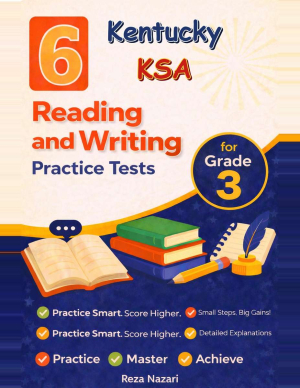
Build a Strong Kentucky Grade 3 KSA English Practice Library
These independently published resources have their own coverage and editions. Check the contents alongside Kentucky’s current English standards before choosing assessment preparation.
Use these Kentucky Grade 3 resources for reading comprehension, language, writing, and full-length practice where available. Click any cover to open the resource page.
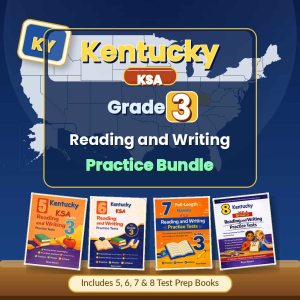
More Grade 3 resources
A USEFUL NEXT STEP
Kentucky Grade 3 English: study questions
Can a text use time order and problem-and-solution structure together?
Yes. Explain the relationship among the ideas. This report presents a difficulty, a change, and an observation in time order while developing a problem and its proposed solution.
Where are the complete Kentucky Grade 3 requirements?
Kentucky’s current directory links the October 2025 Reading and Writing standards, adopted into law in May 2026. Read the Grade 3 expectations in the full state document. The selected reference supports this activity; use the school’s sequence and the remaining expectations for wider coverage.
Official source ↗Resources from Effortless Math · Editorial standards