LEARN · PRACTICE · EXPLORE
Nebraska Grade 3 English
Build Nebraska Grade 3 English skills with an original narrative point of view activity, a worked response, 2021 state references and printable practice.
Focused lessons · Useful practice · Clear next steps
What do Nebraska 3rd graders learn in ELA?
In 3rd grade, Nebraska English language arts centers on main idea and details, vocabulary from context, and writing organized paragraphs. Students take the NSCAS grade 3 ELA test in the spring. This page explains each Nebraska grade 3 ELA standard and pairs it with short lessons and printable worksheets.
Printable Nebraska grade 3 ELA books:
- Nebraska NSCAS Growth Grade 3 ELA: 8 Full Practice Tests
- Nebraska NSCAS Growth Grade 3 ELA: 7 Full Practice Tests
- Nebraska NSCAS Growth Grade 3 ELA: 5 Full Practice Tests
- 6 Nebraska NSCAS Growth English Language Arts (ELA) Grade 3: Full Practice Tests
- Nebraska Grade 3 English Language Arts (ELA) Preparation Bundle
Standards source: Nebraska English Language Arts, Nebraska Department of Education.
Identify the narrator and the limits of the viewpoint
A narrator tells the story; an author writes it. Notice who speaks and which thoughts the narrator reports. This short original account gives a first-person viewpoint and a useful limit on what the reader can know.
Curriculum reference: Nebraska College and Career Ready Standards for English Language Arts, approved September 2, 2021, from the Nebraska Department of Education ELA directory.
Nebraska Grade 3 references for this activity
Nebraska’s current English directory links the 2021 College and Career Ready Standards approved September 2, 2021. The selected code and page below were checked in that document. The framework uses Nebraska LA codes; a generic Common Core checklist is not a substitute for its grade-level requirements. Read the complete standards and use the school’s locally determined curriculum.
| Grade-level expectation | Activity focus | Official requirement |
|---|---|---|
| LA.3.RP.3 | Narrative point of view | Read the state framework (PDF page 47) |
These selected reference labels identify an activity focus, with the grade column and PDF page linked separately. Read the complete state requirements and the school’s sequence, including reading, writing, language, speaking, and listening. This short original example does not fulfill the entire curriculum or establish a student’s grade-level proficiency.
A worked Grade 3 English activity
This original classroom example is separate from official assessment questions.
I held the cardboard ramp while Jo rolled the marble. It stopped halfway down. I worried that my hand had tilted the ramp, but Jo only said, “Let’s check the folded edge.” I kept holding it while Jo smoothed the edge. The marble rolled to the bottom on the next try.
Try the activity
Who tells this account, and what viewpoint does it use? Explain one thought the text supplies and one thought it does not supply.
Follow the reasoning
The person holding the ramp narrates the account in first person. The words I and my show that the narrator participates in the action. The narrator reports worrying that a tilted ramp causes the stop. Jo’s spoken suggestion and later action are also reported, but Jo’s private thoughts are not. We can say Jo suggests checking the folded edge; we cannot say Jo secretly blames the narrator. The next successful roll follows smoothing the edge, yet the passage does not provide a controlled investigation proving the cause of the first stop. Its viewpoint lets us follow the narrator’s worry and observe Jo’s response.
Notice what needs more practice
The narrator’s name is not given. Calling the narrator Jo would confuse the person saying I with the character addressed as Jo. Nor does first person mean that the author personally experiences the event: this is an invented story. Avoid turning the narrator’s worry into a proven fact about the ramp. The text distinguishes an internal concern, a spoken suggestion, and an observed result.
Grade 3 English worksheets
Choose printable practice that matches the skill being taught. Check the task, reading difficulty, and directions before assigning it; the collection is independently published.
Use the next session to build independence
- Underline the words that identify the storyteller.
- Separate the narrator’s thought from Jo’s dialogue.
- Explain what the viewpoint reveals and what remains unknown.
Rewrite the opening as “Sam held the ramp while Jo rolled the marble.” That changes the grammatical viewpoint to third person, but does not automatically reveal every character’s thoughts. Discuss what additional wording would be needed to report Jo’s thinking.
For more general reading and writing resources, visit the Grade 3 English Online Center.
Nebraska Grade 3 English: useful planning questions
Does a first-person narrator know everyone’s thoughts?
No. This narrator reports a personal worry and Jo’s words and actions, but does not report Jo’s private thoughts.
Where are the complete state requirements?
Nebraska’s current English directory links the 2021 College and Career Ready Standards approved September 2, 2021. The selected code and page below were checked in that document. The framework uses Nebraska LA codes; a generic Common Core checklist is not a substitute for its grade-level requirements. Read the complete standards and use the school’s locally determined curriculum. The school’s sequence also includes reading, writing, speaking, listening, and language work beyond this example.
Sources checked October 6, 2026. NDE identifies NSCAS English Language Arts as the general statewide assessment in Grades 3–8, including Grade 3. Follow the school’s assigned assessment pathway and current administration directions. Read the Nebraska NSCAS English overview and the NDE ELA directory for current guidance. Independently published practice may use its own timer, question count, and scoring; those features are not official administration specifications or a prediction of a state performance level. Use the complete standards and the school’s learning sequence to choose further reading, writing, speaking, listening, and language work. This original classroom activity is not an official assessment item.
Grade 3 English in other states
When moving between school systems, compare the official curriculum and the school’s learning sequence. Use the national Online Center’s map to find another state’s resources.
Recommended Nebraska Grade 3 resources
Build a Strong Nebraska Grade 3 NSCAS English Practice Library
These independently published resources have their own coverage and editions. Check the contents alongside Nebraska’s current English standards before choosing assessment preparation.
Use these Nebraska Grade 3 resources for reading comprehension, language, writing, and full-length practice where available. Click any cover to open the resource page.
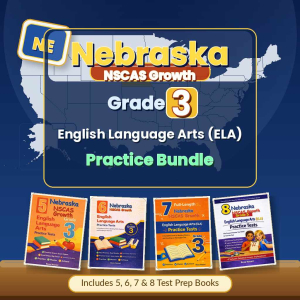 Nebraska Grade 3 English Language Arts (ELA) Preparation Bundle
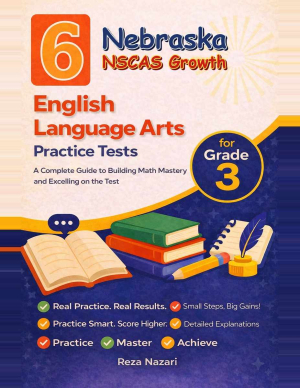 6 Nebraska NSCAS Growth English Language Arts (ELA) Grade 3: Full Practice Tests
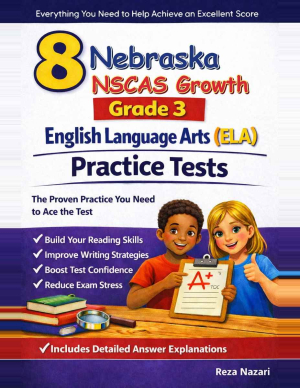 Nebraska NSCAS Growth Grade 3 ELA: 8 Full Practice Tests
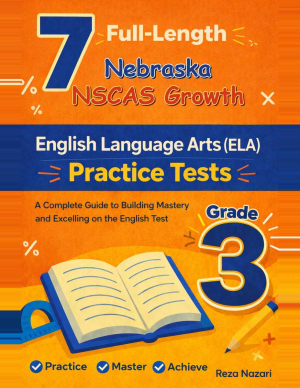 Nebraska NSCAS Growth Grade 3 ELA: 7 Full Practice Tests
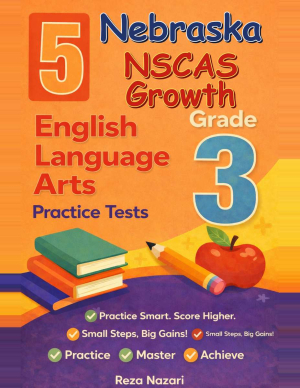 Nebraska NSCAS Growth Grade 3 ELA: 5 Full Practice Tests
More Grade 3 resources
A USEFUL NEXT STEP
Nebraska Grade 3 English: study questions
Does a first-person narrator know everyone’s thoughts?
No. This narrator reports a personal worry and Jo’s words and actions, but does not report Jo’s private thoughts.
Where are the complete Nebraska Grade 3 requirements?
Nebraska’s current English directory links the 2021 College and Career Ready Standards approved September 2, 2021. The selected code and page below were checked in that document. The framework uses Nebraska LA codes; a generic Common Core checklist is not a substitute for its grade-level requirements. Read the complete standards and use the school’s locally determined curriculum.
Official source ↗Resources from Effortless Math · Editorial standards