LEARN · PRACTICE · EXPLORE
New York Grade 3 English
Use an original Grade 3 information text’s headings to answer a question, separate instructions from observations, and practice with New York English resources.
Focused lessons · Useful practice · Clear next steps
What do New York 3rd graders learn in ELA?
In 3rd grade, New York English language arts centers on main idea and details, vocabulary from context, and writing organized paragraphs. Students take the New York State grade 3 ELA test in the spring. This page explains each New York grade 3 ELA standard and pairs it with short lessons, printable worksheets and a full-length practice test.
Printable New York grade 3 ELA books:
Standards source: New York adopted content standards.
Using Headings to Find Information
Use an original Grade 3 information text’s headings to answer a question, separate instructions from observations, and practice with New York English resources. Use this focused activity alongside the school’s wider reading, writing, speaking, listening, and language sequence.
Curriculum reference: 2017 New York State Next Generation English Language Arts Learning Standards, from the New York English Language Arts standards page.
New York Grade 3 references for this activity
New York’s English Language Arts page links the 2017 Next Generation ELA Learning Standards. The state’s implementation timeline places Pre-K–8 instruction under those standards from September 2022, with Grades 3–8 assessment first aligned in Spring 2023. The selected reading references below identify this activity’s focus; use the complete grade requirements and the school’s broader literacy program.
| Selected New York reading reference | Activity focus | State-hosted standards document |
|---|---|---|
| 3R1 | Locate relevant details for an answer | Read the state-hosted document (PDF page 47) |
| 3R5 | Use informational text features to build understanding | Read the state-hosted document (PDF page 47) |
| 3R7 | Explain how a feature contributes to meaning | Read the state-hosted document (PDF page 47) |
These selected reference labels identify an activity focus, with the correct grade and PDF page linked separately. Read the complete standards selected by the school and its learning sequence, including reading, writing, language, speaking, and listening. This short original example does not fulfill the entire curriculum or establish a student’s grade-level proficiency.
A guide with three different jobs
This original classroom example is separate from official assessment questions.
What the class wanted to find out
Our class wanted to know whether labels helped visitors return books to the correct shelf.
How the trial worked
On Monday we put labels on two shelves. A helper watched ten book returns and recorded whether each book reached its labeled shelf. The helper did not move books during the trial.
What the helper observed
Eight books reached the correct shelf. Two were left on the table. The class planned another trial with larger labels, but that trial had not happened when this guide was written.
Try the activity
Which heading helps you find what the helper did? Which heading helps you find the result? Explain how those headings help a reader answer quickly. Has the class shown that larger labels work better?
Follow the reasoning
“How the trial worked” introduces the setup and recording procedure, so it answers what the helper did. “What the helper observed” introduces the results: eight correct returns and two books on the table. The headings divide a question, a method, and a result into recognizable sections. A reader looking for an observation does not have to treat the purpose or proposed next trial as a result. Larger labels are a plan only; no result of that trial is reported. The record shows how ten returns went with the original labels, but lacks a comparison without labels. It therefore does not establish that labels caused all eight correct returns.
Notice what needs more practice
A heading directs attention but does not replace the evidence in its section. The two books on the table are not recorded as books placed on the wrong shelf. Preserve that distinction. All numbers and events are invented for reading practice; they are not findings from a New York school study.
Grade 3 English worksheets
Choose printable practice that matches the skill being taught. Check the task, reading difficulty, and directions before assigning it; the collection is independently published.
Use the next session to build independence
- Choose the heading that matches the question.
- Read the supporting detail within that section.
- Explain what the feature helps distinguish and what remains untested.
Reorganize the guide under the same headings using shorter notes. Then find headings in a teacher-selected real information text. Explain how a heading helps answer one question and why you still need to read the section.
For more general reading and writing resources, visit the Grade 3 English Online Center.
New York Grade 3 English: useful planning questions
Does a heading alone answer the question?
Usually it points to the relevant section. Use the section’s actual details to support the answer, and explain what the heading helps you locate.
Which standards does the school use?
New York’s English Language Arts page links the 2017 Next Generation ELA Learning Standards. The state’s implementation timeline places Pre-K–8 instruction under those standards from September 2022, with Grades 3–8 assessment first aligned in Spring 2023. The selected reading references below identify this activity’s focus; use the complete grade requirements and the school’s broader literacy program. The school’s sequence also includes reading, writing, speaking, listening, and language work beyond this example.
Sources checked October 6, 2026. The 2026–2027 NYSED schedule places Grades 3–8 ELA, including Grade 3, in an April 5–May 14, 2027 window. Each school sets its grade/subject administration dates within that window; ELA uses two consecutive school days. Confirm the learner’s assigned pathway, accommodations, and current school directions. Read the official 2026–2027 testing schedule (PDF), NYSED schedules page, ELA standards page, and instruction and assessment implementation timeline (PDF). Independently published practice has its own directions and scoring. Its result does not predict a state performance level, and this original activity is not an official assessment item.
Grade 3 English in other states
When moving between school systems, compare the official curriculum and the school’s learning sequence. Use the national Online Center’s map to find another state’s resources.
Recommended New York Grade 3 resources
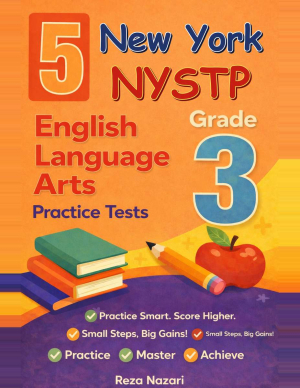
Build a Strong New York Grade 3 NYSTP English Practice Library
These independently published resources have their own coverage and editions. Check the contents alongside New York’s current English standards before choosing assessment preparation.
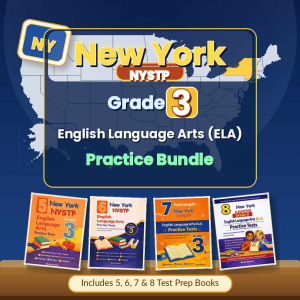
Use these New York Grade 3 resources for reading comprehension, language, writing, and full-length practice where available. Click any cover to open the resource page.
More Grade 3 resources
A USEFUL NEXT STEP
New York Grade 3 English: study questions
Does a heading alone answer the question?
Usually it points to the relevant section. Use the section’s actual details to support the answer, and explain what the heading helps you locate.
Where are the complete New York Grade 3 requirements?
New York’s English Language Arts page links the 2017 Next Generation ELA Learning Standards. The state’s implementation timeline places Pre-K–8 instruction under those standards from September 2022, with Grades 3–8 assessment first aligned in Spring 2023. The selected reading references below identify this activity’s focus; use the complete grade requirements and the school’s broader literacy program.
Official source ↗Resources from Effortless Math · Editorial standards