LEARN · PRACTICE · EXPLORE
Arkansas Grade 3 English
Compare two short accounts of a classroom book cart, organize shared and different details, and write an explanation using Arkansas Grade 3 references.
Focused lessons · Useful practice · Clear next steps
What do Arkansas 3rd graders learn in ELA?
In 3rd grade, Arkansas English language arts centers on main idea and details, vocabulary from context, and writing organized paragraphs. Students take the ATLAS grade 3 ELA test in the spring. This page explains each Arkansas grade 3 ELA standard and pairs it with short lessons, printable worksheets and a full-length practice test.
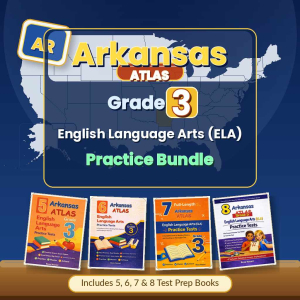
Printable Arkansas grade 3 ELA books:
Standards source: Arkansas Academic Standards, Arkansas Division of Elementary and Secondary Education.
Combine two accounts without losing their differences
Two texts about the same event do not always report the same details. Grade 3 readers can begin by naming what both texts establish, then noticing what only one adds. The following two invented accounts make that distinction visible without requiring outside research.
Curriculum source: Arkansas’s 2023 K–12 English Language Arts Standards, from the Arkansas Department of Education standards directory.
Arkansas Grade 3 references for this activity
The Grade 3 section of Arkansas’s official 2023 K–12 document gives the complete requirements. The references below are selected for this activity, rather than a complete course checklist.
| Arkansas code | Activity focus | Official requirement |
|---|---|---|
| 3.RC.14.RI | Two-text comparison | Read the state document, page 21 |
| 3.W.2.S | Source-based explanation | Read the state document, page 22 |
A worked Grade 3 reading and writing activity
This original classroom example is separate from official assessment questions.
Account A: Our class made a rolling book cart from a donated shelf. Students put picture books on the top shelf and longer books below. The cart visited two classrooms on Friday. Account B: On Friday, the new book cart came to our room. I chose a picture book from the top shelf. Before the cart left, our teacher added three books for the next class.
Try the activity
Make three headings: Both accounts, Only A, and Only B. Place details under each heading. Then write three sentences explaining the cart visit, using at least one detail from each account.
Follow the reasoning
Both accounts describe the book cart visiting classrooms on Friday and placing picture books on the top shelf. Only A explains that a donated shelf became the cart and that longer books went below. Only B describes a reader choosing a book and the teacher adding three more. A combined explanation might say: “The class turned a donated shelf into a book cart. On Friday, a reader chose a picture book from its top shelf. A teacher added three books before it continued to the next class.” These sentences draw from both accounts without pretending both authors witnessed every detail.
Notice what needs more practice
Watch for an answer that repeats Account A and calls it a comparison. Also watch for invented details, such as the cart visiting every classroom. Two classrooms are reported; every classroom is not. Different information is not automatically conflicting information. Nothing in B contradicts the shelf arrangement described in A.
Grade 3 English worksheets
Choose printable practice that matches the skill being taught. Check the task, reading difficulty, and directions before assigning it; the collection is independently published.
Use the next session to build independence
- Read each account separately and name its topic before comparing details.
- Sort the details, keeping an account label beside each note.
- Write the explanation, then underline the detail from A and circle the detail from B.
For a longer classroom task, compare two age-appropriate texts on a topic already being studied. Keep the same three headings, but select only details that answer the research question. If the accounts disagree, record the disagreement rather than choosing the more interesting version without evidence.
For more general reading and writing resources, visit the Grade 3 English Online Center.
Arkansas Grade 3 English: useful planning questions
Must two texts say the same things to be useful together?
No. They may contribute different details about the same topic. A useful comparison identifies the overlap and the additions, and checks whether any statements actually conflict.
Where are the complete state requirements?
The Grade 3 section of Arkansas’s official 2023 K–12 document gives the complete requirements. The references below are selected for this activity, rather than a complete course checklist. The school’s sequence also includes reading, writing, speaking, listening, and language work beyond this example.
State sources checked October 5, 2026. Grade 3 falls within the K–3 literacy screening range and the older-grade ATLAS interim and end-of-year program. Read the screening overview and the older-grade assessment overview.
Grade 3 English in other states
When moving between school systems, compare the official curriculum and the school’s learning sequence. Use the national Online Center’s map to find another state’s resources.
Recommended Arkansas Grade 3 resources
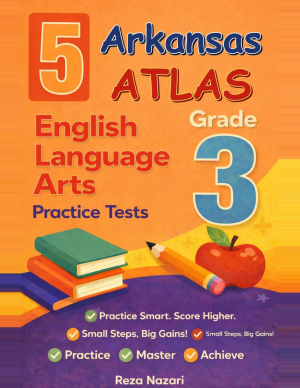
Build a Strong Arkansas Grade 3 ATLAS English Practice Library
Use these Arkansas Grade 3 resources for reading comprehension, language, writing, and full-length practice where available. Click any cover to open the resource page.
A USEFUL NEXT STEP
Arkansas Grade 3 English: study questions
Must two texts say the same things to be useful together?
No. They may contribute different details about the same topic. A useful comparison identifies the overlap and the additions, and checks whether any statements actually conflict.
Where are the complete Arkansas Grade 3 requirements?
The Grade 3 section of Arkansas’s official 2023 K–12 document gives the complete requirements. The references below are selected for this activity, rather than a complete course checklist.
Official source ↗Resources from Effortless Math · Editorial standards