LEARN · PRACTICE · EXPLORE
California Grade 3 English
Use each other and one another to show shared actions, repair an unclear sentence, and check agreement with selected California Grade 3 language references.
Focused lessons · Useful practice · Clear next steps
What do California 3rd graders learn in ELA?
In 3rd grade, California English language arts centers on main idea and details, vocabulary from context, and writing organized paragraphs. Students take the CAASPP grade 3 ELA test in the spring. This page explains each California grade 3 ELA standard and pairs it with short lessons, printable worksheets and a full-length practice test.
Printable California grade 3 ELA books:
Standards source: Content Standards, California Department of Education.
Make each other and one another clear in a sentence
The words each other can express an action going in both directions. They are easy to read past without checking who did what. California adds reciprocal pronouns to its Grade 3 language expectations, so this lesson gives that small but useful feature a concrete classroom setting.
Curriculum source: California Common Core State Standards for ELA/Literacy (modified March 2013), from the California Department of Education resource directory.
California Grade 3 references for this activity
California’s official English language arts document contains the Grade 3 expectations across its subject strands. These are two selected references for the activity below; use the full document for curriculum planning.
| California code | Activity focus | Official requirement |
|---|---|---|
| L.3.1k (CA) | Reciprocal pronouns | Read the state document, page 42 |
| L.3.1f | Agreement in sentences | Read the state document, page 42 |
California additions are marked CA in the official document. The labels here identify the activity’s focus; they do not reproduce the complete requirements. For teaching support, consult the state ELA/ELD Framework.
A worked Grade 3 reading and writing activity
This original classroom example is separate from official assessment questions.
Lena checked Omar’s drawing. Omar checked Lena’s drawing. Later, three students helped one another label their models. Draft sentence: “Lena and Omar checks each other’s drawings.”
Try the activity
Combine the first two sentences using each other. Then repair the draft sentence. Ask the child to explain both changes: the shared action and the verb that agrees with the two named students.
Follow the reasoning
“Lena and Omar checked each other’s drawings” combines the first pair without changing the exchange. Lena checked Omar’s work, and Omar checked Lena’s. In the draft sentence, Lena and Omar names a plural subject, so the present-tense repair is “Lena and Omar check each other’s drawings.” Each other refers back to the students; it does not make the subject singular. The apostrophe in each other’s shows whose drawings are being checked.
Notice what needs more practice
“Lena checked herself” means something different: she checked her own work. Ask the child to trace the action with arrows between two names before choosing a pronoun. Avoid teaching that each other must always be used for exactly two people and one another for more; common usage allows overlap. The important check here is whether the sentence describes a mutual action clearly.
Grade 3 English worksheets
Choose printable practice that matches the skill being taught. Check the task, reading difficulty, and directions before assigning it; the collection is independently published.
Use the next session to build independence
- Draw arrows showing Lena checking Omar’s work and Omar checking Lena’s.
- Say the combined sentence, then write it.
- Write a new sentence about partners helping each other, and underline the subject and verb.
During revision of a classroom paragraph, look for one place where a shared action can be stated more clearly. Keep the names near the pronoun so a reader knows whom it refers to. If the child changes every pronoun to each other, compare mutual action with an action directed toward only one person.
For more general reading and writing resources, visit the Grade 3 English Online Center.
California Grade 3 English: useful planning questions
How is each other different from themselves?
Each other can show an exchange between people. Themselves can show people acting on their own behalf. Compare partners checking each other’s work with partners checking their own work, and ask who checks whose page.
Where are the complete state requirements?
California’s official English language arts document contains the Grade 3 expectations across its subject strands. These are two selected references for the activity below; use the full document for curriculum planning. The school’s sequence also includes reading, writing, speaking, listening, and language work beyond this example.
State sources checked October 5, 2026. Grade 3 is within the Smarter Balanced summative ELA testing range. This original lesson is independent practice. Read the official assessment overview and use the school’s guidance for preparation.
Grade 3 English in other states
When moving between school systems, compare the official curriculum and the school’s learning sequence. Use the national Online Center’s map to find another state’s resources.
Recommended California Grade 3 resources
Build a Strong California Grade 3 CAASPP English Practice Library
Use these California Grade 3 resources for reading comprehension, language, writing, and full-length practice where available. Click any cover to open the resource page.
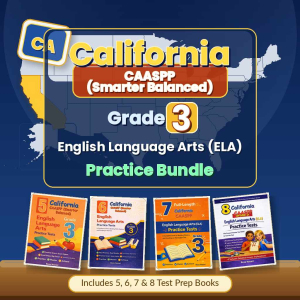 California Grade 3 English Language Arts (ELA) Preparation Bundle
 6 California CAASPP English Language Arts (ELA) Grade 3: Full Practice Tests
 California CAASPP Grade 3 ELA: 8 Full Practice Tests
 California CAASPP Grade 3 ELA: 7 Full Practice Tests
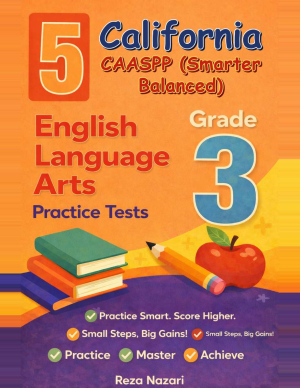 California CAASPP Grade 3 ELA: 5 Full Practice Tests
A USEFUL NEXT STEP
California Grade 3 English: study questions
How is each other different from themselves?
Each other can show an exchange between people. Themselves can show people acting on their own behalf. Compare partners checking each other’s work with partners checking their own work, and ask who checks whose page.
Where are the complete California Grade 3 requirements?
California’s official English language arts document contains the Grade 3 expectations across its subject strands. These are two selected references for the activity below; use the full document for curriculum planning.
Official source ↗Resources from Effortless Math · Editorial standards