LEARN · PRACTICE · EXPLORE
Rhode Island Grade 3 English
Distinguish your point of view from an author’s in an original Grade 3 reading activity, with Rhode Island references and a worked explanation.
Focused lessons · Useful practice · Clear next steps
What do Rhode Island 3rd graders learn in ELA?
In 3rd grade, Rhode Island English language arts centers on main idea and details, vocabulary from context, and writing organized paragraphs. Students take the RICAS grade 3 ELA test in the spring. This page explains each Rhode Island grade 3 ELA standard and pairs it with short lessons and printable worksheets.
Printable Rhode Island grade 3 ELA books:
- Rhode Island RICAS Grade 3 ELA: 8 Full Practice Tests
- Rhode Island RICAS Grade 3 ELA: 7 Full Practice Tests
- Rhode Island RICAS Grade 3 ELA: 5 Full Practice Tests
- 6 Rhode Island RICAS English Language Arts (ELA) Grade 3: Full Practice Tests
- Rhode Island Grade 3 English Language Arts (ELA) Preparation Bundle
Standards source: Rhode Island adopted content standards.
Separate Your View from the Author’s
Distinguish your point of view from an author’s in an original Grade 3 reading activity. Read the passage, try the task, and use the explanation to check the evidence behind your response.
Curriculum reference: Rhode Island Core Standards for English Language Arts/Literacy, 2021, from the Rhode Island English language arts standards page.
Rhode Island Grade 3 references for this activity
Rhode Island’s Council on Elementary and Secondary Education endorsed the Rhode Island Core Standards for English language arts/literacy and mathematics on March 9, 2021. This activity links a selected reading reference in RIDE’s 2021 English document. The complete curriculum also includes writing, language, speaking, and listening; check the school’s texts and learning sequence.
| Selected Rhode Island reading reference | Activity focus | State-linked standards document |
|---|---|---|
| RI.3.6 | Distinguish your point of view from an author’s | Read the state-linked document (PDF page 27) |
These selected reference labels identify an activity focus, with the correct grade and PDF page linked separately. Read the complete standards selected by the school and its learning sequence, including reading, writing, language, speaking, and listening. This short original example does not fulfill the entire curriculum or establish a student’s grade-level proficiency.
How to arrange a reading shelf
This original classroom example is separate from official assessment questions.
Arrange the reading shelf by topic. Put books about animals together and books about space together. A reader who wants a particular topic can see several choices in one place. Keep labels clear so readers can find the group they need.
Try the activity
What arrangement does the author favor, and what reason supports it? A reader says, “I prefer putting books in order by the writers’ names.” Separate that reader’s view from the author’s view without changing either one.
Follow the reasoning
The author favors arranging books by topic. The reason is that readers interested in a topic can find several related choices together. The other reader favors ordering books by writers’ names. That is the reader’s preference, not a statement the author makes. The author’s instructions and reason establish the view in this passage; they do not establish that every other arrangement fails. A clear response might say: “The author recommends topic groups to help readers find related books. I might prefer a different arrangement, but that preference is my view.” Students should name their own actual preference rather than copy the example as a required opinion.
Notice what needs more practice
The invented passage presents one recommendation. It does not report a measured comparison of shelving systems. Agreeing or disagreeing with the author does not change what the author says.
Grade 3 English worksheets
Choose printable practice that matches the skill being taught. Check the task, reading difficulty, and directions before assigning it; the collection is independently published.
Use the next session to build independence
- State the author’s recommendation.
- Locate the reason given for it.
- Write your own view in a separate sentence.
Use a teacher-selected informational paragraph that expresses a view. Explain that view with evidence, then write a clearly labeled personal response.
For more general reading and writing resources, visit the Grade 3 English Online Center.
Rhode Island Grade 3 English: useful planning questions
Must I agree with an author to explain the author’s view?
No. You can describe the author’s position accurately and then state a different view of your own.
Which standards does the school use?
Rhode Island’s Council on Elementary and Secondary Education endorsed the Rhode Island Core Standards for English language arts/literacy and mathematics on March 9, 2021. This activity links a selected reading reference in RIDE’s 2021 English document. The complete curriculum also includes writing, language, speaking, and listening; check the school’s texts and learning sequence. The school’s sequence also includes reading, writing, speaking, listening, and language work beyond this example.
Sources checked October 6, 2026. RIDE places the RICAS English and mathematics assessments in Grades 3–8, including Grade 3. Confirm the school’s current assignments, directions, and accommodations. This independently authored reading activity is not an official RICAS item and does not reproduce a state test. Read the Rhode Island English assessment overview and English standards guidance. Independently published practice has its own directions and scoring. Its result does not predict a state performance level, and this original activity is not an official assessment item.
Grade 3 English in other states
When moving between school systems, compare the official curriculum and the school’s learning sequence. Use the national Online Center’s map to find another state’s resources.
Recommended Rhode Island Grade 3 resources
Build a Strong Rhode Island Grade 3 RICAS English Practice Library
These independently published resources have their own coverage and editions. Check the contents alongside Rhode Island’s current English standards before choosing assessment preparation.
Use these Rhode Island Grade 3 resources for reading comprehension, language, writing, and full-length practice where available. Click any cover to open the resource page.
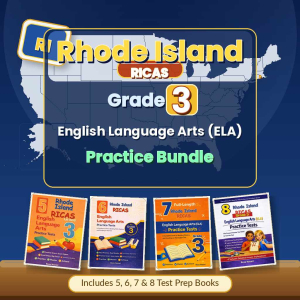 Rhode Island Grade 3 English Language Arts (ELA) Preparation Bundle
 6 Rhode Island RICAS English Language Arts (ELA) Grade 3: Full Practice Tests
 Rhode Island RICAS Grade 3 ELA: 8 Full Practice Tests
 Rhode Island RICAS Grade 3 ELA: 7 Full Practice Tests
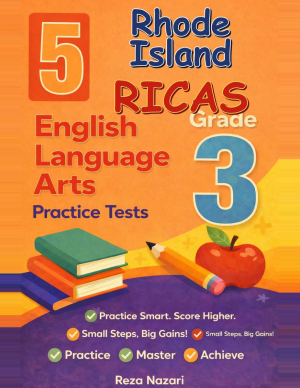 Rhode Island RICAS Grade 3 ELA: 5 Full Practice Tests
More Grade 3 resources
A USEFUL NEXT STEP
Rhode Island Grade 3 English: study questions
Must I agree with an author to explain the author’s view?
No. You can describe the author’s position accurately and then state a different view of your own.
Where are the complete Rhode Island Grade 3 requirements?
Rhode Island’s Council on Elementary and Secondary Education endorsed the Rhode Island Core Standards for English language arts/literacy and mathematics on March 9, 2021. This activity links a selected reading reference in RIDE’s 2021 English document. The complete curriculum also includes writing, language, speaking, and listening; check the school’s texts and learning sequence.
Official source ↗Resources from Effortless Math · Editorial standards