Free Grade 3 English Worksheets for Rhode Island Students
Rhode Island is small, but third grade isn’t. Somewhere in those ten months a kid has to make the jump from sounding words out to figuring out what a paragraph is really doing, and they have to do it while learning long division at the same time. It’s a big year for a little person.
This page is a small library of free Grade 3 ELA worksheets for that big year. They line up with Rhode Island’s ELA standards, and they’re the kind of practice RICAS rewards, slow reading, evidence on the page, a sentence or two that actually answers the question. Each worksheet is one skill on one printable, with an answer key that doesn’t just say “B.” It explains the reasoning, in language a third grader can use.
Free to print. No accounts. No “enter your email.” Click, open, print. Whether you’re a teacher in Providence, a parent in Newport, or a tutor working with a single kid on a Saturday morning, you’re welcome to take what you need.
What’s in here
Rhode Island’s ELA standards are built on the same backbone as Massachusetts’s, which makes sense, since RICAS itself shares its blueprint with MCAS. So the Grade 3 skills covered here are the ones any third-grade teacher in Cranston or Warwick is already working on: reading stories carefully, reading articles carefully, decoding the longer words, building short pieces of writing, and putting commas where they actually belong.
If you scroll this list and feel the urge to print every PDF, resist. The trick is one worksheet, well used. A pile gets done badly or not at all.
Reading: Literature
- Text Evidence in Stories, [RL.3.1] proving your answer with a line from the story
- Central Message, Lesson, or Moral, [RL.3.2] the lesson tucked inside the plot
- Describing Characters in a Story, [RL.3.3] traits, feelings, motivations
- Literal and Nonliteral Language, [RL.3.4] when the words mean more than they say
- Parts of Stories, Dramas, and Poems, [RL.3.5] chapters, scenes, stanzas
- Point of View in Stories, [RL.3.6] whose voice is telling this
- Illustrations in Stories, [RL.3.7] the picture is doing some of the storytelling
- Comparing Stories, [RL.3.9] two stories, side by side
Reading: Nonfiction
- Text Evidence in Nonfiction, [RI.3.1] point to the line in the article
- Main Idea and Key Details, [RI.3.2] what’s the article mostly about, and how do you know
- Sequence, Steps, and Cause & Effect, [RI.3.3] first, next, because, so
- Vocabulary in Nonfiction, [RI.3.4] topic-specific words in science and social-studies texts
- Text Features in Nonfiction, [RI.3.5] headings, captions, sidebars
- Author’s Point of View in Nonfiction, [RI.3.6] opinion vs. Plain fact
- Using Maps, Photos, and Diagrams, [RI.3.7] the picture is part of the argument
- Logical Connections in Nonfiction, [RI.3.8] how one paragraph leads to the next
- Comparing Two Texts on the Same Topic, [RI.3.9] two writers, one subject
Foundational Reading Skills
- Prefixes and Suffixes, [RF.3.3a] un-, re-, -ful, -less
- Words with Latin Suffixes, [RF.3.3b] the -tion and -sion endings
- Decoding Multisyllable Words, [RF.3.3c] splitting long words into syllables
- Irregularly Spelled Words (Sight Words), [RF.3.3d] the ones that just have to be memorized
- Reading Fluency: Rate and Expression, [RF.3.4b] reading aloud like a person, not a robot
- Self-Correcting While You Read, [RF.3.4c] backing up when a sentence stops working
Working on Math Too? Try the Rhode Island RICAS Grade 3 Math Bundle
Many third graders are getting ready for the RICAS in both subjects. If your child also needs math practice that matches the same standards, this companion bundle is the shortest path, workbook, study guide, and full practice tests in one download.

Writing
- Opinion Writing, [W.3.1] say what you think and prove it
- Informative / Explanatory Writing, [W.3.2] teach a reader something they didn’t know
- Narrative Writing, [W.3.3] tell a story in order, with the right details
- Organizing Writing for Task and Purpose, [W.3.4] different writing for different jobs
- Editing and Revising, [W.3.5] making the draft better on the second pass
- Short Research Project, [W.3.7] ask a real question, go find answers
- Gathering Information and Taking Notes, [W.3.8] writing down what matters
Listening and Speaking
- Listening for Main Idea (Read-Aloud), what was that mostly about
- Asking Questions of a Speaker, good follow-up questions
- Reporting on a Topic, telling the class about something clearly
Grammar
- Parts of Speech
- Regular and Irregular Plural Nouns
- Abstract Nouns
- Regular and Irregular Verbs
- Simple Verb Tenses
- Subject, Verb and Pronoun, Antecedent Agreement
- Comparative and Superlative Adjectives and Adverbs
- Coordinating and Subordinating Conjunctions
- Simple, Compound, and Complex Sentences
Capitalization, Punctuation, and Spelling
- Capitalizing Words in Titles
- Commas in Addresses and Dates
- Commas and Quotation Marks in Dialogue
- Possessives
- Conventional Spelling
- Spelling Patterns and Generalizations
- Using Reference Materials to Check Spelling
Vocabulary and Word Study
- Word Choice for Effect, [L.3.3a] picking the stronger word
- Spoken vs. Written English, [L.3.3b] casual talk vs. Classroom writing
- Context Clues, [L.3.4a] figure a word out from the sentence around it
- Affixes for Vocabulary, [L.3.4b] word parts as clues
- Root Words, [L.3.4c] the base word inside a longer one
- Using Glossaries and Beginning Dictionaries
- Figurative Language: Similes, Metaphors, and Idioms
- Real-Life Word Connections, [L.3.5b] connecting words to real situations
- Shades of Meaning, [L.3.5c] close cousins that aren’t quite the same
- Academic and Domain-Specific Vocabulary, [L.3.6] the school words third graders are meeting for the first time
How to actually use these
A short admission: most “free worksheet” pages set you up to fail. They hand you fifty PDFs and assume you know what to do. Here’s a better way.
Print one. Just one. A single worksheet, well chosen, well used, beats a packet of ten every day of the week. Look at last week’s homework for the skill that wobbled, find that worksheet, print only that.
Read the Quick Review aloud, with your kid. The shaded box at the top of every page is the lesson. Walk through it. Try the example together. Then hand over the pencil.
Don’t stand over them while they work. Pressure makes thinking shrink. Sit somewhere else for ten minutes.
Use the answer key as a conversation. Sit together, walk through what’s right and what’s not, and ask “why” even on the right ones. The explanations are written for a third grader, in language a third grader can absorb.
Save the redo for next week. If a worksheet didn’t land tonight, don’t push it. Try a different worksheet on the same skill in five or six days. The wait is the part that builds memory.
A note about RICAS
A lot of Rhode Island parents land on pages like this in late winter, when the RICAS calendar starts to feel close. The honest answer: these aren’t test-prep worksheets in the cram sense. They’re the same skills the RICAS measures, taught one at a time. Because RICAS shares its blueprint with MCAS, you can also count on the test rewarding the same close-reading habits Massachusetts students have built for years.
If you want one starting point, pick Main Idea and Key Details for nonfiction and Text Evidence in Stories for fiction. Those two are where most struggling third-grade scores land, and both improve fast with focused practice.
Questions Rhode Island families ask
Are these aligned with Rhode Island’s ELA standards? Yes. RI ELA standards for Grade 3 align tightly with Massachusetts’s, and each worksheet here targets a specific standard.
Can I use these for homeschool? Of course. Lots of Rhode Island families do, one or two a week works well, paired with library reading.
My kid reads above grade level. Push toward Comparing Two Texts on the Same Topic and Figurative Language. Both stretch ahead-of-grade readers in fair ways.
My kid is struggling with reading. Start small, Context Clues and Decoding Multisyllable Words. They unlock more than they look like they should.
Really free? Really free. Take what you need.
One last thing
If your kid prints a worksheet, gets through half, and asks for a snack, that’s an okay session. The point isn’t the finished page; the point is the careful thinking. Try something shorter tomorrow, or try the same skill next week. Come back any time you need a new one.
Best Bundle to Ace the Rhode Island RICAS Grade 3 ELA
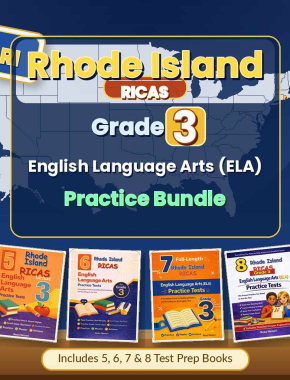
Looking for the best resource to help your kid ace the Rhode Island RICAS? Try this bundle, four full practice-test books (5 + 6 + 7 + 8 tests) covering the same Grade 3 reading, writing, and language skills your child is already learning. Instant PDF download, answer keys included.

Related to This Article
More math articles
- Unlocking the Secrets of Similar Polygons: Shape, Size, and Proportions!
- How to Find The Slope of Roots: Derivative of Radicals
- Chapter 35: Political Socialization
- How to Improve Math Skills as an Adult: A Self-Study Roadmap
- Free Grade 3 English Worksheets for Louisiana Students
- The Best Grade 7 ELA Practice Tests for Arkansas Students
- Other Topics Puzzle – Challenge 100
- The Best Grade 4 ELA Practice Tests for Louisiana Students
- Health Disparities, the Sick Role, and Medicalization
- How to Write Linear Functions Word Problems







What people say about "Free Grade 3 English Worksheets for Rhode Island"?
No one replied yet.