LEARN · PRACTICE · EXPLORE
North Dakota Grade 3 English
Find important points across two original Grade 3 information texts about a reading corner, with North Dakota English references and printable practice.
Focused lessons · Useful practice · Clear next steps
What do North Dakota 3rd graders learn in ELA?
In 3rd grade, North Dakota English language arts centers on main idea and details, vocabulary from context, and writing organized paragraphs. Students take the NDSA grade 3 ELA test in the spring. This page explains each North Dakota grade 3 ELA standard and pairs it with short lessons, printable worksheets and a full-length practice test.
Printable North Dakota grade 3 ELA books:
Standards source: North Dakota adopted content standards.
Find Shared Key Details
Find important points across two original Grade 3 information texts about a reading corner, with North Dakota English references and printable practice. Connect this activity with the school’s wider literacy sequence.
Curriculum reference: North Dakota English Language Arts Content Standards, June 2023, from the NDDPI English Language Arts standards page.
North Dakota Grade 3 references for this activity
NDDPI’s current English Language Arts page links the June 2023 K–12 standards. The document organizes literacy through foundations, communication, reading, writing, and inquiry/research; foundations apply through Grade 6, while later grades extend reading, writing, communication, and inquiry. Selected references here use the state document’s own grade and strand codes. Read the school’s complete course sequence alongside the full standards rather than treat one activity as an entire literacy program.
| Selected North Dakota reading reference | Activity focus | State-linked standards document |
|---|---|---|
| 3.R.9 | Determine important points and key details in two nonfiction texts on one topic | Read the state-linked document (PDF page 20) |
These selected reference labels identify an activity focus, with the correct grade and PDF page linked separately. Read the complete standards selected by the school and its learning sequence, including reading, writing, language, speaking, and listening. This short original example does not fulfill the entire curriculum or establish a student’s grade-level proficiency.
Two notes about one reading corner
This original classroom example is separate from official assessment questions.
Text A — The class note: The reading corner has a basket of short books and a mat beside the window. Readers choose a book and return it to the basket afterward. Keeping books together makes the next choice easier.
Text B — The helper’s note: Before the next reading session, the helper checks that the books are in the basket and that the mat has space for readers. A book left on the mat belongs back in the basket.
Try the activity
What important point do both notes make about the books? Give a key detail from each. What does the helper’s note add that the class note does not directly say?
Follow the reasoning
Both notes explain how returning books to the basket keeps the reading corner ready for another session. Text A directly asks readers to return a chosen book and explains the benefit for the next choice. Text B describes the helper’s check and gives the example of a book left on the mat. It adds responsibility for checking the space before a session. A useful response identifies the shared point and supports it from both notes, rather than select an unrelated detail such as the window alone. The notes describe roles in a routine; neither says that the helper must do every reader’s returning for them.
Notice what needs more practice
The two notes are invented information texts about one classroom routine. They do not report how consistently anyone follows it. A shared detail may be important because it supports the topic, not because it appears most often. Do not claim that a basket itself guarantees students will read more.
Grade 3 English worksheets
Choose printable practice that matches the skill being taught. Check the task, reading difficulty, and directions before assigning it; the collection is independently published.
Use the next session to build independence
- Identify the topic shared by both notes.
- Select a key detail from each that supports one important point.
- Explain what the second note adds.
Compare two teacher-selected information texts about a familiar place or activity. State a shared important point and choose evidence from both. Identify one detail relevant to only one text’s purpose.
For more general reading and writing resources, visit the Grade 3 English Online Center.
North Dakota Grade 3 English: useful planning questions
Must both texts say exactly the same thing?
No. They can share a topic and important point while supplying different details or explaining different roles.
Which standards does the school use?
NDDPI’s current English Language Arts page links the June 2023 K–12 standards. The document organizes literacy through foundations, communication, reading, writing, and inquiry/research; foundations apply through Grade 6, while later grades extend reading, writing, communication, and inquiry. Selected references here use the state document’s own grade and strand codes. Read the school’s complete course sequence alongside the full standards rather than treat one activity as an entire literacy program. The school’s sequence also includes reading, writing, speaking, listening, and language work beyond this example.
Sources checked October 6, 2026. The official 2026–2027 assessment-window page lists general ND A+ summative English language arts in Grades 3–8 and 10, including Grade 3, within March 15–May 7, 2027. Confirm the school’s actual day, the learner’s assigned assessment pathway, and accommodations. Read the NDDPI 2026–2027 assessment windows and current ELA standards resources. Independently published practice has its own directions and scoring. Its result does not predict a state performance level, and this original activity is not an official assessment item.
Grade 3 English in other states
When moving between school systems, compare the official curriculum and the school’s learning sequence. Use the national Online Center’s map to find another state’s resources.
Recommended North Dakota Grade 3 resources
Build a Strong North Dakota Grade 3 NDSA English Practice Library
These independently published resources have their own coverage and editions. Check the contents alongside North Dakota’s current English standards before choosing assessment preparation.
Use these North Dakota Grade 3 resources for reading comprehension, language, writing, and full-length practice where available. Click any cover to open the resource page.
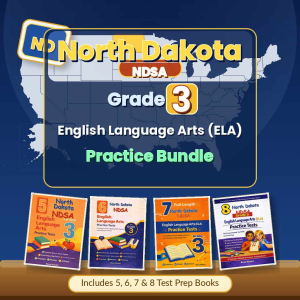 North Dakota Grade 3 English Language Arts (ELA) Preparation Bundle
 6 North Dakota NDSA English Language Arts (ELA) Grade 3: Full Practice Tests
 North Dakota NDSA Grade 3 ELA: 8 Full Practice Tests
 North Dakota NDSA Grade 3 ELA: 7 Full Practice Tests
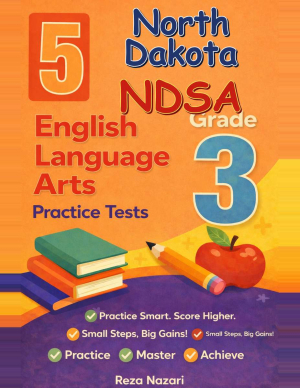 North Dakota NDSA Grade 3 ELA: 5 Full Practice Tests
More Grade 3 resources
A USEFUL NEXT STEP
North Dakota Grade 3 English: study questions
Must both texts say exactly the same thing?
No. They can share a topic and important point while supplying different details or explaining different roles.
Where are the complete North Dakota Grade 3 requirements?
NDDPI’s current English Language Arts page links the June 2023 K–12 standards. The document organizes literacy through foundations, communication, reading, writing, and inquiry/research; foundations apply through Grade 6, while later grades extend reading, writing, communication, and inquiry. Selected references here use the state document’s own grade and strand codes. Read the school’s complete course sequence alongside the full standards rather than treat one activity as an entire literacy program.
Official source ↗Resources from Effortless Math · Editorial standards