LEARN · PRACTICE · EXPLORE
Connecticut Grade 3 English
Explain reread, preview, and helpful in an original rehearsal note, using Connecticut Grade 3 language references and a worked vocabulary routine.
Focused lessons · Useful practice · Clear next steps
What do Connecticut 3rd graders learn in ELA?
In 3rd grade, Connecticut English language arts centers on main idea and details, vocabulary from context, and writing organized paragraphs. Students take the Smarter Balanced grade 3 ELA test in the spring. This page explains each Connecticut grade 3 ELA standard and pairs it with short lessons, printable worksheets and a full-length practice test.
Printable Connecticut grade 3 ELA books:
- Connecticut Smarter Balanced Grade 3 ELA: 8 Full Practice Tests
- Connecticut Smarter Balanced Grade 3 ELA: 7 Full Practice Tests
- Connecticut Smarter Balanced Grade 3 ELA: 5 Full Practice Tests
- 6 Connecticut Smarter Balanced English Language Arts (ELA) Grade 3: Full Practice Tests
- Connecticut Grade 3 English Language Arts (ELA) Preparation Bundle
Standards source: Connecticut ELA resources, Connecticut State Department of Education.
Use word parts and the sentence to check a meaning
Recognizing a prefix is useful only when a reader connects it to a sensible meaning. This activity combines familiar base words, added word parts, and sentence context. It also asks students to notice when a word-part guess needs checking.
Curriculum source: Common Core State Standards for English Language Arts & Literacy, adopted as Connecticut Core Standards in 2010, from the Connecticut State Department of Education ELA resource directory.
Connecticut Grade 3 references for this activity
Connecticut uses the Core Standards for English language arts, adopted in 2010. The full ELA document contains the Grade 3 expectations across its subject strands. These are two selected references for the activity on this page; use the full document for curriculum planning.
| Core Standards reference | Activity focus | Official requirement |
|---|---|---|
| L.3.4b | Meaning changes when an affix is added | Read the primary standards document, page 29 |
| L.3.4c | Use a known root to interpret a related word | Read the primary standards document, page 29 |
These are selected CCSS references used in Connecticut’s Core Standards. Activity labels describe a teaching focus rather than reproduce the full requirements. Districts develop their own curriculum sequence; use the complete document and the school’s plan for wider coverage.
A worked Grade 3 reading and writing activity
This original classroom example is separate from official assessment questions.
Before rehearsal, Nia got a preview of the short play by looking through its pages. She reread her first line after noticing a word she had missed. A helpful classmate pointed to the right place, and Nia practiced the line again.
Try the activity
Explain reread by identifying the familiar word and the part added to it. Use view and pre- to make a first interpretation of preview, then check that interpretation against the sentence. Explain what help contributes to helpful. Write a new sentence using one of the words so its meaning is clear.
Follow the reasoning
Read is the familiar base in reread; re- adds the idea of doing it again. The missed word explains why Nia reads her line a second time. View means look at, and pre- can indicate before, so preview suggests a look beforehand. The opening phrase “Before rehearsal” and the pages support that interpretation. Helpful describes the classmate as providing help; pointing to the correct place is the supporting action. A new sentence might be, “I will reread the directions to check the step I missed.”
Notice what needs more practice
A response that defines reread as “read quickly” has not connected re- to the action. Ask what Nia does after the missed word. A response that defines preview as the full performance goes beyond the sentence: she looks through pages beforehand. Word parts are clues, not a rule that any sequence of matching letters always has the same meaning. Do not treat the re in red as a prefix merely because the letters match. Check whether the proposed base word and meaning fit the whole word.
Grade 3 English worksheets
Choose printable practice that matches the skill being taught. Check the task, reading difficulty, and directions before assigning it; the collection is independently published.
Use the next session to build independence
- Find a familiar base or root before naming the added part.
- Explain how the added part changes the meaning.
- Read the whole sentence to test the interpretation.
- Write a new sentence that makes the meaning visible through an action or detail.
Compare helpful with helpless in two teacher-created sentences. Discuss how changing the ending changes the meaning, and why the surrounding action still matters. Then ask the student to collect a small word family from a familiar base, explaining each member instead of only listing spellings. Consult a child-friendly dictionary when a word’s meaning does not fit the first guess. For independent practice, use one new word at a time so the student can explain the reasoning rather than memorizing a long list of prefixes.
For more general reading and writing resources, visit the Grade 3 English Online Center.
Connecticut Grade 3 English: useful planning questions
Can word parts tell me the meaning without reading the sentence?
They can suggest a meaning, but context checks whether that interpretation fits. When the parts or the sentence remain unclear, use an appropriate dictionary or ask for help.
Where are the complete state requirements?
Connecticut uses the Core Standards for English language arts, adopted in 2010. The full ELA document contains the Grade 3 expectations across its subject strands. These are two selected references for the activity on this page; use the full document for curriculum planning. The school’s sequence also includes reading, writing, speaking, listening, and language work beyond this example.
State sources checked October 5, 2026. Grade 3 is within the Connecticut Smarter Balanced English language arts testing range. This original lesson is independent practice. Read the official assessment overview and use the school’s guidance for preparation.
Grade 3 English in other states
When moving between school systems, compare the official curriculum and the school’s learning sequence. Use the national Online Center’s map to find another state’s resources.
Recommended Connecticut Grade 3 resources
Build a Strong Connecticut Grade 3 SBAC English Practice Library
Use these Connecticut Grade 3 resources for reading comprehension, language, writing, and full-length practice where available. Click any cover to open the resource page.
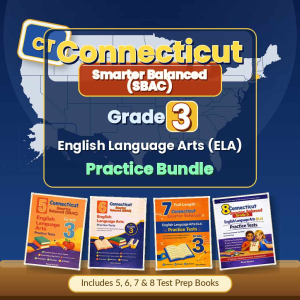 Connecticut Grade 3 English Language Arts (ELA) Preparation Bundle
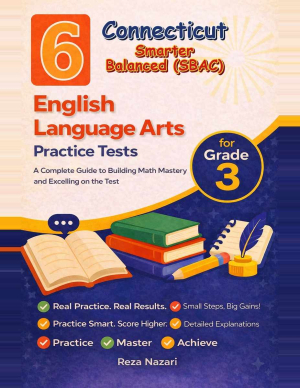 6 Connecticut Smarter Balanced English Language Arts (ELA) Grade 3: Full Practice Tests
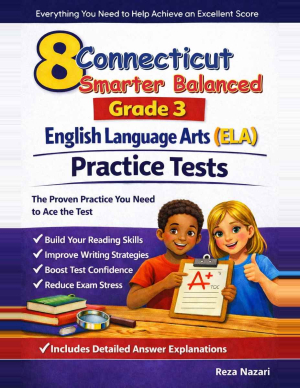 Connecticut Smarter Balanced Grade 3 ELA: 8 Full Practice Tests
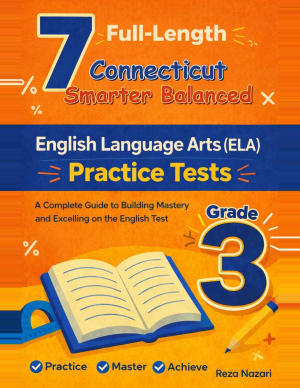 Connecticut Smarter Balanced Grade 3 ELA: 7 Full Practice Tests
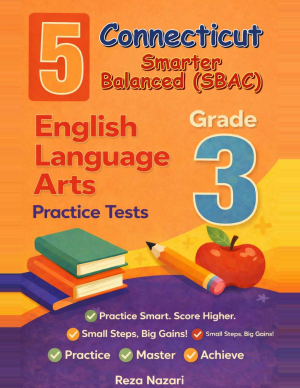 Connecticut Smarter Balanced Grade 3 ELA: 5 Full Practice Tests
A USEFUL NEXT STEP
Connecticut Grade 3 English: study questions
Can word parts tell me the meaning without reading the sentence?
They can suggest a meaning, but context checks whether that interpretation fits. When the parts or the sentence remain unclear, use an appropriate dictionary or ask for help.
Where are the complete Connecticut Grade 3 requirements?
Connecticut uses the Core Standards for English language arts, adopted in 2010. The full ELA document contains the Grade 3 expectations across its subject strands. These are two selected references for the activity on this page; use the full document for curriculum planning.
Official source ↗Resources from Effortless Math · Editorial standards