LEARN · PRACTICE · EXPLORE
New Jersey Grade 3 English
Explore New Jersey Grade 3 English through an original story about a failed plan, character evidence, worked explanations, and further reading and writing practice.
Focused lessons · Useful practice · Clear next steps
What do New Jersey 3rd graders learn in ELA?
In 3rd grade, New Jersey English language arts centers on main idea and details, vocabulary from context, and writing organized paragraphs. Students take the NJSLA grade 3 ELA test in the spring. This page explains each New Jersey grade 3 ELA standard and pairs it with short lessons, printable worksheets and a full-length practice test.
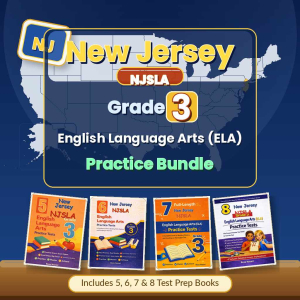
Printable New Jersey grade 3 ELA books:
Standards source: 2023 New Jersey ELA standards.
Explain how a character’s response changes what happens next
Explore New Jersey Grade 3 English through an original story about a failed plan, character evidence, worked explanations, and further reading and writing practice. The selected 2023 New Jersey standards identify this activity’s focus; use the complete grade expectations and the school’s teaching sequence for broader planning.
Curriculum reference: 2023 New Jersey Student Learning Standards for English Language Arts, official grade page, from the official New Jersey ELA standards directory.
New Jersey Grade 3 references for this activity
The 2023 New Jersey Student Learning Standards for English Language Arts define grade-specific end-of-year expectations. These selected references point to the activity’s reading focus; the complete grade page also includes language, writing, speaking, and listening. Use the full expectations and the school’s teaching sequence when planning instruction.
| Selected state reference | Activity focus | Official grade page |
|---|---|---|
| RL.CR.3.1 | Use textual evidence to answer literary questions | Read the complete grade expectations |
| RL.IT.3.3 | Connect characters’ traits and motivations to the plot | Read the complete grade expectations |
These selected reference labels identify an activity focus, with links to the official grade page. Read the complete New Jersey standards and the school’s learning sequence, including reading, writing, language, speaking, and listening. This short original example does not fulfill the entire curriculum or establish a student’s grade-level proficiency.
The handle that would not hold
This original classroom example is separate from official assessment questions.
Eli wanted to carry the class’s paper scenery to the assembly in one trip. He fastened a narrow paper handle to a large cardboard tray. When he lifted it, the handle tore and the scenery slid onto the desk.
“I can make a stronger handle,” Eli said. He reached for more paper. Noor held the tray steady. “Or we can each carry one side,” she suggested. Eli looked at the pile, then set the paper down.
They practiced carrying the empty tray together. At the doorway Eli stopped and waited for Noor to turn her side. They carried the scenery to the assembly without dropping it. “Next time, let’s plan the turns first,” Eli said.
Try the activity
Describe how Eli responds to the torn handle at first and how his response changes. Explain how the change affects the story’s ending. Use details from the beginning, middle, and end.
Follow the reasoning
Eli first tries to repair his own plan: after the handle tears, he reaches for more paper and says he can make a stronger handle. Noor proposes sharing the load. Eli sets the paper down and practices carrying the tray with her, which shows that he accepts a different solution. At the doorway he waits for Noor; this action demonstrates coordination instead of simply insisting on one quick trip. Their shared carrying leads to the successful delivery described at the end. His final suggestion about planning turns shows attention to what made the joint solution work. A response can infer that Eli becomes more willing to cooperate, but it should ground that inference in his changed actions. The text never states that he stops caring about efficiency; he changes how he tries to complete the task.
Notice what needs more practice
“Eli is nice” is a trait label without the evidence or plot connection requested. “Noor fixed the handle” contradicts the story: they carry the tray together instead. Do not infer that Eli will cooperate in every future situation from one story. Keep the difference between a stated event, such as setting the paper down, and an interpretation, such as becoming willing to consider another plan. There can be more than one supported description of his development.
Grade 3 English worksheets
Choose printable practice that matches the skill being taught. Check the task, reading difficulty, and directions before assigning it; the collection is independently published.
Use the next session to build independence
- List Eli’s first response to the failed handle.
- Find an action that shows him accepting Noor’s suggestion.
- Explain how that action helps bring about the ending.
Write a different ending in which Eli keeps using the narrow paper handle. Then explain how the changed decision would change the plot. Mark your new ending as your own writing rather than evidence from the original story. Use the comparison to practice separating a character’s action from the effect that follows it.
For more general reading and writing resources, visit the Grade 3 English Online Center.
New Jersey Grade 3 English: useful planning questions
Does naming a character trait fully explain the plot?
No. Explain which actions support the trait and how those actions affect what happens next. A label without details leaves the reasoning incomplete.
Which standards does the school use?
The 2023 New Jersey Student Learning Standards for English Language Arts define grade-specific end-of-year expectations. These selected references point to the activity’s reading focus; the complete grade page also includes language, writing, speaking, and listening. Use the full expectations and the school’s teaching sequence when planning instruction. The school’s sequence also includes reading, writing, speaking, listening, and language work beyond this example.
Sources checked October 6, 2026. The official 2026–2027 schedule lists NJSLA-A ELA for Grades 3–9, including Grade 3. NJDOE describes ELA and mathematics as adaptive assessments. Confirm the learner’s assigned pathway and school directions. Read the official adaptive assessment overview, 2026–2027 statewide schedule, and 2023 ELA standards directory. Independently published practice has its own timing and scoring and does not predict a state performance level. Use the teacher’s sequence for further reading, writing, speaking, listening, and language work. This original activity is not an official assessment item.
Grade 3 English in other states
When moving between school systems, compare the official curriculum and the school’s learning sequence. Use the national Online Center’s map to find another state’s resources.
Recommended New Jersey Grade 3 resources
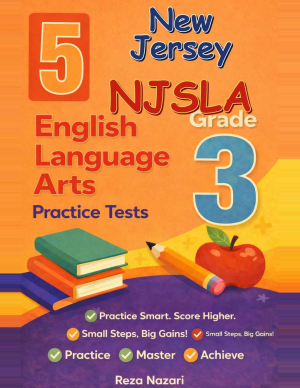
Build a Strong New Jersey Grade 3 NJSLA English Practice Library
These independently published resources have their own coverage and editions. Check the contents alongside New Jersey’s current English standards before choosing assessment preparation.
Use these New Jersey Grade 3 resources for reading comprehension, language, writing, and full-length practice where available. Click any cover to open the resource page.
More Grade 3 resources
A USEFUL NEXT STEP
New Jersey Grade 3 English: study questions
Does naming a character trait fully explain the plot?
No. Explain which actions support the trait and how those actions affect what happens next. A label without details leaves the reasoning incomplete.
Where are the complete New Jersey Grade 3 requirements?
The 2023 New Jersey Student Learning Standards for English Language Arts define grade-specific end-of-year expectations. These selected references point to the activity’s reading focus; the complete grade page also includes language, writing, speaking, and listening. Use the full expectations and the school’s teaching sequence when planning instruction.
Official source ↗Resources from Effortless Math · Editorial standards