LEARN · PRACTICE · EXPLORE
Washington Grade 3 English
Compare changes in two versions of the same story. Follow an original Grade 3 reading activity and a selected reference from Washington’s adopted 2026 English standards.
Focused lessons · Useful practice · Clear next steps
What do Washington 3rd graders learn in ELA?
In 3rd grade, Washington English language arts centers on main idea and details, vocabulary from context, and writing organized paragraphs. Students take the Smarter Balanced (SBA) grade 3 ELA test in the spring. This page explains each Washington grade 3 ELA standard and pairs it with short lessons, printable worksheets and a full-length practice test.
Printable Washington grade 3 ELA books:
- Washington Smarter Balanced Grade 3 ELA: 8 Full Practice Tests
- Washington Smarter Balanced Grade 3 ELA: 7 Full Practice Tests
- Washington Smarter Balanced Grade 3 ELA: 5 Full Practice Tests
- 6 Washington Smarter Balanced English Language Arts (ELA) Grade 3: Full Practice Tests
- Washington Grade 3 English Language Arts (ELA) Preparation Bundle
Standards source: Washington adopted content standards.
Compare Two Versions of One Story
Compare changes in two versions of the same story. Work through the short reading below, explain your response, and try the skill in a fuller classroom text. The selected reference comes from the adopted 2026 standards; the school’s implementation sequence matters during the transition.
Curriculum reference: Washington State Learning Standards for English Language Arts, adopted 2026, from the Washington English language arts standards page.
Washington Grade 3 references for this activity
Washington OSPI’s English directory links the adopted 2026 standards. The PDF records adoption on August 6, 2026. OSPI says educators can explore, learn about, and begin using them in 2026–27, with required use with students in 2027–28. Ask the school which sequence it is following during that transition. The selected Grade 3 indicator on this page is a focus for this original activity, not a complete curriculum or a certification of every independent resource.
| Selected Washington reading reference | Activity focus | State-linked standards document |
|---|---|---|
| ELA.3.R.5.c | Compare changes in two versions of the same story | Read the state-linked document (PDF page 35) |
These selected reference labels identify an activity focus, with the correct grade and PDF page linked separately. Read the complete standards selected by the school and its learning sequence, including reading, writing, language, speaking, and listening. This short original example does not fulfill the entire curriculum or establish a student’s grade-level proficiency.
The paper kite: two tellings
This original classroom example is separate from official assessment questions.
Version A: The paper kite caught in a low branch. Tessa tugged the string, and the paper tore. She brought the pieces to her friend. Together they made a smaller kite from the undamaged paper.
Version B: The paper kite caught in a low branch. Tessa stopped tugging and asked her friend to help. They waited for an adult to take the kite down. The paper remained whole, and they carried it home.
Try the activity
Name the shared problem and compare how the two versions resolve it. Which change leads to a different ending? Explain what a reader might learn from each version without claiming that only one lesson is possible.
Follow the reasoning
Both versions begin with Tessa’s kite caught in a branch, but her response differs. In A, she tugs, the paper tears, and collaboration leads to a smaller replacement. In B, she stops, asks for help, and waits; the intact kite is carried home. The changed action before the outcome helps explain the different endings. A reader might connect A with finding a new use after a setback and B with pausing to seek help. Those interpretations should be linked to the actual events. Simply saying one ending is better expresses a preference; it does not compare the sequence that produces each ending.
Notice what needs more practice
These are two invented versions of the same scene, not reports about an actual kite. Neither passage explains how the adult removes it. They provide no instructions for reaching branches or retrieving objects. Other supported interpretations may be discussed.
Grade 3 English worksheets
Choose printable practice that matches the skill being taught. Check the task, reading difficulty, and directions before assigning it; the collection is independently published.
Use the next session to build independence
- Identify the problem both versions share.
- Compare the response and outcome in each.
- Connect an interpretation with the changed events.
Read two teacher-selected versions of the same story. Compare characters, events, and outcomes before discussing how a change affects the meaning. Keep each version’s details in its own column.
For more general reading and writing resources, visit the Grade 3 English Online Center.
Washington Grade 3 English: useful planning questions
Is choosing a favorite enough to compare two versions?
No. A comparison identifies shared features and meaningful differences with details from both versions. A preference can follow that explanation.
Which standards does the school use?
Washington OSPI’s English directory links the adopted 2026 standards. The PDF records adoption on August 6, 2026. OSPI says educators can explore, learn about, and begin using them in 2026–27, with required use with students in 2027–28. Ask the school which sequence it is following during that transition. The selected Grade 3 indicator on this page is a focus for this original activity, not a complete curriculum or a certification of every independent resource. The school’s sequence also includes reading, writing, speaking, listening, and language work beyond this example.
Sources checked October 6, 2026. OSPI’s state-testing overview lists Smarter Balanced English and mathematics in Grades 3–8 and 10. Grade 3 is included in that listed English range; follow current school directions and accommodations. OSPI distinguishes standards implementation from assessment updates: changes for new media-literacy, digital-citizenship, and data-science standards are planned no earlier than 2028–29, beginning with pilots. This does not establish a changed current test format, timing, or item count. Read the Washington English assessment overview, English standards guidance, and standards and assessment transition guidance. Independently published practice has its own directions and scoring. Its result does not predict a state performance level, and this original activity is not an official assessment item.
Grade 3 English in other states
When moving between school systems, compare the official curriculum and the school’s learning sequence. Use the national Online Center’s map to find another state’s resources.
Recommended Washington Grade 3 resources
Choose Washington Grade 3 English practice resources
These independently published resources have their own coverage and editions. Check the contents alongside Washington’s current English standards before choosing assessment preparation.
Use these Washington Grade 3 resources for reading comprehension, language, writing, and full-length practice where available. Click any cover to open the resource page.
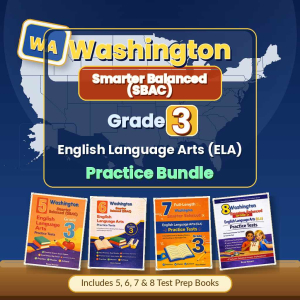 Washington Grade 3 English Language Arts (ELA) Preparation Bundle
 6 Washington Smarter Balanced English Language Arts (ELA) Grade 3: Full Practice Tests
 Washington Smarter Balanced Grade 3 ELA: 8 Full Practice Tests
 Washington Smarter Balanced Grade 3 ELA: 7 Full Practice Tests
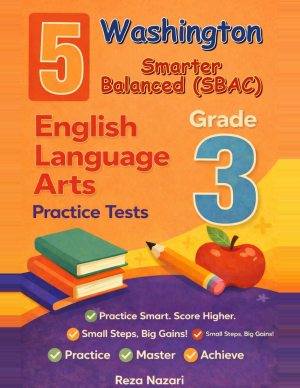 Washington Smarter Balanced Grade 3 ELA: 5 Full Practice Tests
More Grade 3 resources
A USEFUL NEXT STEP
Washington Grade 3 English: study questions
Is choosing a favorite enough to compare two versions?
No. A comparison identifies shared features and meaningful differences with details from both versions. A preference can follow that explanation.
Where are the complete Washington Grade 3 requirements?
Washington OSPI’s English directory links the adopted 2026 standards. The PDF records adoption on August 6, 2026. OSPI says educators can explore, learn about, and begin using them in 2026–27, with required use with students in 2027–28. Ask the school which sequence it is following during that transition. The selected Grade 3 indicator on this page is a focus for this original activity, not a complete curriculum or a certification of every independent resource.
Official source ↗Resources from Effortless Math · Editorial standards