LEARN · PRACTICE · EXPLORE
New Hampshire Grade 3 English
Explore New Hampshire Grade 3 English with a character-and-action reading, an evidence-based explanation, worksheets, and selected curriculum references.
Focused lessons · Useful practice · Clear next steps
What do New Hampshire 3rd graders learn in ELA?
In 3rd grade, New Hampshire English language arts centers on main idea and details, vocabulary from context, and writing organized paragraphs. Students take the NH SAS grade 3 ELA test in the spring. This page explains each New Hampshire grade 3 ELA standard and pairs it with short lessons and printable worksheets.
Printable New Hampshire grade 3 ELA books:
- New Hampshire NH SAS Grade 3 ELA: 8 Full Practice Tests
- New Hampshire NH SAS Grade 3 ELA: 7 Full Practice Tests
- New Hampshire NH SAS Grade 3 ELA: 5 Full Practice Tests
- 6 New Hampshire NH SAS English Language Arts (ELA) Grade 3: Full Practice Tests
- New Hampshire Grade 3 English Language Arts (ELA) Preparation Bundle
Standards source: New Hampshire school-approval rules, Ed 306.29.
Grade 3: connect a character’s choice to the story’s events
Describing a character as kind or helpful is more convincing when a reader can explain an action and its effect. This original classroom scene supports that reasoning. Students identify what the character wants, how she responds, and what changes because of her choice. The short text is an entry point for a longer classroom story, not a replacement for reading whole works.
Curriculum reference: 2010 Common Core ELA/literacy standards, original publisher’s document, from the New Hampshire school-approval rules (Ed 306.29).
New Hampshire Grade 3 references for this activity
New Hampshire’s current school-approval rules, Ed 306.29, allow local boards to use the adopted 2010 Common Core English standards or approved alternative academic standards. Confirm the school’s choice and competencies first. The selected Common Core references here were checked in the original publisher’s 2010 document, using the correct grade column. These references identify this activity’s focus and are not a complete local curriculum checklist.
| Selected Common Core reference | Activity focus | Publisher’s document |
|---|---|---|
| RL.3.3 | Explain a character’s motivation, action, and effect on events | Read the publisher’s document (PDF page 12) |
These selected reference labels identify an activity focus, with the grade column and PDF page linked separately. Read the complete standards selected by the school and its learning sequence, including reading, writing, language, speaking, and listening. This short original example does not fulfill the entire curriculum or establish a student’s grade-level proficiency.
How does Anika change the group’s next step?
This original classroom example is separate from official assessment questions.
Anika wanted to finish the class display before lunch. Tomas had not drawn his part because he could not find his notes. Anika slid her own drawing aside and helped him sort the papers in his folder. When they found the notes, Tomas began drawing. The display was still unfinished at lunch, but both students now had a piece to contribute.
Try the activity
Describe one trait or motivation that the passage supports for Anika. Explain how her action contributes to the next event. Then identify a detail that prevents you from claiming the group finished before lunch.
Follow the reasoning
Anika wants the display finished, but she also acts helpfully when Tomas cannot begin. Sorting the papers with him leads to finding the notes, which allows him to start drawing. This connection supports an explanation of helpfulness through an action and its consequence. The ending explicitly says the display is still unfinished at lunch, so the reader should not turn a helpful action into a claim of complete success. A careful account can recognize progress and an unmet goal at the same time.
Notice what needs more practice
“She is nice” names a possible trait but leaves the reasoning unstated. Ask which action supports the label and what follows it. “She finished the display” contradicts the ending. “She never cares about deadlines” goes beyond this one event. Students need to separate a supported description from a broad judgment about every situation in a character’s life.
Grade 3 English worksheets
Choose printable practice that matches the skill being taught. Check the task, reading difficulty, and directions before assigning it; the collection is independently published.
Use the next session to build independence
- Mark the sentence about Anika’s goal and the sentence about her response to Tomas. Explain how those details work together.
- Write a cause-and-next-event sentence that connects sorting papers, finding notes, and starting the drawing.
- In a longer classroom story, revisit the initial character description after a later choice. Change the explanation when new evidence warrants it.
Extend the reading with a teacher-selected story that includes several meaningful choices. Ask how actions influence the sequence, and whether a trait remains a useful description across more than one scene. Practice recounting, vocabulary, and discussion as part of the wider lesson rather than assigning a character label in isolation.
For more general reading and writing resources, visit the Grade 3 English Online Center.
New Hampshire Grade 3 English: useful planning questions
Can a helpful choice still leave a goal unfinished?
Yes. Anika’s help lets Tomas begin his drawing, but the ending says the display remains unfinished at lunch. Both details belong in an accurate explanation of the scene.
Which standards does the school use?
New Hampshire’s current school-approval rules, Ed 306.29, allow local boards to use the adopted 2010 Common Core English standards or approved alternative academic standards. Confirm the school’s choice and competencies first. The selected Common Core references here were checked in the original publisher’s 2010 document, using the correct grade column. These references identify this activity’s focus and are not a complete local curriculum checklist. The school’s sequence also includes reading, writing, speaking, listening, and language work beyond this example.
Sources checked October 6, 2026. The 2025–2026 public NH SAS manual describes general ELA testing in Grades 3–8, including Grade 3, with reading and writing sessions. Confirm the learner’s assigned pathway and the school’s current directions. Read the public NH SAS manual resource page, students and families portal and school-approval rules. The manual reviewed here is the 2025–2026 edition; confirm later-year directions with the school. Independently published practice has its own timing and scoring and does not predict a state performance level. Use local competencies and the teacher’s sequence for further reading, writing, speaking, listening, and language work. This original activity is not an official assessment item.
Grade 3 English in other states
When moving between school systems, compare the official curriculum and the school’s learning sequence. Use the national Online Center’s map to find another state’s resources.
Recommended New Hampshire Grade 3 resources
Build a Strong New Hampshire Grade 3 NH SAS English Practice Library
These independently published resources have their own coverage and editions. Check the contents alongside New Hampshire’s current English standards before choosing assessment preparation.
Use these New Hampshire Grade 3 resources for reading comprehension, language, writing, and full-length practice where available. Click any cover to open the resource page.
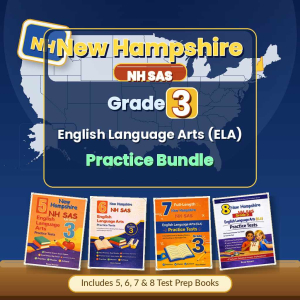 New Hampshire Grade 3 English Language Arts (ELA) Preparation Bundle
 6 New Hampshire NH SAS English Language Arts (ELA) Grade 3: Full Practice Tests
 New Hampshire NH SAS Grade 3 ELA: 8 Full Practice Tests
 New Hampshire NH SAS Grade 3 ELA: 7 Full Practice Tests
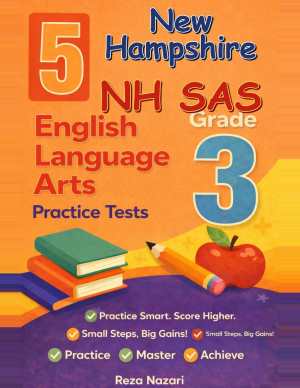 New Hampshire NH SAS Grade 3 ELA: 5 Full Practice Tests
More Grade 3 resources
A USEFUL NEXT STEP
New Hampshire Grade 3 English: study questions
Can a helpful choice still leave a goal unfinished?
Yes. Anika’s help lets Tomas begin his drawing, but the ending says the display remains unfinished at lunch. Both details belong in an accurate explanation of the scene.
Where are the complete New Hampshire Grade 3 requirements?
New Hampshire’s current school-approval rules, Ed 306.29, allow local boards to use the adopted 2010 Common Core English standards or approved alternative academic standards. Confirm the school’s choice and competencies first. The selected Common Core references here were checked in the original publisher’s 2010 document, using the correct grade column. These references identify this activity’s focus and are not a complete local curriculum checklist.
Official source ↗Resources from Effortless Math · Editorial standards