LEARN · PRACTICE · EXPLORE
Massachusetts Grade 3 English
Track a problem, attempted solution, and ending in an original story, with Massachusetts Grade 3 English references and learning resources.
Focused lessons · Useful practice · Clear next steps
What do Massachusetts 3rd graders learn in ELA?
In 3rd grade, Massachusetts English language arts centers on main idea and details, vocabulary from context, and writing organized paragraphs. Students take the MCAS grade 3 ELA test in the spring. This page explains each Massachusetts grade 3 ELA standard and pairs it with short lessons, printable worksheets and a full-length practice test.
Printable Massachusetts grade 3 ELA books:
- Massachusetts MCAS Grade 3 ELA: 8 Full Practice Tests
- Massachusetts MCAS Grade 3 ELA: 7 Full Practice Tests
- Massachusetts MCAS Grade 3 ELA: 5 Full Practice Tests
- 6 Massachusetts MCAS English Language Arts (ELA) Grade 3: Full Practice Tests
- Massachusetts Grade 3 English Language Arts (ELA) Preparation Bundle
Standards source: Massachusetts English Language Arts, Massachusetts Department of Elementary and Secondary Education.
Explain how a story moves from problem to solution
Do more than label a beginning and an ending. Ask how each part creates the need for the next part of the story.
Curriculum reference: 2017 Massachusetts English Language Arts and Literacy Framework, from the Massachusetts Department of Elementary and Secondary Education current frameworks directory.
Massachusetts Grade 3 references for this activity
The state’s current frameworks directory links the 2017 Massachusetts English Language Arts and Literacy Framework, adopted in March 2017. Read the individual Grade 3 requirements and the school’s sequence. These selected references support this activity; they do not cover the whole English curriculum.
| Grade-level expectation | Activity focus | Official requirement |
|---|---|---|
| RL.3.5 | Structural elements and successive parts of fiction | Read the state framework (PDF page 53) |
| RL.3.1 | Explicit text support for answers | Read the state framework (PDF page 53) |
These are selected grade-level expectations from the current 2017 Massachusetts English framework. Activity labels describe a teaching focus rather than reproduce complete requirements. Read the linked state document’s complete grade-level expectations, including its grade-specific details, alongside the school’s curriculum sequence.
A worked Grade 3 reading and writing activity
This original classroom example is separate from official assessment questions.
The library club needed a sign for its outdoor book table. Ana wrote BOOKS HERE on a sheet of paper, but the breeze folded it against the table leg. She taped the corners down. Now the sign stayed flat, yet people walking past could not see it from the path. Ana found a spare cardboard panel and propped it upright behind the books. Her paper message was visible, and the club kept both the panel and the tape for the next table.
Try the activity
Identify the central problem, Ana’s first attempted solution, the remaining difficulty, and the final solution. Explain how the part about taping the corners connects the first problem with the need for the cardboard panel. Use details rather than only saying first, next, and last.
Follow the reasoning
The club needs a sign that passersby can see. The breeze creates the first difficulty by folding the paper. Taping the corners solves that movement problem, but the flat sign is still hard to see from the path. That remaining difficulty motivates the upright panel. The final arrangement makes the message visible and leads the club to save the materials. The taping episode is therefore not an unrelated interruption: it provides a partial solution and reveals why another change is needed. A useful account explains the connections among the parts as well as their order.
Notice what needs more practice
A student may name the problem as needing books, although the table already has them. Return to the opening sentence and the repeated visibility details. Another may call the first attempt a total failure, missing that it kept the sign flat. Encourage precise language: a partial solution can lead to the next step. The story does not tell us the club’s attendance or sales, so the visible sign is the supported outcome. This short example introduces structural reasoning; a longer work can contain several problems, shifts, or endings.
Grade 3 English worksheets
Choose printable practice that matches the skill being taught. Check the task, reading difficulty, and directions before assigning it; the collection is independently published.
Use the next session to build independence
- Write a brief label for each problem and attempt.
- Draw arrows showing why the next action was needed.
- Explain one arrow using a specific detail from the story.
Imagine removing the sentence about people on the path. Ask how that omission would affect the reason for the upright panel. Then restore it and compare the two versions. Let students create a short story in which an attempted solution helps with one difficulty but leaves another. When reading a classroom text, track successive sections before assigning a simple problem-solution label. This focus follows Massachusetts’s Grade 3 structural requirement while leaving room for the school’s wider literature, informational reading, and writing work.
For more general reading and writing resources, visit the Grade 3 English Online Center.
Massachusetts Grade 3 English: useful planning questions
Can an attempted solution help and still lead to another problem?
Yes. The tape keeps the sign flat but does not make it visible from the path. Explain which difficulty was solved and which still motivates the next event.
Where are the complete state requirements?
The state’s current frameworks directory links the 2017 Massachusetts English Language Arts and Literacy Framework, adopted in March 2017. Read the individual Grade 3 requirements and the school’s sequence. These selected references support this activity; they do not cover the whole English curriculum. The school’s sequence also includes reading, writing, speaking, listening, and language work beyond this example.
Sources checked October 6, 2026. Grade 3 is within the MCAS English language arts testing range. The state overview identifies English language arts and mathematics testing in Grades 3–8 and 10. Follow the school’s assigned pathway and current administration directions. The official MCAS overview states that MCAS is untimed within a regular school day. Independently published practice may use its own timer, question count, and scoring; those features are not official MCAS specifications or a prediction of a state performance level. Use the complete framework and the school’s learning sequence to choose further reading, writing, speaking, listening, and language work. This original classroom activity is not an official assessment item.
Grade 3 English in other states
When moving between school systems, compare the official curriculum and the school’s learning sequence. Use the national Online Center’s map to find another state’s resources.
Recommended Massachusetts Grade 3 resources
Build a Strong Massachusetts Grade 3 MCAS English Practice Library
These independently published resources have their own coverage and editions. Check the contents alongside Massachusetts’s current English standards before choosing assessment preparation.
Use these Massachusetts Grade 3 resources for reading comprehension, language, writing, and full-length practice where available. Click any cover to open the resource page.
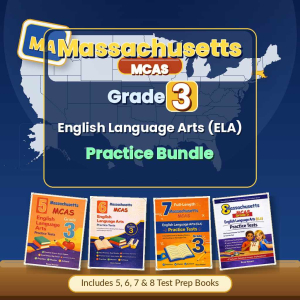 Massachusetts Grade 3 English Language Arts (ELA) Preparation Bundle
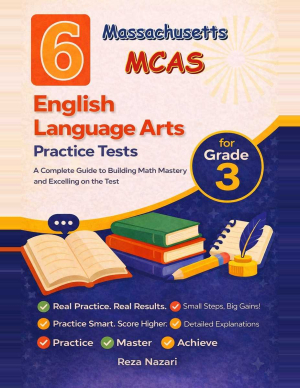 6 Massachusetts MCAS English Language Arts (ELA) Grade 3: Full Practice Tests
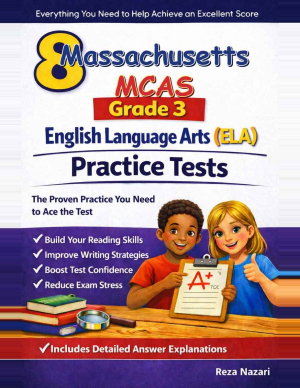 Massachusetts MCAS Grade 3 ELA: 8 Full Practice Tests
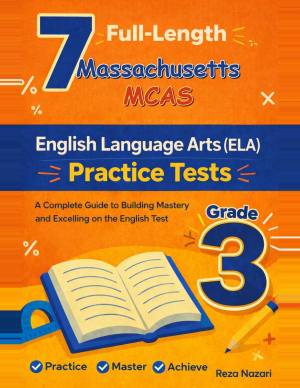 Massachusetts MCAS Grade 3 ELA: 7 Full Practice Tests
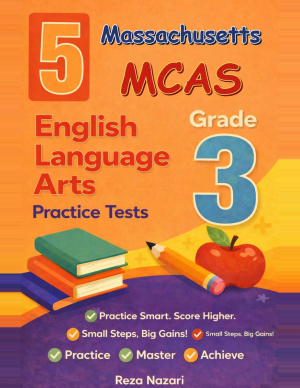 Massachusetts MCAS Grade 3 ELA: 5 Full Practice Tests
More Grade 3 resources
A USEFUL NEXT STEP
Massachusetts Grade 3 English: study questions
Can an attempted solution help and still lead to another problem?
Yes. The tape keeps the sign flat but does not make it visible from the path. Explain which difficulty was solved and which still motivates the next event.
Where are the complete Massachusetts Grade 3 requirements?
The state’s current frameworks directory links the 2017 Massachusetts English Language Arts and Literacy Framework, adopted in March 2017. Read the individual Grade 3 requirements and the school’s sequence. These selected references support this activity; they do not cover the whole English curriculum.
Official source ↗Resources from Effortless Math · Editorial standards