LEARN · PRACTICE · EXPLORE
Florida Grade 3 English
Florida Grade 3 English: plan reading, writing, vocabulary, and discussion practice. Use learning references and the state curriculum source to choose a target.
Focused lessons · Useful practice · Clear next steps
What do Florida 3rd graders learn in ELA?
In 3rd grade, Florida English language arts centers on main idea and details, vocabulary from context, and writing organized paragraphs. Students take the FAST grade 3 ELA test in the spring. This page explains each Florida grade 3 ELA standard and pairs it with short lessons, printable worksheets and a full-length practice test.
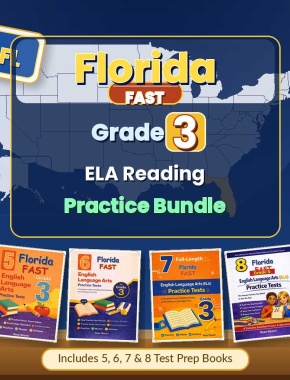
Printable Florida grade 3 ELA books:
Standards source: Standards & Instructional Support, Florida Department of Education.
Florida Grade 3 English is where students read more complex texts, explain ideas with evidence, grow vocabulary, and write organized responses. This guide gives Florida families and educators a student-friendly reference for lessons, tutoring, homeschool pacing, and review: 53 rewritten skill targets across 11 ELA strands, with emphasis on planning, drafting, revising, editing, and publishing clear writing; reading, writing, language, speaking, and listening. For classroom progress, tutoring, homeschool planning, or FAST review, the best practice uses consistent reading time, thoughtful annotations, precise word study, and purposeful writing.
Use this Florida Grade 3 English page for daily literacy blocks, reteaching, enrichment, and targeted practice. The explanations are written for planning and learning support, not copied from official standards language.
Free Grade 3 ELA Checklist + Practice Plan
Use this Florida Grade 3 English language arts guide as a printable standards checklist. Start with the overview, mark the skills your student already handles, then choose one weak area for focused review before FAST or classroom assessments.
Florida Grade 3 English Standards Overview
For Florida, Grade 3 English helps students read more complex texts, explain ideas with evidence, grow vocabulary, and write organized responses. This overview organizes Benchmarks for Excellent Student Thinking (B.E.S.T) into plain-language strands so you can quickly see what to teach, review, or reteach.
Writing
For Florida Grade 3, this strand supports planning around planning, drafting, revising, editing, and publishing clear writing. Includes 6 quick skill targets.
Writing
For Florida Grade 3, this strand supports planning around planning, drafting, revising, editing, and publishing clear writing. Includes 8 quick skill targets.
Communication and Media
For Florida Grade 3, this strand makes room for short checks on reading, writing, language, speaking, and listening. Includes 2 quick skill targets.
Foundational Reading and Word Study
For Florida Grade 3, this strand makes room for short checks on reading, writing, language, speaking, and listening. Includes 2 quick skill targets.
Foundational Reading and Word Study
For Florida Grade 3, this strand gives students repeated work with reading, writing, language, speaking, and listening. Includes 2 quick skill targets.
Reading Comprehension
For Florida Grade 3, this strand makes room for short checks on reading, writing, language, speaking, and listening. Includes 6 quick skill targets.
Reading Literature
For Florida Grade 3, this strand keeps lessons anchored in reading, writing, language, speaking, and listening. Includes 8 quick skill targets.
Reading Informational Text
For Florida Grade 3, this strand keeps lessons anchored in reading, writing, language, speaking, and listening. Includes 8 quick skill targets.
Grade 3 FAST English Practice Plan
A useful Florida Grade 3 plan should balance reading, writing, language, and speaking. Start with Writing, Communication and Media; then rotate shorter review tasks so skills stay connected.
For Florida Grade 3, a strong weekly rhythm can be simple: a passage annotation, a vocabulary check, a brief constructed response, and a quick revision task.
Need Focused Grade 3 FAST English Practice?
Pair this Florida Grade 3 standards guide with targeted ELA practice so students can move from knowing the expectations to answering reading, writing, vocabulary, and language questions with confidence.
All Florida Grade 3 English Standards, Rewritten
The codes below follow the Florida Grade 3 source standards structure. Each skill label is intentionally short, original, and written for fast planning.
Florida Grade 3 ELA.3.C Writing
Use these Grade 3 expectations as learning references. Common Core-style codes refer to the Common Core standards; they do not certify a complete match to Florida’s current curriculum. State-specific references also need to be checked against the current official document. Follow your teacher’s assigned targets when wording, codes, or grade placement differ.
| Code | Learning reference |
|---|---|
| ELA.3.C | Communication |
| ELA.3.C.1 | Communicating Through Writing |
| ELA.3.C.2 | Communicating Orally |
| ELA.3.C.3 | Following Conventions |
| ELA.3.C.4 | Researching |
| ELA.3.C.5 | Creating and Collaborating |
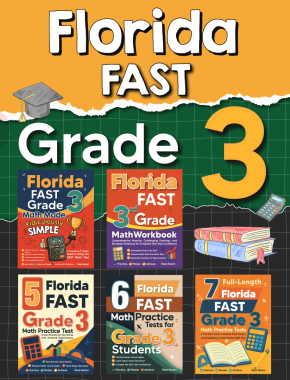
Also Reviewing Florida Grade 3 Math?
Many Florida families prepare English and math together. If your Grade 3 student also needs math support, this matching resource can help keep review organized.
Florida Grade 3 ELA.3.C.1 Writing
| Code | Learning reference |
|---|---|
| ELA.3.C.1.1 | Write in cursive all upper and lowercase letters |
| ELA.3.C.1.2 | Write personal or fictional narratives using a logical sequence of events, appropriate descriptions, dialogue, a variety of transitional words or phrases, and an ending |
| ELA.3.C.1.3 | Write opinions about a topic or text, include reasons supported by details from one or more sources, use transitions, and provide a conclusion |
| ELA.3.C.1.4 | Write expository texts about a topic, using one or more sources, providing an introduction, facts and details, some elaboration, transitions, and a conclusion |
| ELA.3.C.1.5 | Improve writing as needed by planning, revising, and editing with guidance and support from adults and feedback from peers |
| ELA.3.C.2.1 | Present information orally, in a logical sequence, using nonverbal cues, appropriate volume, and clear pronunciation |
| ELA.3.C.3.1 | Follow the rules of standard English grammar, punctuation, capitalization, and spelling appropriate to grade level |
| ELA.3.C.4.1 | Conduct research to answer a question, organizing information about the topic from multiple sources |
Florida Grade 3 ELA.3.C.5 Communication and Media
| Code | Learning reference |
|---|---|
| ELA.3.C.5.1 | Use two or more multimedia elements to enhance oral or written tasks |
| ELA.3.C.5.2 | Use digital writing tools individually or collaboratively to plan, draft, and revise writing |
Florida Grade 3 ELA.3.F Foundational Reading and Word Study
| Code | Learning reference |
|---|---|
| ELA.3.F | Foundations |
| ELA.3.F.1 | Learning and Applying Foundational Reading Skills |
Florida Grade 3 ELA.3.F.1 Foundational Reading and Word Study
| Code | Learning reference |
|---|---|
| ELA.3.F.1.3 | Use knowledge of grade-level phonics and word-analysis skills to decode words |
| ELA.3.F.1.4 | Read grade-level texts with accuracy, automaticity, and appropriate prosody or expression |
Florida Grade 3 ELA.3.R Reading Comprehension
| Code | Learning reference |
|---|---|
| ELA.3.R.1 | Reading Prose and Poetry |
| ELA.3.R.1 | Reading Prose and Poetry |
| ELA.3.R.2 | Reading Informational Text |
| ELA.3.R.2 | Reading Informational Text |
| ELA.3.R.3 | Reading Across Genres |
| ELA.3.R.3 | Reading Across Genres |
Florida Grade 3 ELA.3.R.1 Reading Literature
| Code | Learning reference |
|---|---|
| ELA.3.R.1.1 | Explain how one or more characters develop throughout the plot in a literary text |
| ELA.3.R.1.1 | Explain how one or more characters develop throughout the plot in a literary text |
| ELA.3.R.1.2 | Explain a theme and how it develops, using details, in a literary text |
| ELA.3.R.1.2 | Explain a theme and how it develops, using details, in a literary text |
| ELA.3.R.1.3 | Explain different characters' perspectives in a literary text |
| ELA.3.R.1.3 | Explain different characters' perspectives in a literary text |
| ELA.3.R.1.4 | Identify types of poems: free verse, rhymed verse, haiku, and limerick |
| ELA.3.R.1.4 | Identify types of poems: free verse, rhymed verse, haiku, and limerick |
Florida Grade 3 ELA.3.R.2 Reading Informational Text
| Code | Learning reference |
|---|---|
| ELA.3.R.2.1 | Explain how text features contribute to meaning and identify the text structures of chronology, comparison, and cause/effect in texts |
| ELA.3.R.2.1 | Explain how text features contribute to meaning and identify the text structures of chronology, comparison, and cause/effect in texts |
| ELA.3.R.2.2 | Identify the central idea and explain how relevant details support that idea in a text |
| ELA.3.R.2.2 | Identify the central idea and explain how relevant details support that idea in a text |
| ELA.3.R.2.3 | Explain the development of an author's purpose in an informational text |
| ELA.3.R.2.3 | Explain the development of an author's purpose in an informational text |
| ELA.3.R.2.4 | Identify an author's claim and explain how an author uses evidence to support the claim |
| ELA.3.R.2.4 | Identify an author's claim and explain how an author uses evidence to support the claim |
Florida Grade 3 ELA.3.R.3 Reading Literature
| Code | Learning reference |
|---|---|
| ELA.3.R.3.1 | Identify and explain metaphors, personification, and hyperbole in text(s) |
| ELA.3.R.3.1 | Identify and explain metaphors, personification, and hyperbole in text(s) |
| ELA.3.R.3.2 | Summarize a text to enhance comprehension |
| ELA.3.R.3.2 | Summarize a text to enhance comprehension |
| ELA.3.R.3.3 | Compare and contrast how two authors present information on the same topic or theme |
| ELA.3.R.3.3 | Compare and contrast how two authors present information on the same topic or theme |
Florida Grade 3 ELA.3.V Vocabulary
| Code | Learning reference |
|---|---|
| ELA.3.V | Vocabulary |
| ELA.3.V.1 | Finding Meaning |
Florida Grade 3 ELA.3.V.1 Vocabulary
| Code | Learning reference |
|---|---|
| ELA.3.V.1.1 | Recognize and appropriately use grade-level academic vocabulary in speaking and writing |
| ELA.3.V.1.2 | Identify and apply knowledge of common Greek and Latin roots, base words, and affixes to determine the meaning of unfamiliar words in grade-level content |
| ELA.3.V.1.3 | Use context clues, figurative language, word relationships, reference materials, and/or background knowledge to determine the meaning of multiple-meaning and unknown words and phrases, appropriate to grade level |
Recommended Florida Grade 3 resources
Build a Strong Florida Grade 3 FAST English Practice Library
Use these Florida Grade 3 resources for reading comprehension, language, writing, and full-length practice where available. Click any cover to open the resource page.


Free Florida Grade 3 English Worksheets
Looking for printable practice that lines up with Florida Grade 3 English standards? Our companion worksheets page collects 38 single-skill PDFs aligned to the FAST, reading, writing, grammar, vocabulary, and fluency, each with a Quick Review and an answer key. No login, no email required.
How to Use This Florida Grade 3 English Checklist
- Choose one Grade 3 English strand. Start with the current Florida unit, a recent assessment, or the skill that needs the most support.
- Use a real text. Practice Florida Grade 3 reading standards with poems, stories, articles, speeches, passages, and student-friendly nonfiction.
- Ask for evidence. Florida Grade 3 students should point to words, sentences, or details that support the answer.
- Write a short response. Turn Florida Grade 3 reading work into a short constructed response, a reading journal entry, or a polished paragraph.
- Spiral for Florida FAST review. Revisit Grade 3 vocabulary, grammar, comprehension, and writing each week so skills stay active.
Florida Grade 3 English Standards FAQ
What does this page cover?
This page provides Grade 3 English Language Arts learning references and links to Florida curriculum resources in clear, original language for families, teachers, tutors, and homeschool planners.
Is this official standards wording?
No. This Florida Grade 3 page is an independent, student-friendly guide for planning and practice. Use the official standards source for formal policy wording.
How should students practice English standards?
For Florida Grade 3, read closely, answer with evidence, revise sentences, talk through ideas, and return to vocabulary often. Strong English practice connects skills instead of isolating them.
How does this connect to testing?
The Grade 3 standards describe what students learn; FAST is the assessment context students may encounter in Florida. Strong preparation comes from careful reading, evidence-based answers, clear writing, and command of language conventions.
Source Note
This independent Florida guide paraphrases Grade 3 English Language Arts expectations for readability and learning support. It is not official wording and is not affiliated with the state education agency. Always consult official standards documents for formal language, updates, and compliance decisions.
For more Florida Grade 3 support, visit the Grade 3 Learning Center.
A USEFUL NEXT STEP
Florida Grade 3 English: study questions
How should I choose a Grade 3 english study target?
Choose a current classroom target, find the matching learning reference, and use a lesson or available practice resource to check understanding. State documents control local wording and placement; shared reference codes are not a certified crosswalk.
Official source ↗Are these activities official state assessments?
These are independently published learning resources. A practice score does not predict or replace an official state score. Use the directions in each activity and consult your school for official testing and accommodation rules.
Resources from Effortless Math · Editorial standards